
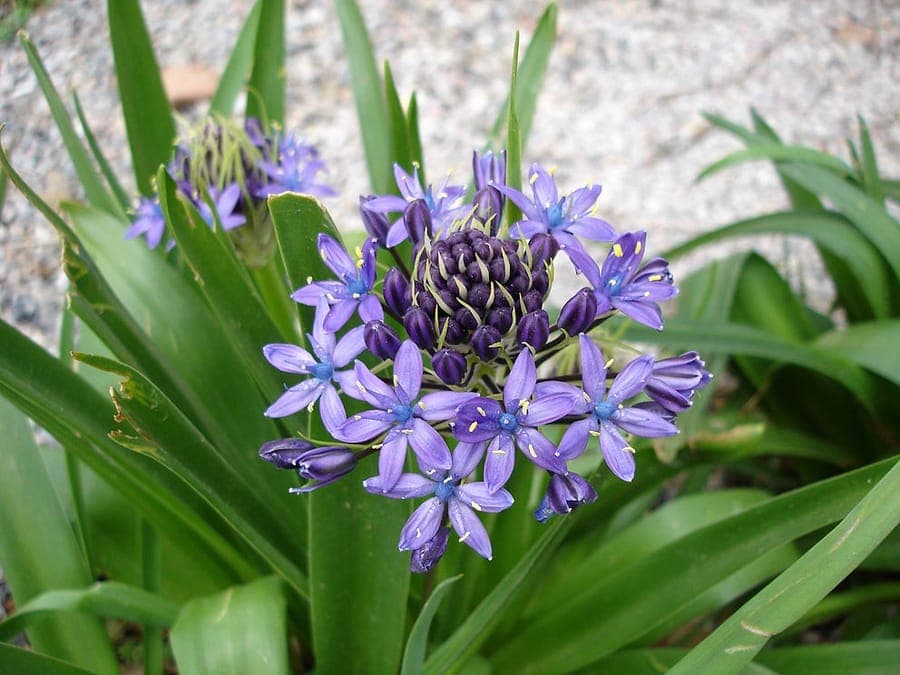
Wikimedia Commons / CC BY-SA 3.0, via Wikimedia Commons
Scilla peruviana (Portuguese squill): complete guide
Scilla peruviana
Want to see Scilla peruviana (Portuguese squill): complete guide in your garden?
1 minute, no credit card
Scilla peruviana, commonly known as Portuguese squill, Cuban lily, or giant squill, is a stunning spring bulb native to Mediterranean regions (North Africa, Iberian Peninsula, and Italy). This robust bulbous plant belongs to the Asparagaceae family and is celebrated for its distinctive dome-shaped clusters of sky-blue to purple-violet tiny star flowers. With its strong growth habit, early spring bloom, and dramatically dense flower clusters, it is a prominent accent plant for sunny borders, gravel gardens, and large containers.
Overview
Scilla peruviana is a large, imposing bulb (20-30 centimeters tall, sometimes taller) blooming April to May in temperate climates. Bulbs are considerably larger than other Scilla species (2-3 centimeters diameter) and produce numerous long grass-like leaves. Each plant forms a single thick flower stem terminating in a dome-shaped raceme of 100 plus tiny sky-blue to purple-violet stars. This is a long-lived bulb that spreads gradually and increases in size over years, especially in sunny, well-drained locations.
Appearance and Bloom
The dome-shaped flower cluster is the striking feature: densely packed with 100-300 tiny six-petaled stars, sky-blue to purple-violet (sometimes pale blue or whitish-grey in certain cultivars). Each star measures approximately 0.5 centimeters wide. Bloom progresses from bottom to top of the raceme, creating a transition from green-budded base to blue-flowered apex over 3-4 weeks. Leaves are thick, linear, overlapping, disappearing by June-July. Following bloom, seed capsules develop.
Ideal Location
Scilla peruviana thrives in full sun (minimum 6-8 hours daily). This is absolutely essential for full flower expansion and compact growth. Partial shade significantly reduces flowering. Plant in sunny borders, against south-facing walls, in gravel scree, or in large sunny containers. Well-ventilated locations encourage strong, upright growth.
Soil Composition
Well-drained, even dry soils are essential. Gravel, sand, and small stone fragments (50-70 percent of mix) create ideal conditions. Minimal organic matter; rich soils promote lush foliage and rot. Slightly acidic to neutral pH (6.0-7.0) is suitable. In wet or clay soils, plant in raised beds with gravel base and sand-amended soil. Gravel top-dressing protects bulbs from moisture accumulation.
Free design
Want to see Scilla peruviana (Portuguese squill): complete guide in your garden? Make a free design now.
Watering
Scilla peruviana is very drought-tolerant after establishment. Water after planting if no rain follows. During growth (March-May), water only if no rain occurs for 4 weeks. Once foliage begins to die (June), cease watering. In very dry summers, supplemental water extends bloom. Avoid waterlogging entirely; moisture causes rot. Container specimens require regular watering, but ensure perfect drainage.
Pruning
Minimal pruning required. Allow foliage to gradually yellow and die back naturally; this nourishes the bulb. Remove only completely dead leaves by July. Seed heads can be removed post-bloom to conserve energy for bulb growth, or left if naturalization is desired.
Maintenance Calendar
September-October: Planting time in temperate zones. November-February: Underground development; no intervention. March-May: Growth and bloom period; moderate watering. June-July: Foliage dies back; seeds mature. August-October: Bulbs rest and enlarge.
Winter Hardiness
Scilla peruviana is hardy to USDA zones 6-7 (to minus 15-20 Celsius). In zones 8-10, it thrives. In zone 5 or colder, mulch bulbs under 10-15 centimeters sand/gravel for protection, or grow in containers to bring indoors in winter. In wet climates, moisture rot is more problematic than frost damage; ensure excellent drainage.
Companion Plants
Pair with other Mediterranean spring bloomers: yellow Allium christophii, Fritillaria, Ornithogalum, and low-growing artemisia or santolina for contrast. Group 3-5 bulbs for dramatic impact. In sunny borders, combine with Salvia, Lavandula, and grey-leaved plants like Senecio. In containers, mix with olive, rosemary, or Gaura.
Closing
Scilla peruviana is a showstopper plant for warm, sunny gardens craving dramatic spring color. Bulbs are available from specialized bulb suppliers (October-November planting season). Choose alba for white, atropurpurea for deep purple, or standard blue. Visit gardenworld.app to design the perfect warm, sunny Mediterranean landscape centered on this stunning bulb.
Want to see Scilla peruviana (Portuguese squill): complete guide in your garden? Make a free design now.
Upload a photo, pick a style, and get a photorealistic design with plant list in under a minute.
No credit card required


Similar plants
Narrow-leaved dracaena: complete guide
Dracaena angustifolia
Everything about Dracaena angustifolia - the narrow-leaved dracaena: location, care, overwintering and use as a houseplant or patio plant.
Chaparral yucca: complete guide to Hesperoyucca whipplei
Hesperoyucca whipplei
Hesperoyucca whipplei (Our Lord's candle) is a dramatic rosette-forming plant from California that produces a towering flower spike, ideal for dry and gravel gardens.
False lily-of-the-valley: complete guide
Maianthemum dilatatum
Everything about Maianthemum dilatatum, the false lily-of-the-valley. Care, shade location, propagation and garden combinations for this popular shade ground cover.