
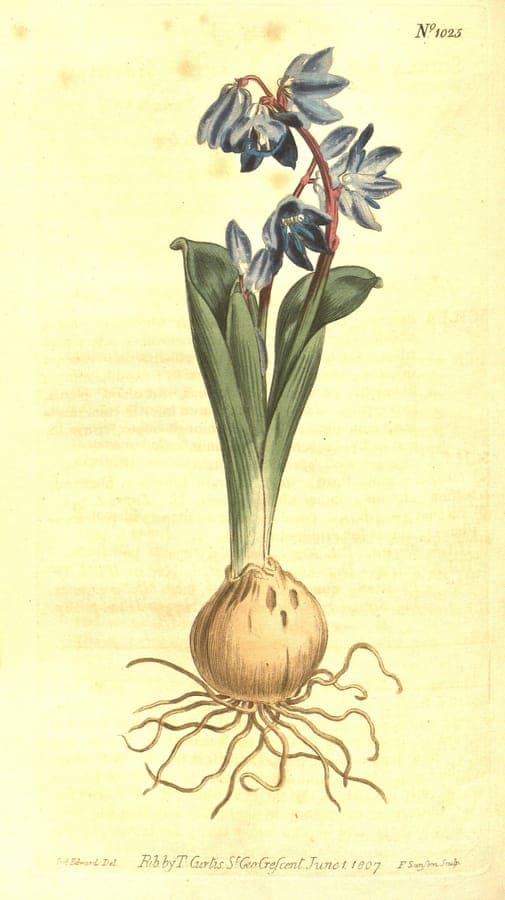
Bentham-Moxon Trust.; Curtis, William; Curtis's botanical magazine dedications, 1827-1927 : portraits and biographical notes.; Royal Botanic Gardens, Kew.; Stanley Smith Horticultural Trust. / Public domain, via Wikimedia Commons
Scilla amoena (star-hyacinth): complete guide
Scilla amoena
Want to see Scilla amoena (star-hyacinth): complete guide in your garden?
1 minute, no credit card
Scilla amoena, commonly known as star-hyacinth or pretty squill, is an elegant spring-flowering bulb from southern Turkey and Mediterranean regions. Belonging to the Asparagaceae family, this diminutive bulb is celebrated for its brilliant blue star-like flowers that open in profusion during March and April. With its shallow-growing bulbs, fine grass-like foliage, and compact habit, it is an indispensable classic for spring gardens, under shrubs, and in containers.
Overview
Scilla amoena is a petite bulbous plant (10-15 centimeters tall) blooming March to April, depending on local spring conditions. The bulbs are small, roughly pea-sized, and plant easily in groups. Each bulb produces 5-8 fine green leaves and a single flower stem bearing 4-15 tiny six-petaled stars in bright blue. This is an exceptionally hardy, long-lived plant that returns reliably year after year, gradually multiplying.
Appearance and Bloom
The defining feature is the brilliant sky-blue stars (approximately 0.8 centimeter in diameter) with a central yellow-stamened center. Flowers open fully into open stars and close again in evening. Leaves are green, linear, emerging from the bulb base and disappearing by April. Each star-flower opens sequentially along the stem, creating extended bloom over 2-3 weeks. After bloom, small seed capsules form.
Ideal Location
Scilla amoena flowers best in full sun to partial shade (4-8 hours direct sun daily). In warm regions, partial shade beneath deciduous shrubs is preferable to harsh afternoon sun. Plant beneath shrubs, under trees (where dappled sun reaches flowers), in low borders, or in groups beside pathways. Ensure good air circulation; avoid moisture-trapping corners.
Soil Composition
Well-drained, even dry soils are ideal. Scilla amoena tolerates poor to moderately rich soil. Sandy or gravelly soil is preferred. In heavy clay, amend with sand, perlite, and compost (40 percent total amendment) to boost drainage. Slightly acidic to neutral pH (5.0-6.5) is suitable. Light organic mulch (2-3 centimeters) aids moisture retention but keep away from bulb crowns to prevent rotting.
Free design
Want to see Scilla amoena (star-hyacinth): complete guide in your garden? Make a free design now.
Watering
Scilla amoena is very drought-tolerant. Water after planting if no rain follows. During bloom season, water only if no rain occurs for 3 weeks. Otherwise, minimal water is required. After bloom, foliage gradually yellows and disappears; watering ceases. Avoid waterlogging in winter-spring when drainage is poor. Container specimens require regular watering due to faster drainage.
Pruning
No pruning is required. After bloom, foliage gradually yellows and disappears naturally, nourishing the bulb for next season. Remove only completely dead leaves. Seed heads can be removed post-bloom to prevent self-seeding, or left if naturalization is desired.
Maintenance Calendar
September-November: Planting time for bulbs in temperate zones. February-March: Emergence and bloom begin. March-April: Peak bloom period. May-June: Foliage yellows and dies back; minimal water needed. July-August: Bulbs rest underground.
Winter Hardiness
Scilla amoena is excellent hardy to USDA zone 3 (to minus 35 Celsius). Bulbs endure frost cycles without damage. In very wet winters, bulb rot can occur if drainage is poor; ensure good water pathways.
Companion Plants
Pair with other spring bloomers: Crocus (yellow, purple, or white), Muscari (grape hyacinth), Chionodoxa (glory-of-the-snow), Puschkinia, Helleborus (winter rose), snowdrops, and snowflakes. Low-growing perennials like Phlox subulata and Heuchera provide summer cover where Scillas disappear. Hostas and Helleborus assist in partial shade settings.
Closing
Scilla amoena is a foolproof secret for reliable spring color year after year. Bulbs are affordably available from nurseries and bulb suppliers (September-October). Plant dozens for maximum impact and natural drifts. Visit gardenworld.app to design the perfect spring garden featuring these heavenly blue treasures.
Want to see Scilla amoena (star-hyacinth): complete guide in your garden? Make a free design now.
Upload a photo, pick a style, and get a photorealistic design with plant list in under a minute.
No credit card required


Similar plants
Narrow-leaved dracaena: complete guide
Dracaena angustifolia
Everything about Dracaena angustifolia - the narrow-leaved dracaena: location, care, overwintering and use as a houseplant or patio plant.
Chaparral yucca: complete guide to Hesperoyucca whipplei
Hesperoyucca whipplei
Hesperoyucca whipplei (Our Lord's candle) is a dramatic rosette-forming plant from California that produces a towering flower spike, ideal for dry and gravel gardens.
False lily-of-the-valley: complete guide
Maianthemum dilatatum
Everything about Maianthemum dilatatum, the false lily-of-the-valley. Care, shade location, propagation and garden combinations for this popular shade ground cover.