Wikimedia Commons / Public domain, via Wikimedia Commons
Little bluestem (Schizachyrium scoparium): growing guide
Schizachyrium scoparium
Want to see Little bluestem (Schizachyrium scoparium): growing guide in your garden?
Full design in HD: €7.99
Look after your Little bluestem with the GardenWorld app
Identify plants with your camera and get a care calendar with reminders for this plant.


Overview
Little bluestem (Schizachyrium scoparium) is the grass that paints the North American prairie in autumn. Across millions of hectares, from southern Canada to northern Mexico, its upright clumps turn from blue-green to copper, coral and mahogany as the days shorten, while countless silvery seed tufts catch the low sun. It is the state grass of both Kansas and Nebraska, and for good reason: few plants define a landscape so completely.
In British and European gardens it is a newer arrival, carried in on the wave of naturalistic and prairie-style planting. It has earned its place quickly. Unlike many ornamental grasses it stays slim and upright, it asks for almost nothing once established, and it gives three distinct seasons of interest: cool blue in summer, fiery colour in autumn and straw tones with silver fluff through winter.
The plant belongs to the grass family (Poaceae) and was long classified as Andropogon scoparius, a name still found on older labels and in American field guides. It forms a narrow, erect clump around 60 to 100 cm tall in flower and only 30 to 45 cm wide. As a warm-season grass it does nothing much until May, then grows steadily through summer and flowers in August.
Breeders have selected a range of cultivars, mostly for foliage colour and sturdiness. 'The Blues' has strikingly powder-blue stems. 'Blaze' is grown for its deep orange-red autumn colour. 'Standing Ovation' was chosen because it stays bolt upright even on richer soils, and 'Prairie Blues' combines blue summer foliage with strong autumn tints.
Appearance and flowering
For most of the summer little bluestem is a column of fine, narrow leaves and rounded stems in blue-green or grey-blue, often flushed purple towards the base. The nodes along the stems frequently turn wine red well before autumn.
Flowering begins in August, but do not expect the large plumes of miscanthus or pennisetum. Instead, dozens of short racemes, each 3 to 6 cm long and partly tucked into a leaf sheath, appear along the upper half of every stem. The flowers themselves are small, with purplish anthers, and easy to overlook.
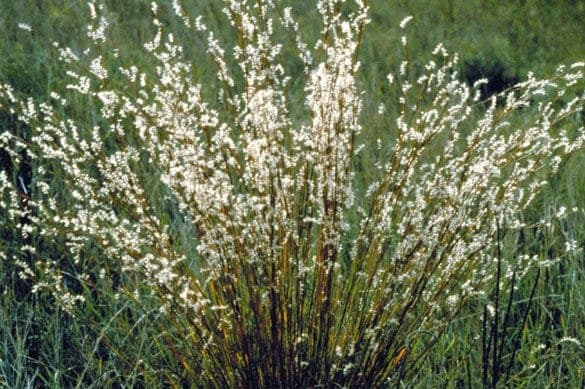
The real display arrives in September as the seed ripens. Each seed carries a tuft of silky white hairs, and the whole plant becomes speckled with tiny puffs that sparkle when backlit. The photograph shows exactly this stage: a clump of reddish-brown stems laden with white fluff, glowing in late-afternoon light. At the same time the foliage and stems colour up, from copper-orange to coral, burgundy or deep mahogany depending on cultivar, soil and weather. Remarkably, the colour holds well into winter before softening to a warm tan, and the stems stay upright even under snow.
Ideal location
Little bluestem is a sun lover through and through. Give it at least six hours of direct sun a day, and more if you can. In shade it grows lax, flops open and its autumn colour turns dull. It comes from open grassland where sun and wind reach every stem, and the closer you can match that in the garden, the better it will look.
Good spots include a sunny prairie border, a dry bank, a gravel garden or the edge of a south-facing patio. It also suits green roofs with at least 15 cm of growing medium, and it tolerates roadside salt spray better than most perennials.
Space plants 40 to 50 cm apart. Because each clump is narrow, the grass looks best in drifts or repeated through a border. A sweep of fifteen or twenty plants threaded with flowering perennials gives a convincing taste of the prairie.
Soil requirements
This is where little bluestem parts company with most garden plants: it wants lean, sharply drained soil. Sandy, stony or gravelly ground is ideal, as is a poor loam. In fertile, moisture-retentive soil it grows soft and lush and tends to collapse by late summer, which is why sturdier cultivars such as 'Standing Ovation' were developed.
So do not dig in compost or manure. On heavy clay, work coarse grit and sharp sand into the top 20 to 30 cm, or plant on a slightly raised bed. Cold, waterlogged clay in winter is one of the very few things that will kill it. Soil pH matters little; anything from slightly acidic to chalky is fine.
Free preview
Want to see Little bluestem (Schizachyrium scoparium): growing guide in your garden? Make a free preview of your design.
Watering
Plant in spring, ideally April or May, when the soil is warming up. Warm-season grasses root poorly into cold autumn ground and are more likely to rot over their first winter. In the first summer, water once a week in dry spells, roughly 5 litres per plant, so the roots are encouraged downwards.
After that you can more or less forget about it. In the wild its roots go well over a metre deep, and an established clump shrugs off long dry summers. Too much water is the bigger danger, as it makes the plant floppy and prone to crown rot. Keep it well away from automatic irrigation.
Pruning
Leave the stems standing all winter. Clumps of copper stems topped with silver fluff are among the best winter silhouettes a garden can offer, and the dense base gives shelter to overwintering insects. Finches and other seed-eating birds will pick at the heads.
Cut everything back to 5 to 10 cm in late February or March. A pair of shears makes short work of it; tie large clumps together with string first and you can cut them in one go. After a few years the centre of a clump may thin out. Divide it in May, once it is actively growing, rather than in autumn.
Little bluestem needs no other attention. It self-seeds only modestly in European gardens and is not listed as invasive anywhere in Europe.
Maintenance calendar
January–February: Enjoy the tawny winter clumps. Cut back to 5 to 10 cm at the end of February.
March–April: Clear away old growth. Plant new specimens from mid-April.
May: First blue-green shoots appear. The best time to divide older clumps.
June–July: Steady growth to full height. Water only young plants during prolonged drought.
August: Flowering, with small racemes along the stems.
September–October: Silvery seed tufts and full autumn colour. The high point of the year.
November–December: Colour fades slowly to tan. Leave everything standing. For a month-by-month list of garden jobs, have a look at the planting calendar on gardenworld.app.
Winter hardiness
In North America little bluestem grows as far north as USDA zone 3, where winters reach around -35 °C. Frost is therefore no concern anywhere in Britain or Ireland. The top growth dies back and the crown overwinters below ground.
The real threat in a maritime climate is winter wet. On heavy, poorly drained soil a clump can rot away during a long, mild, sodden winter. Good drainage is far more important than any form of protection, and covering the plant with straw or fleece is never necessary.
It is not known to be toxic to people or pets.
Companion plants
Little bluestem makes a superb matrix for a prairie border, providing structure and filling the gaps between flowering plants without smothering them. Purple coneflower (Echinacea purpurea) is a natural partner, its pink daisies standing out against the blue-green stems. Butterfly weed (Asclepias tuberosa) adds vivid orange in summer and likes the same dry, lean soil.
In July and August the purple spikes of Liatris spicata rise like candles between the clumps. For autumn, heath aster (Symphyotrichum ericoides) produces clouds of tiny white daisies that sit beautifully with the silver seed tufts.
If you want to mix grasses, add prairie dropseed (Sporobolus heterolepis), a finer-textured grass with scented flower heads and the same love of sun and drainage. Black-eyed Susan (Rudbeckia) and wild marjoram also fit in well.
Final thoughts
Schizachyrium scoparium rewards you most when you give it least: poor soil, full sun, no feeding and very little water. In return you get a slim blue column in summer, a blaze of copper and red in autumn and a shimmering winter presence. For dry, sunny gardens and naturalistic planting, it is one of the finest grasses you can grow.
If you are not sure how to build a prairie-style scheme around it, or which companions will suit your conditions, you can have a garden design created on gardenworld.app that takes your soil and aspect into account, so little bluestem ends up exactly where it will shine.
Frequently asked questions about Little bluestem
Is Little bluestem winter hardy?
In North America little bluestem grows as far north as USDA zone 3, where winters reach around -35 °C. Frost is therefore no concern anywhere in Britain or Ireland.
When and how do you prune Little bluestem?
Leave the stems standing all winter. Clumps of copper stems topped with silver fluff are among the best winter silhouettes a garden can offer, and the dense base gives shelter to overwintering insects.
How much water does Little bluestem need?
Plant in spring, ideally April or May, when the soil is warming up. Warm-season grasses root poorly into cold autumn ground and are more likely to rot over their first winter.
Where does Little bluestem grow best?
Little bluestem is a sun lover through and through. Give it at least six hours of direct sun a day, and more if you can.
What soil does Little bluestem need?
This is where little bluestem parts company with most garden plants: it wants lean, sharply drained soil. Sandy, stony or gravelly ground is ideal, as is a poor loam.

See it in your garden
See Little bluestem in your garden
One photo of your garden and a few questions. You see the result in about a minute.
Try it with a photoIdentify this plant in your own garden. Identify a plant
Similar plants
Purple coneflower: complete guide
Echinacea purpurea
Everything about Purple Coneflower (Echinacea purpurea): planting, care, pruning and combinations. Expert tips for a thriving prairie-style garden.
Butterfly milkweed: complete guide
Asclepias tuberosa
Grow Butterfly milkweed (Asclepias tuberosa) with stunning orange flowers. Perfect for monarchs and dry locations. Comprehensive care guide for this showy native plant.
Liatris spicata: complete guide
Liatris spicata
Liatris spicata brings colorful flower spikes to your garden. Discover everything about this stately flower, from cultivation to care.
