
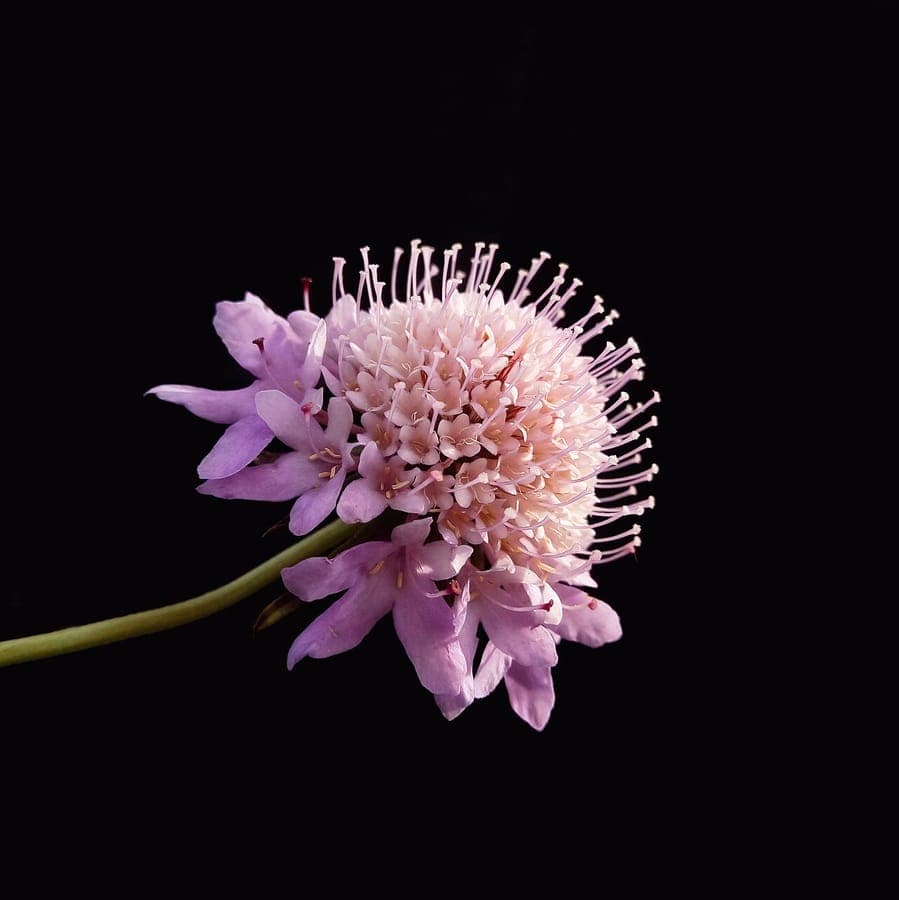
Rouibi Dhia Eddine Nadjm / CC BY-SA 4.0, via Wikimedia Commons
Mournful widow: complete guide
Scabiosa atropurpurea
Want to see Mournful widow: complete guide in your garden?
1 minute, no credit card
Mournful widow (Scabiosa atropurpurea), also called Mourning Bride or purple pincushion, is a dramatic annual flowering plant with striking deep purple to nearly black flowers. The plant is native to southern Europe the Azores and the Mediterranean region. Although traditionally annual it can behave as biennial in mild climates. The plant typically reaches 60-90 centimeters tall with slender upright stems covered in fine gray-green foliage. The flowers are approximately 25-35 millimeters in diameter emerging from June through October. Each flower head consists of many small florets tightly clustered in a pincushion-like formation. The color is very dark purple to nearly black with red-purple edges.
The plant grows rapidly reaching full flowering size in approximately 12-14 weeks after sowing. Roots are fine taproot-like roots growing deeply. Once planted the plant should not be transplanted. Mournful widow attracts many pollinators including bees butterflies and other insects making it valuable for pollinator gardens. Flowers are long vase-life flowers lasting to 14 days in fresh water making them ideal for flower arranging.
Seed sowing should begin in March-April for July-October bloom. Seed can be sown directly in beds or started indoors and transplanted. Seeds germinate in 10-14 days at temperatures of 15-20 degrees Celsius. Seeding must have light covering because seed needs light for germination. Seedlings can be planted directly in gardens once frost danger has passed. The plant does not tolerate light frost and will die at temperatures below -2 degrees Celsius.
Mournful widow prefers well-drained soil with pH 6.5 to 7.5. The plant grows on many soil types from nutrient-poor to rich soil. Preferred light is full sun with minimum 6 hours direct sunlight daily. The plant can tolerate partial shade but will bloom less densely. In very hot climates partial afternoon shade can prevent flower scorch.
Watering should be regular during the growing season. During dry periods daily watering may be needed although the plant tolerates some drought. Excessive water can cause mildew and root rot so drainage is essential. Stems can be supported with stakes if the plant leans and wind presses down.
Feeding is beneficial for continuous blooming. Once every two weeks a balanced fertilizer like 10-10-10 or a bloom formula can be given. Organic mulch around plant bases helps moisture retention and nutrient uptake. Faded flowers must be regularly removed to stimulate more flower production and extend plant vigor. A plant blooming in June can continue through October or frost if faded flowers are continuously removed.
Mournful widow is ideal for cut flowers border backgrounds mixed beds and pollinator borders. In northern Europe it grows well in warm summers. In cool climates warm south-facing exposures are preferred. The plant self-seeds so young plants may appear the following season if seed is allowed to mature. Plant companions include calendulas lavenders and cosmos. The combination of deep purple mournful widow with bright yellow calendulas creates spectacular yellow-purple contrast effects in summer gardens.
Want to see Mournful widow: complete guide in your garden? Make a free design now.
Upload a photo, pick a style, and get a photorealistic design with plant list in under a minute.
No credit card required


Similar plants
Yellow honeysuckle (Lonicera tragophylla): complete guide
Lonicera tragophylla
Meet yellow honeysuckle (Lonicera tragophylla): a Chinese climber with large golden flowers that thrives in partial shade.
Lonicera korolkowii: complete guide
Lonicera korolkowii Stapf
Discover blueleaf honeysuckle, a vigorous shrub with beautiful flowers. Guide on growing, shaping and why this Asian climbing plant is perfect for gardens.
Lonicera oblongifolia: complete guide
Lonicera oblongifolia Hook.
Discover swamp fly honeysuckle, a North American woodland plant. Guide on growing, caring and why this native species is valuable for gardens.