
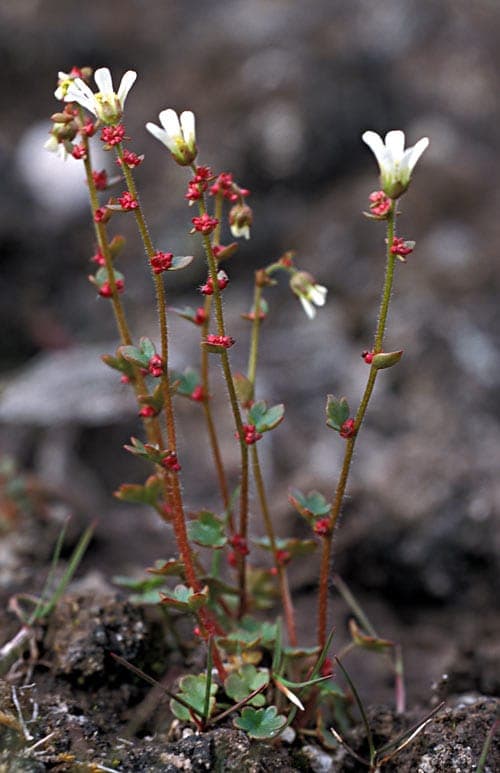
Wikimedia Commons / CC BY-SA 3.0, via Wikimedia Commons
Nodding saxifrage: complete guide
Saxifraga cernua
Want to see Nodding saxifrage: complete guide in your garden?
1 minute, no credit card
Overview
Nodding saxifrage (Saxifraga cernua) is a fascinating alpine plant native to the subarctic and subalpine Northern Hemisphere. This small, elegant plant belongs to the Saxifragaceae family and grows naturally on rocky mountain slopes and boggy meadows. Nodding saxifrage is particularly noteworthy because it reproduces both by seed and by bulblets. The plant forms small, almond-green leaf rosettes with elegant, drooping white flowers.
This plant is perfect for enthusiasts of rare alpine plants. Nodding saxifrage is very low (only 10 to 20 centimeters) and requires some special care to grow well. The unique feature is that the plant forms small bulbous plantlets in the leaf axils, which can be used for propagation.
Appearance and bloom cycle
Nodding saxifrage reaches only 10 to 20 centimeters in height and forms small, neat rosettes of smooth, green foliage. The leaves are small, almond-like, about 0.5 to 1 centimeter long and glossy green. They often turn purplish-red when cold.
Flowers appear from June through August and are particularly elegant. They hang from thin, arching stems (hence the name nodding) and are small, about 1 centimeter, white to pink colored. After flowering, the plant forms characteristic small bulblets that can be used for propagation.
Ideal location
Nodding saxifrage loves partial shade to full sun. Plant it in a location with light dappling or where it receives afternoon shade. The plant grows best in cool environments without extreme heat. In very warm areas, provide afternoon shade for this plant.
More important than light is sufficient moisture without stagnation. Plant nodding saxifrage where it does not receive direct hot afternoon sun.
Soil requirements
Nodding saxifrage grows best in well-draining, humus-rich soil. It differs from many other saxifrage species because it can handle moister soil. Use potting soil with plenty of compost material and sand. The plant prefers neutral to slightly acidic soil.
In rocks or borders, add humus and ensure light drainage. The plant should not be placed in dry, nutrient-poor soil.
Free design
Want to see Nodding saxifrage: complete guide in your garden? Make a free design now.
Watering
Nodding saxifrage requires regular water and cannot dry out. Water regularly, especially during the growing season. Keep the soil moderately moist, not waterlogged. In pots, regular moisture monitoring is essential.
During dry periods, give extra attention to watering. Also spray the plant regularly, especially in very warm conditions.
Pruning and maintenance
Nodding saxifrage requires very little maintenance. It practically self-cleans. Remove dead leaves and flowers when necessary. The most important thing is monitoring moisture and drainage.
Collect the small bulblets and plant them in pots with very moist, humus-rich soil. This is the easiest way to propagate this plant.
Maintenance calendar
Spring (March-May): Plant new plants in humus-rich, well-draining soil. Water regularly. Monitor for pests.
Summer (June-August): The plant flowers. Water well. Ensure it does not dry out during warm periods. Collect bulblets.
Autumn (September-October): Water slightly less. Plant bulblets in moist soil.
Winter (November-February): Nodding saxifrage is hardy. Water carefully but ensure soil does not completely dry out.
Winter hardiness
Nodding saxifrage is hardy to about -10 degrees Celsius. In very cold winters, protection can help. In temperate climates it grows without problems. Always ensure good drainage in winter.
Companion plants
Nodding saxifrage grows well with other moisture-loving alpine plants such as primula, dwarf astilbe and other moss-forming saxifrage species. In alpine troughs you can plant it with other moisture-loving alpine material.
Ensuring all plants have similar moisture requirements is important.
Closing
Nodding saxifrage is a fascinating alpine plant for gardeners who love rare, special plants. It grows easily in humus-rich, moist soil and offers elegant white flowers and unique propagation methods. Purchase your plant from garden centers, and discover the beauty of this rare mountain plant.
Want to learn more about alpine plants? Visit gardenworld.app for inspiration and plant tips. On gardenworld.app you'll find ideas for creating moist alpine borders.
Want to see Nodding saxifrage: complete guide in your garden? Make a free design now.
Upload a photo, pick a style, and get a photorealistic design with plant list in under a minute.
No credit card required


Similar plants
Korean astilbe: complete guide
Astilbe grandis
Discover Korean astilbe (Astilbe grandis): a tall shade plant with elegant flower plumes for pond edges and borders.
Heuchera pilosissima: complete guide to seaside alumroot
Heuchera pilosissima
Seaside alumroot (Heuchera pilosissima), an elegant North American dwarf perennial with hairy red-tinged foliage and red flower spikes.
Starry saxifrage: complete guide
Micranthes stellaris
Full guide to Micranthes stellaris, the starry saxifrage: location, soil, blooming and garden use. A tough alpine plant for moist, shady rock faces and pond margins.