
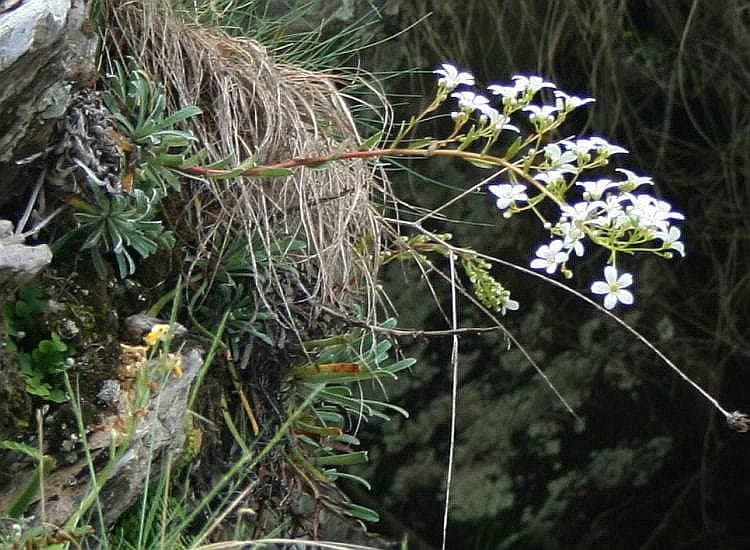
Franz Xaver / CC BY-SA 3.0, via Wikimedia Commons
Saxifraga callosa: complete guide to limestone saxifrage
Saxifraga callosa
Want to see Saxifraga callosa: complete guide to limestone saxifrage in your garden?
1 minute, no credit card
Overview
Saxifraga callosa, commonly known as limestone saxifrage or thick-leaved saxifrage, is an elegant alpine plant native to southeastern France, Italy, Sardinia, and Sicily. Belonging to the Saxifragaceae family, this plant is highly prized in alpine and rock garden arrangements.
This distinctive plant forms dense rosettes of thick, bluish-green leaves that naturally establish on rocky slopes throughout southern Europe. From May through July, delicate white flowers emerge in abundant panicles above the foliage, creating a spectacular display.
Appearance and Bloom
Saxifraga callosa grows as a solid mat (cushion) of closely-grouped rosettes composed of densely-packed, thick leaves. The leaves are narrow and elongated, bluish-gray-green, with a characteristic white powdery rim (farina).
The plant forms a compact mound approximately 5-10 centimeters high and 15-30 centimeters across. Rosettes grow closely together forming an attractive, evergreen display throughout the year.
From May through June, delicate white flowers appear on long, slender stems rising 20-40 centimeters above the foliage. The flowers are small but numerous, forming dense panicles. After flowering, that rosette slowly dies and is replaced by young rosettes.
Ideal Location
Saxifraga callosa thrives in full sun to partial shade. Plants require minimum 4-6 hours direct daily sunlight for optimal flowering and compact growth.
The plant demands extremely well-draining, gritty conditions. In moisture-rich areas, the plant may develop rot problems. Position this alpine plant in rock garden locations where water drains rapidly.
Avoid still, sheltered locations where moisture accumulation may occur. Alpine wind helps prevent dampness buildup.
Soil and Drainage
Saxifraga callosa has high drainage requirements. Use extremely gritty, mineral-rich mix with minimum 50% gravel or lava rock.
When planting in rock gardens: place several layers of gravel below the plant for drainage. Mix soil with sand, gravel, and small broken tufa stones.
The plant grows best in nutrient-poor, but not deficient, well-textured soils. Add compost carefully - excess organic matter promotes rot.
Watering
Saxifraga callosa is drought-tolerant and requires minimal water once established. Newly-planted specimens should be watered carefully during their first growing season.
Established plants need water only during severe dry periods. In temperate climates with regular rainfall, supplemental water is rarely needed.
Water from below or from the side - avoid wetting the rosettes themselves, which can cause rot problems. Water early morning if watering is necessary.
Free design
Want to see Saxifraga callosa: complete guide to limestone saxifrage in your garden? Make a free design now.
Pruning and Maintenance
Saxifraga callosa requires minimal pruning. After flowering, cut spent flower stems at the base of the rosette.
Wilted or dying outer rosettes can be carefully removed. This keeps the plant healthy and encourages new growth.
Remove any dead leaves or stems. The plant itself maintains an orderly, compact form without active pruning.
Propagation
Saxifraga callosa can be propagated through:
Seed: sow fresh seed in early spring on gritty seed mix. Seeds are tiny - sow carefully. Maintain moisture but not wetness. Germination occurs within 2-4 weeks at cool temperatures.
Offsets: young rosettes (offsetlets) develop around the mother plant. Once large enough, these can be carefully removed and individually planted in gritty mix.
Leaf cuttings: individual leaves can be used to propagate new plants in gritty sand.
Companion Alpine Plants
For an alpine rock garden:
- Sempervivum species (Houseleeks) - similar growth pattern, different color forms
- Sedum acre (Mouse-tail stonecrop) - low-growing succulent
- Armeria maritima (Sea thrift) - small pink flowers
- Silene acaulis (Moss campion) - ultra-dwarf alpine
Winter Hardiness
Saxifraga callosa is completely winter-hardy, tolerating temperatures to -15 to -20 degrees Celsius. The plant is ideal for temperate alpine climates.
The plant remains green throughout winter. However, in very wet, cold winters, moisture problems can occur - ensure excellent drainage.
Diseases and Pests
Saxifraga callosa is very healthy. Moisture accumulation can occasionally cause leaf rot. This is prevented through excellent drainage.
Slugs may occasionally damage foliage - employ biological slug control if problematic.
Rock Garden Design
Use Saxifraga callosa as:
- Central rock garden feature for its evergreen display
- Front planting in alpine borders
- Container planting in alpine stone troughs
- Crack plant in retaining walls
Maintenance Calendar
January-March: Prepare for flowering. Check drainage after winter.
April-May: Flowering period. Ensure adequate drainage.
June-July: Seed formation. Deadhead spent flowers.
August-October: Growing period. Minimal intervention.
November-December: Prepare for winter. Maintain excellent drainage.
Winter Hardiness
Saxifraga callosa is very winter-tolerant, with full hardiness to -15 to -20 degrees Celsius. The plant forms no special winter adaptation - it remains actively green.
In very wet, dark winters, problems may occur - ensure excellent drainage.
Conclusion
Saxifraga callosa is a beautiful, reliable alpine plant for rock gardens and alpine containers. With minimal care, you will enjoy years of delicate flowers and evergreen displays.
Start with healthy young plants from alpine-specialized nurseries on gardenworld.app.
Find alpine care supplies and rock garden materials at specialized alpine garden centers.
Want to see Saxifraga callosa: complete guide to limestone saxifrage in your garden? Make a free design now.
Upload a photo, pick a style, and get a photorealistic design with plant list in under a minute.
No credit card required


Similar plants
Korean astilbe: complete guide
Astilbe grandis
Discover Korean astilbe (Astilbe grandis): a tall shade plant with elegant flower plumes for pond edges and borders.
Heuchera pilosissima: complete guide to seaside alumroot
Heuchera pilosissima
Seaside alumroot (Heuchera pilosissima), an elegant North American dwarf perennial with hairy red-tinged foliage and red flower spikes.
Starry saxifrage: complete guide
Micranthes stellaris
Full guide to Micranthes stellaris, the starry saxifrage: location, soil, blooming and garden use. A tough alpine plant for moist, shady rock faces and pond margins.