
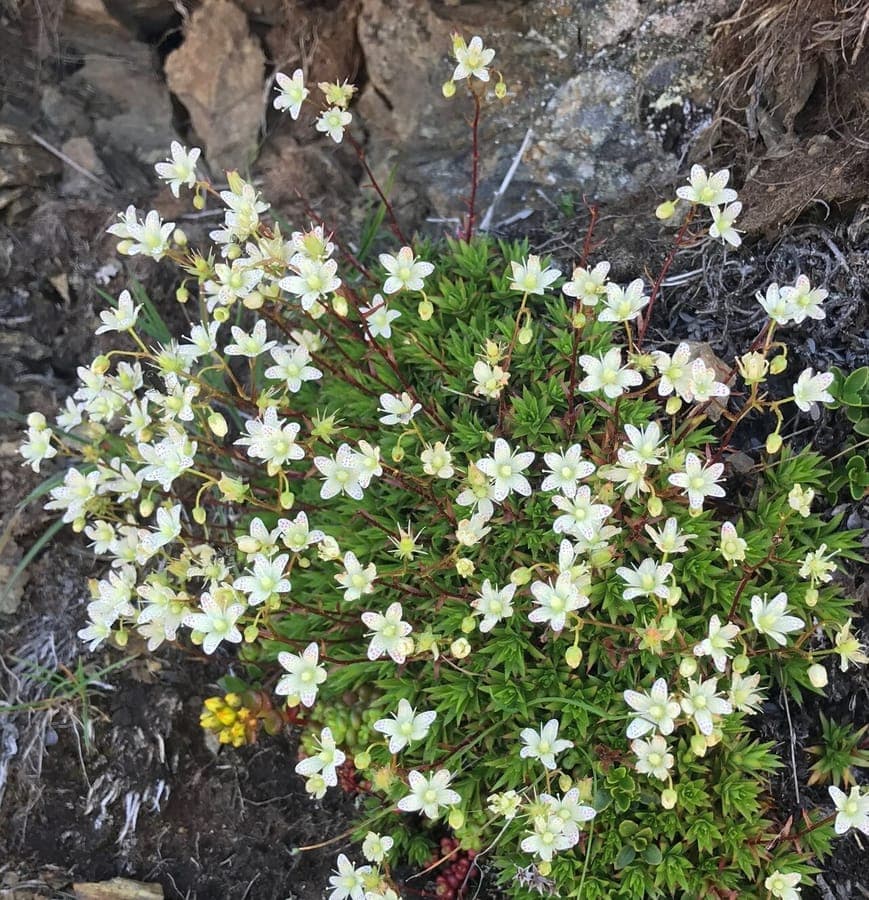
marek (iNaturalist user name) / CC BY 4.0, via Wikimedia Commons
Spotted saxifrage: complete guide
Saxifraga bronchialis
Want to see Spotted saxifrage: complete guide in your garden?
1 minute, no credit card
Overview
Saxifraga bronchialis, commonly known as spotted saxifrage, matted saxifrage or yellowdot saxifrage, is a compact, cushion-forming perennial in the family Saxifragaceae. The species was described as early as 1753 by Carl Linnaeus in his foundational work Species Plantarum. Its native range is remarkable in extent: from Siberian Russia - the Altai mountains, Siberian taiga, Mongolian border steppes - through the Russian Far East, the Kuril Islands, Sakhalin, Kamchatka, Japan and northern China, all the way to Alaska, the Aleutian Islands, Canada (British Columbia, Alberta, Yukon) and the western United States (Washington, Oregon, Idaho, Montana, Wyoming, Colorado, Utah and New Mexico). The plant grows naturally on rocky mountain slopes, in rock crevices and on stony tundra at elevations from sea level to well above the treeline.
The name bronchialis reflects historical botanical practice: Linnaeus named the plant after a supposed medicinal effect on the airways (bronchi), though this has not been confirmed by modern pharmacology. The common names matted saxifrage and spotted saxifrage describe, respectively, its characteristic dense mat-forming growth habit and the distinctive spotted flower petals that set this species apart visually from most other saxifrages.
For gardeners, Saxifraga bronchialis is an excellent choice for rock gardens, alpine troughs and crevices in dry stone walls. The fine, spine-tipped leaves form compact cushion mats, while the flowers are exceptional in their detail: white petals bearing red-orange and yellow spots - the combination behind the names 'spotted saxifrage' and 'yellowdot saxifrage'. At gardenworld.app you can see how to incorporate this alpine miniature into a front garden or rock garden design and which companion plants complement it best.
Appearance & bloom cycle
Saxifraga bronchialis is a low-growing, densely branched perennial that rarely exceeds 5 to 15 cm in height but expands laterally to form cushion mats 20 to 40 cm across. The vegetative cushions consist of countless small rosettes, each built from narrow, stiff leaves 0.5 to 1.5 cm long. The leaves are rigid and spine-tipped - almost needle-like - with a row of small glandular teeth along the margin, a diagnostic characteristic of the species. Leaf colour is green to blue-green, and the texture is firm and somewhat leathery.
The flowers are the absolute highlight of this plant and set Saxifraga bronchialis apart from most other saxifrage species. The five petals are white with a vivid pattern of red to orange-red spots and separate yellow nectary spots near the base - an exceptionally intricate pattern that has earned the plant its 'spotted saxifrage' name. Each flower measures 1 to 1.5 cm across. The flowers are carried on upright, slender stems 5 to 12 cm tall and appear in loose, open clusters.
The flowering period falls in summer: depending on elevation and climate, the plant blooms from June to August. At lower, warmer garden sites the bloom begins in May to June. After flowering, small capsule fruits develop containing numerous fine seeds. The plant is easily propagated by seed or by removing small rosette offsets in early spring.
Ideal location
Saxifraga bronchialis requires a rocky or stony site with excellent drainage and abundant light. Across its vast range from Siberian Russia to Alaska and the American Rocky Mountains, it grows on bare rock faces, in rock crevices, on stony tundra and mountain slopes that receive intense summer sun but are buried under snow in winter.
In the garden, the best positions are: a rock garden with larger boulders and crevices, the joints of a dry stone wall, an alpine trough or a stone and grit bed. The plant prefers a south- or southwest-facing, open, sunny to lightly shaded location. Intense midday heat combined with dry soil can stress the fine roots; some shading by larger stones or a west-facing aspect is preferable in the hottest climates.
Avoid positions where fallen leaves or other organic debris can accumulate on the cushions: moisture and decomposing material around the stiff leaf tips quickly cause cushion rot. An open, well-aired position where water runs off rapidly is essential.
In containers - alpine bowls or terracotta pots with a grit layer - the plant grows well provided the container drains perfectly and can be protected in winter. Overwintering a container outdoors in an unheated greenhouse or cold frame is a reliable option for those uncertain about frost hardiness at a particular site.
Soil requirements
The soil requirements of Saxifraga bronchialis are the most critical factor for success: the plant needs lean, fast-draining, slightly to moderately acid soil with a pH between 5.0 and 7.0. In nature it grows on limestone, granite, gravel and in rock crevices - substrates that contain almost no organic matter and dry out extremely rapidly after rain.
In the garden, prepare a dedicated saxifrage bed using a mixture of:
- two parts coarse grit (particle size 2 to 4 mm)
- one part perlite or pumice (for drainage and weight)
- one part lean, lightly humus-rich garden soil or alpine potting compost
- optionally a top-dressing of fine gravel or stone chips
Avoid any organically rich compost or peat - excessive nutrition produces a waterlogged, weakly growing plant prone to rotting. A lightly alkaline limestone grit bed also works well, as many saxifrage species grow on limestone in the wild. Saxifraga bronchialis equally tolerates non-calcareous, granite-type substrates.
The surface layer can consist of a few centimetres of fine grit or pebbles positioned directly around the leaf cushions. This keeps moisture away from the leaf bases, promotes air circulation and reflects warmth back to the plant, which encourages flowering.
Watering
Saxifraga bronchialis has moderate water needs and tolerates periods of drought well, but it also does not want prolonged desiccation. The key is balance: regular but sparing watering, with emphasis on allowing the substrate to dry between waterings.
In spring and early summer, during active growth and flowering, water when the growing medium feels dry at 3 to 4 cm depth. This is typically once a week to once a fortnight in cool, overcast weather, and somewhat more frequently in warm, dry conditions. Always water at the base of the plant, never over the leaf cushions, as wet leaf bases are the most common cause of botrytis rot in saxifrage species.
In summer, once the flowering period has ended, reduce watering frequency. Reduce further in autumn and water very sparingly in winter - particularly for container-grown plants. Roots should remain cool and very slightly moist, never wet.
For plants growing outdoors in a well-constructed rock garden or crevice bed, normal rainfall patterns in the Netherlands and Belgium are generally sufficient, provided drainage is genuinely excellent. Supplementary watering is only needed during sustained dry spells lasting more than three weeks in summer.
Free design
Want to see Spotted saxifrage: complete guide in your garden? Make a free design now.
Pruning
Saxifraga bronchialis requires minimal pruning, but what little is done has a real effect on plant health and flowering performance. After flowering - in August or September - carefully pull off or snip away the dried petals and wilted flower stems with tweezers or small scissors. This prevents rotting material from falling onto the leaf cushions and triggering fungal infections.
If the cushions become too large after several years or begin to rot in the centre (a common problem in older saxifrage specimens), remove small edge sections in early spring and root them as cuttings. Replant the vital outer sections in fresh substrate and remove the exhausted central portion. In this way the plant is rejuvenated without being lost entirely.
In autumn, carefully remove any fallen leaves and organic debris from around the stiff leaf tips using tweezers or a soft brush. This small piece of maintenance prevents a great deal of rot over winter.
Stem debris and old plant material can be composted. Seed capsules intended for propagation should be dried in a warm, airy spot and stored in a paper envelope in the refrigerator until early spring.
Maintenance calendar
January - February: The plant overwinters naturally under snow in the wild; in the garden, leave outdoors on well-drained ground. Check that no leaf fall has accumulated on the cushions. No watering.
March: Gently remove any dead material at the edges of the cushions. First new growth becomes visible. Begin watering cautiously once the soil has thawed.
April - May: Strong growth period. Leaf cushions expand. Flower buds begin to appear. Water when the substrate feels dry at 3 to 4 cm depth. No feeding.
June - July: Peak of flowering. Enjoy the beautifully spotted flowers. Water at the base only, never over the plant. Remove spent flower stems promptly.
August - September: Flowering ends. Clear away petals and stems. Reduce watering. Optionally take edge cuttings for propagation.
October - November: Continue reducing watering frequency. Remove organic debris from around the plant. No additional winter protection needed on well-drained ground.
December: Dormant period. No watering or feeding. Check drainage. In mild, wet, frostless periods ensure no water pools at the leaf bases.
Winter hardiness
Saxifraga bronchialis is exceptionally cold hardy. The species is native to Alaska, the Aleutian Islands, the subarctic regions of Canada and Russia, and mountain summits in the Rocky Mountains - areas where winters of -30 to -40 degrees Celsius are entirely normal. In garden cultivation in the Netherlands, Belgium and northern Germany (USDA zones 4 to 7), the plant overwinters without any difficulty whatsoever.
The greatest winter risk, as with other saxifrage species, is not cold but moisture. Snow is actually beneficial: it insulates the cushions and keeps them dry under the frozen layer. Problems arise when driving rain combined with freezing causes water droplets to freeze in the leaf axils and damage the delicate tissue of the leaf bases. An open, well-draining site - a lightly sloping rock bed or grit bed - eliminates this risk for the most part.
In a well-constructed rock garden or crevice bed, spotted saxifrage needs no additional winter protection even in the harshest Dutch winters. In a waterlogged clay soil or a container that does not drain properly the plant is more vulnerable; a lightweight transparent cover or cold frame in winter is then an option.
At gardenworld.app you can see how alpine plants like Saxifraga bronchialis are combined with other hardy mountain species in a rock garden for year-round colour and structure.
Companion plants
Saxifraga bronchialis combines beautifully with other rock garden and alpine plants that make equivalent demands on soil and site. Ideal companions include:
- Sempervivum (Houseleek) - the fleshy leaf rosettes contrast beautifully with the fine, spiny cushions of Saxifraga and are at home in the same lean, stony soils. Grows in identical positions.
- Sedum (Stonecrop) - low, fleshy species such as Sedum acre, Sedum album and Sedum hispanicum tuck into crevices around larger saxifrage mats and share the same preference for dry, stony conditions.
- Draba (Whitlow grass) - small, cushion-forming alpine plants that occupy a comparable rocky site and bloom early in the season with yellow flowers, providing pre-bloom colour before Saxifraga flowers open.
- Saxifraga paniculata (Livelong saxifrage) - a close relative that also forms cushions but is somewhat larger; creates a varied saxifrage composition in a rock bed.
- Thymus serpyllum (Wild thyme) - low creeping thyme that seeks out the warmth of rocks, carpets the crevices and produces purple flowers in June-July, coinciding with the flowering of spotted saxifrage.
- Armeria maritima (Thrift) - compact grass-tuft rosettes with spherical pink flower heads; the same preference for dry, open, stony positions.
Space Saxifraga bronchialis 20 to 30 cm from other small alpine plants in the rock garden; the saxifrage mats spread slowly and are not invasive.
Conclusion
Saxifraga bronchialis, the spotted saxifrage, is a jewel for the rock garden and alpine bed. The cushion-forming, compact growth habit, the spiny-fine leaf texture and above all the exceptionally beautiful spotted flowers make this a plant that more than earns its place in the garden. Exceptional cold hardiness - down to USDA zone 4 - combined with minimal care requirements make it an ideal choice for anyone seeking a robust and elegant alpine plant. Specialist alpine nurseries and garden centres with a dedicated alpine section are the best sources for young plants. Visit gardenworld.app to discover more inspiring rock garden combinations featuring Saxifraga and its companions.
Want to see Spotted saxifrage: complete guide in your garden? Make a free design now.
Upload a photo, pick a style, and get a photorealistic design with plant list in under a minute.
10,000+ gardens designed already
No credit card required


Similar plants
Korean astilbe: complete guide
Astilbe grandis
Discover Korean astilbe (Astilbe grandis): a tall shade plant with elegant flower plumes for pond edges and borders.
Heuchera pilosissima: complete guide to seaside alumroot
Heuchera pilosissima
Seaside alumroot (Heuchera pilosissima), an elegant North American dwarf perennial with hairy red-tinged foliage and red flower spikes.
Starry saxifrage: complete guide
Micranthes stellaris
Full guide to Micranthes stellaris, the starry saxifrage: location, soil, blooming and garden use. A tough alpine plant for moist, shady rock faces and pond margins.