
J.M.Garg / CC BY-SA 3.0, via Wikimedia Commons
Saraca asoca: complete guide
Saraca asoca
Want to see Saraca asoca: complete guide in your garden?
1 minute, no credit card
Overview
Saraca asoca, commonly known as Ashoka tree, is a medium-sized tree of the Fabaceae family native to tropical and subtropical Asia, from Bangladesh to Sri Lanka and Myanmar. The tree is considered sacred in many Eastern cultures and is known by various names across different regions.
In European contexts, the Ashoka tree is highly prized as an ornamental in warmer regions thanks to its stunning orange-red flowers and interesting growth pattern. The tree also grows well in containers and can be supported as a larger shrub or specially trained tree.
Appearance and Bloom
The Ashoka tree reaches heights of 33 to 66 feet in natural conditions, but typically grows smaller in cultivation, between 16 to 33 feet. The tree forms a broad, open canopy with mixed, fine foliage. The leaves are striking: they emerge reddish or coppery, darkening to green as they mature.
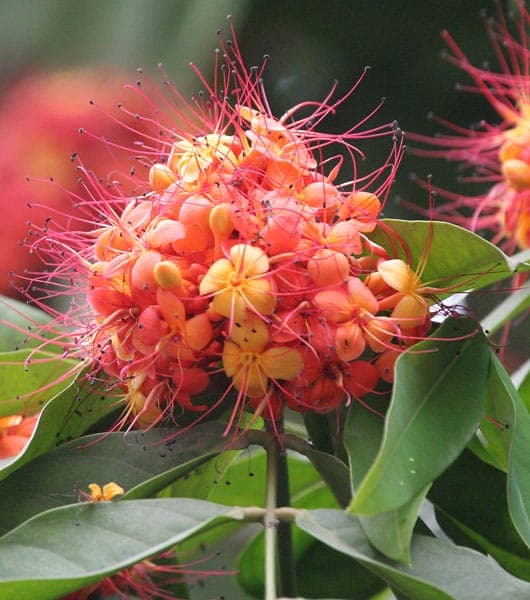
Flowers are highly decorative and the tree's main feature. They are bright orange to deep red-orange, quite small (approximately 0.8 inches), and grow in dense, compact inflorescences attractive to birds and insects. Flowering occurs in early spring (March-May in the Northern Hemisphere).
Ideal Location
The Ashoka tree requires warm temperatures (minimum 59 degrees Fahrenheit/15C year-round) and is therefore only suitable for very warm regions or containers in temperate climates. Full sun to partial shade is needed for good growth and flowering.
Plant in a protected location without strong wind, as young twigs can break easily. The tree thrives in urban environments and tolerates pollution reasonably well.
Free design
Want to see Saraca asoca: complete guide in your garden? Make a free design now.
Soil
The Ashoka tree prefers moist but well-drained soil. Heavy clay can be improved through compost and sand addition. Poor soils benefit from regular fertilizer applications.
Prefer neutral to slightly alkaline pH. Add well-rotted compost or organic matter at planting to improve soil structure.
Watering
Mature trees tolerate normal rainfall in tropical climates, but should receive regular water until well established. In drier climates, regular watering is needed during the growing season.
Young trees must receive regular water during their first growing year. In containers, daily watering may be necessary in hot periods.
Pruning
Minimal pruning is needed. Remove only dead or damaged branches. The tree grows naturally in an attractive pattern and requires no drastic shaping.
Maintenance Calendar
March-May: Flowering period. Water regularly. June-September: Growth period. Moderate feeding once monthly. October-February: Dormant season. Reduce watering.
Winter Hardiness
The Ashoka tree is tropical and tolerates no frost. Temperatures below 50 degrees Fahrenheit/10C cause damage. In temperate climates, the tree must be overwintered indoors or treated as an annual.
Companion Plants
In warmer settings, the Ashoka tree combines well with:
With other tropical flowering trees: Frangipani, Tibouchina. With tropical-looking shrubs: Justicia, Lantana. With evergreen shrubs: as background.
Closing
The Ashoka tree is for gardeners in warm climates seeking something different from ordinary tree species. The stunning orange-red flowers and sacred associations make it a sought choice. Plant in warm regions or large containers for tropical beauty.
Available through specialized tropical plant suppliers. Visit gardenworld.app for warm-climate garden design!
Want to see Saraca asoca: complete guide in your garden? Make a free design now.
Upload a photo, pick a style, and get a photorealistic design with plant list in under a minute.
No credit card required


Similar plants
Tall Silky Lupine: complete guide
Lupinus elatus
Tall silky lupine is a fast-growing Californian perennial with silvery foliage and blue-purple flower spikes, ideal for a prairie-style garden.
Garfield Lupine: complete guide
Lupinus garfieldensis
The Garfield lupine is a rare, fast-growing American perennial for alkaline, dry grassland gardens, with striking blue flower spikes.
Lupinus elegans: complete guide
Lupinus elegans
Lupinus elegans, the elegant lupine, is a spectacular blooming plant from Mexico with blue flower spikes. Care, cultivation and garden use.