
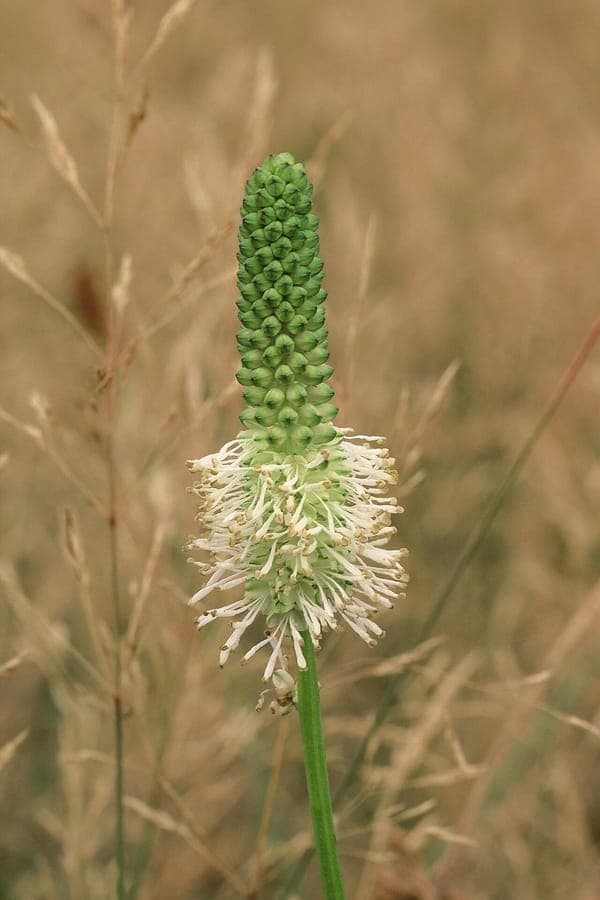
NPS Photo / Public domain, via Wikimedia Commons
Sanguisorba canadensis: complete guide to white burnet
Sanguisorba canadensis
Want to see Sanguisorba canadensis: complete guide to white burnet in your garden?
1 minute, no credit card
Overview
Sanguisorba canadensis, commonly known as Canadian burnet or white burnet, is an elegant perennial belonging to the Rosaceae family. Native to eastern Canada and eastern North America, this plant grows naturally in wet meadows and marshes along river banks.
This graceful plant is renowned for its distinctive white flowers appearing in tall, upright bottlebrushed spikes. Reaching 60-90 centimeters in height, Sanguisorba canadensis fits perfectly in mid-border positions within mixed herbaceous planting schemes.
Appearance and Bloom
Sanguisorba canadensis grows as an upright, non-invasive perennial with attractive dark green, finely-divided compound leaves. The foliage is more delicate and refined than related species, creating an attractive backdrop for the flowers.
From July through September, striking white flowers appear in dense, bottlebrushed spikes rising on tall stems. These flower spikes can reach 10-15 centimeters in length and display a distinctive pure white color that is highly visible from a distance.
The flowers are highly attractive to bees and other pollinators. Following bloom, characteristic seedheads form and remain decorative well into autumn.
Ideal Location
Sanguisorba canadensis thrives in full sun to partial shade. Plants require minimum 4-6 hours direct daily sunlight for optimal flowering, though the species tolerates considerable shade.
The plant prefers moisture-rich soil with consistent water supply. While it thrives in wet conditions, it also grows well in normal garden soil if irrigation is provided during dry periods.
Avoid exposed windy locations where strong winds may lodge tall flower stems.
Soil
Sanguisorba canadensis performs best in fertile, moist soil enriched with organic material. A pH range of 5.5 to 7.5 is acceptable.
When planting: incorporate generous amounts of aged manure or well-rotted compost into the planting area. In arid regions, add extra compost to improve water retention.
Annually, following flowering, apply a compost mulch around the plant base to replenish nutrients.
Watering
Newly planted Sanguisorba canadensis must be watered regularly during its first growing season. Water whenever the top inch of soil feels dry.
Established plants are reasonably drought-tolerant but perform better with consistent moisture. Supply deep watering 1-2 times weekly during dry periods.
Mulch around the plant with a 5-7 centimeter layer of compost to improve moisture retention and regulate soil temperature.
Free design
Want to see Sanguisorba canadensis: complete guide to white burnet in your garden? Make a free design now.
Pruning and Maintenance
Sanguisorba canadensis requires minimal pruning. After flowering, deadhead spent flower spikes approximately halfway down to stimulate secondary smaller blooms.
In spring: remove all dead stems from the previous season at ground level.
The plant tolerates division in spring or fall. Dig up mature clumps, divide into 2-3 portions, and replant immediately.
Propagation
Sanguisorba canadensis can be grown from fresh seed or by division of established plants.
Seed: sow fresh seed in early spring on moist seed-starting mix. Keep soil consistently moist until germination. Germination occurs within 3-4 weeks.
Division: in spring or autumn, dig up the plant and carefully separate into two or more divisions. Each division should contain several growth points. Replant immediately at the same depth.
Companion Planting
For an elegant perennial scheme:
- Filipendula species (Meadowsweet) - similar moisture preference, different flower color
- Lythrum salicaria (Purple loosestrife) - contrasting red flowers
- Iris sibirica (Siberian iris) - blue-purple flowers, moisture-loving
- Hosta species - foliage contrast, moisture-loving
Maintenance Calendar
March-April: Remove dead stems, apply fresh compost.
May-June: Growing season. Ensure consistent moisture.
July-August: Flowering period. Deadhead spent spikes.
September-October: Autumn. Harvest seed if desired.
November-February: Dormant season.
Winter Hardiness
Sanguisorba canadensis is completely winter-hardy, tolerating temperatures as low as -20 to -25 degrees Celsius. The plant is ideal for temperate and cold climates.
The plant sheds all foliage in winter and enters dormancy. New shoots emerge from the crown in spring.
Health Issues
Sanguisorba canadensis is extremely healthy, subject to few diseases or pests. Shade-grown specimens may be slightly moisture-sensitive - ensure good air circulation.
Landscape Uses
Use Sanguisorba canadensis as:
- Background plant in herbaceous borders
- Cut flower for tall stems
- Pollinator plant in wildlife gardens
- Moisture-tolerant plant for wet garden areas
Conclusion
Sanguisorba canadensis is an impressive, reliable perennial for any garden. With minimal care, you will enjoy years of elegant white flowers.
Start with healthy young plants from reputable nurseries on gardenworld.app.
Find all perennial plant care supplies at Intratuin and Gamma.
Want to see Sanguisorba canadensis: complete guide to white burnet in your garden? Make a free design now.
Upload a photo, pick a style, and get a photorealistic design with plant list in under a minute.
No credit card required


Similar plants
Siberian crab apple: complete guide
Malus x robusta
Complete guide to the Siberian crab apple (Malus x robusta): location, soil, pruning, winter hardiness and the best companion plants for your garden.
Chinese flowering crabapple (Malus x spectabilis): complete guide
Malus x spectabilis
Meet the Chinese flowering crabapple (Malus x spectabilis): a classic spring bloomer with carmine buds and pink blossom.
Potentilla crassinervia: complete guide
Potentilla crassinervia
Potentilla crassinervia, the Corsican cinquefoil, grows wild on Corsica and Sardinia's peaks. Discover how to grow this hardy alpine rock garden gem.