
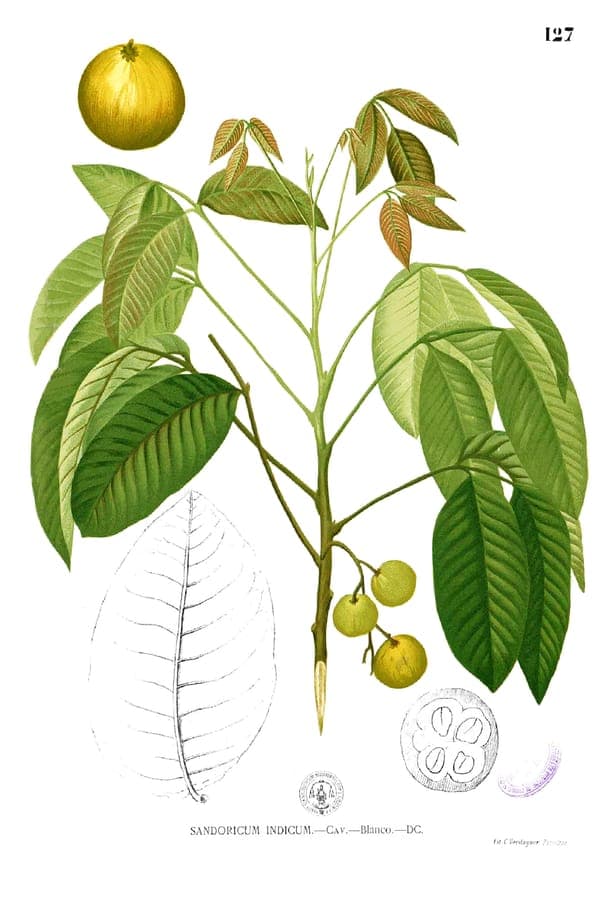
Francisco Manuel Blanco (O.S.A.) / Public domain, via Wikimedia Commons
Sandoricum koetjape: complete guide to santol fruit trees
Sandoricum koetjape
Want to see Sandoricum koetjape: complete guide to santol fruit trees in your garden?
1 minute, no credit card
Overview
Sandoricum koetjape, commonly known as santol or red santol, is an impressive tropical fruit tree native to Southeast Asia. Belonging to the Meliaceae family (the mahogany family), this tree is prized for producing abundant, delicious fruits that taste like a cross between pineapple and apple.
In its native range, santol trees grow to 25 meters tall, though in cultivated gardens they typically remain smaller. The tree produces beautiful greenish-yellow flowers followed by round, golden-yellow fruits highly valued in South Asian markets.
Appearance and Bloom
Sandoricum koetjape grows as an imposing, densely-foliaged tree with ornamental compound leaves. The glossy green leaflets are elongated and can reach 30-50 centimeters in total leaf length.
In spring (March-April in the Southern Hemisphere), small yellowish-white flowers appear in dense panicles. These fragrant flowers produce a subtle honey-like aroma and attract numerous honeybees.
Fruits appear approximately 4-5 months after flowering. Each fruit is round to oval, about 5-8 centimeters in diameter, with a yellow to orange exterior. The flesh is white, firm, and pleasantly sweet with a slight tartness.
Ideal Location
Sandoricum koetjape requires a warm, sunny location with minimum 6-8 hours of direct daily sunlight. The tree can grow in partial shade, but fruit production will be diminished.
The tree is best suited to tropical and subtropical climates where temperatures never drop below 10-15 degrees Celsius. In temperate climates, it can be grown in a greenhouse or warm conservatory.
Provide shelter from strong winds that damage foliage and young fruit. The tree also thrives in salt-laden seaside locations common in tropical areas.
Soil
Sandoricum koetjape grows in various soil types but performs best in fertile, well-draining soil with a slightly acidic pH of 6.0-6.8.
When planting: dig a hole approximately twice as wide as the root ball. Incorporate generous organic material (compost, rotted leaves) and well-aged manure.
Ensure excellent soil drainage - waterlogged conditions cause root rot. In wet areas, raise the planting bed to improve drainage.
Watering
Newly planted santol trees require regular watering during their first two years while roots establish. Supply water three times weekly during dry seasons.
For established trees: water deeply but less frequently. During rainy seasons, natural rainfall may suffice. During dry periods, supply water weekly to 30 centimeters depth.
Mulch the tree base with a 5-10 centimeter layer of rotted leaves or compost to improve moisture retention and regulate soil temperature.
Free design
Want to see Sandoricum koetjape: complete guide to santol fruit trees in your garden? Make a free design now.
Pruning and Shaping
Sandoricum koetjape requires minimal pruning but early formative pruning helps establish strong structure.
First year: head back the central leader and encourage side branches to create a broad, open canopy. This improves air circulation and facilitates later harvesting.
Annual pruning: remove dead, diseased, or crossing branches. Remove downward-growing limbs that form angles less than 45-60 degrees. Post-harvest light pruning is acceptable, but heavy cutting reduces future flowering.
Flowering and Fruit Set
Sandoricum koetjape typically flowers once yearly in spring, though multiple bloom periods are possible in stable tropical climates.
Fruit set depends on:
- Adequate pollination (self-fertile but bee-assisted)
- Sufficient nutrition, especially phosphorus
- Adequate water during flowering and fruit development
- Freedom from water stress during critical periods
Pests and Diseases
Sandoricum koetjape is relatively problem-free but may encounter:
- Caterpillars: control with biological insecticide
- Fruit flies: use baited traps or fine netting
- Fungal issues (humid climates): improve air circulation, remove damaged fruit
Companion Trees
For a tropical fruit grove:
- Mangifera indica (Mango) - similar size, different harvest season
- Artocarpus heterophyllus (Jackfruit) - larger framework tree
- Psidium guajava (Guava) - smaller understory fruit tree
Maintenance Calendar
January-February: Prepare for flowering. Apply compost and phosphate fertilizer.
March-April: Flowering period. Ensure consistent watering.
May-July: Fruit development. Thin fruits if needed.
August-October: Harvest ripe fruits, begin pruning.
November-December: Prepare for next season, apply fertilizer.
Winter Hardiness
Sandoricum koetjape is not cold-hardy and cannot tolerate freezing. In temperate climates, the tree must be grown in containers that can be moved indoors or under protective structures.
Optimal growth occurs at temperatures between 24-30 degrees Celsius. Temperatures below 10 degrees cause leaf drop and growth cessation.
Harvesting and Nutrition
Fruits ripen 4-5 months after flowering. Harvest when the exterior turns yellow to orange and feels slightly soft.
The fruit is rich in vitamins A and C, minerals, and antioxidants. Eaten fresh, in juices, or dried, santol fruits are highly nutritious and delicious.
Conclusion
Sandoricum koetjape brings tropical fruit abundance to warm gardens. With basic care, this impressive tree thrives for years producing nutritious fruits.
Start with healthy nursery specimens from gardenworld.app or specialized tropical fruit nurseries.
Find fruit tree care supplies at specialized garden centers.
Want to see Sandoricum koetjape: complete guide to santol fruit trees in your garden? Make a free design now.
Upload a photo, pick a style, and get a photorealistic design with plant list in under a minute.
No credit card required


Similar plants
Muskwood: complete guide
Guarea guidonia
Everything about muskwood (Guarea guidonia): tropical origins, appearance, cultivation in conservatories and warm gardens, care and companions.
Trichilia dregeana: complete guide
Trichilia dregeana
Trichilia dregeana is an African tree with beautiful foliage and striking flowers. Learn how to care for this exotic plant in your garden.
Swietenia macrophylla: complete guide
Swietenia macrophylla
Discover Honduran mahogany - a tropical timber tree with architectural beauty. Growing requirements, care guide and sustainability for warm climates.