
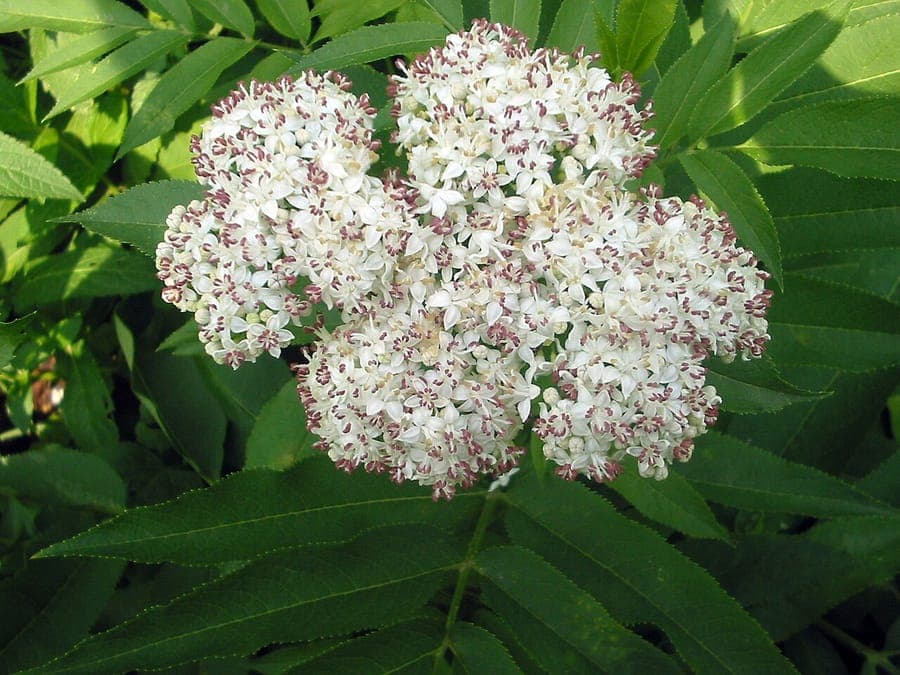
No machine-readable author provided. Bogdan assumed (based on copyright claims). / CC BY-SA 3.0, via Wikimedia Commons
Danewort: complete guide
Sambucus ebulus
Want to see Danewort: complete guide in your garden?
1 minute, no credit card
Overview
Danewort (Sambucus ebulus), also called Dwarf Elder, is a distinctive herbaceous member of the Viburnaceae family, native to North Africa, Europe, and extending to southern Turkmenistan. Unlike tree-form elders, danewort remains low and spreads via rhizomes. Historically valued for its white flowers, glossy black berries, and traditional medicinal uses, this plant brings unique character to diverse garden settings.
Appearance and bloom cycle
Danewort grows as a dense, compact mound, typically 60-120 cm in height. The stems are bright green, often tinged red, with prominent lenticels (breathing pores). Foliage consists of large, pinnate leaves, 10-15 cm long, on distinctly reddish or purple petioles. In June and July, fragrant white flowers appear in flat-topped cyme clusters, attracting numerous pollinators. These are followed by glossy black berries in August-September that attract birds.
Ideal location
Danewort grows well in full sun to partial shade, needing 3-4 hours of direct sunlight daily. The plant tolerates more shade than larger elder species. Position away from strong winds in very exposed locations. Flowering is reduced in heavily shaded spots, though the plant survives.
Soil requirements
Danewort is quite adaptable regarding soil type, thriving in both heavy clay and sandy soils. The plant prefers well-draining, moderately fertile soils. Slightly acidic to neutral soils (pH 5.5-7.0) are optimal. The plant accepts moderately dry to moist conditions but waterlogged roots must be avoided.
Watering
Danewort requires moderate water. Water regularly during the growing season, especially in dry periods. Once established, the plant shows reasonable drought tolerance in hot summers. Regular watering in the first two years is essential for good establishment. Avoid waterlogged conditions. Overhead irrigation helps prevent powdery mildew in damp weather.
Free design
Want to see Danewort: complete guide in your garden? Make a free design now.
Pruning
Pruning requirements are minimal. Remove dead or damaged stems annually. The plant can be lightly pruned in spring if desired. Young plants should be shaped in their first year to develop a dense, neat form. Spent flower clusters may be removed, though the berries are decorative and valuable for birds.
Maintenance calendar
Spring (March-April): Light prune, remove dead wood, mulch, apply balanced fertilizer. Summer (June-July): Water during dry spells, support flower clusters if needed, monitor pests. Autumn (August-September): Allow berries to mature for wildlife, tidy fallen leaves. Winter (November-February): Minimal care required; remove dead wood as necessary.
Winter hardiness
Danewort is hardy in USDA zones 5-9, surviving temperatures of -15°C and lower. The plant may die back to ground level in severe winters but usually regenerates from the rootstock in spring. Stem dieback causes no concern as the plant is designed for regular rejuvenation.
Companion plants
Danewort pairs well with other shrubs and perennials sharing similar moisture preferences, including holly, dogwood, and ornamental grasses. Autumn-flowering perennials like asters and sedums provide pleasing contrasts. The plant fits naturally in wildlife gardens and informally planted borders.
Closing
Danewort is a distinctive addition to medium to large gardens, offering white flowers and decorative berries throughout the season. Visit gardenworld.app to discover more plant combinations that complement danewort beautifully. With modest care requirements and proven hardiness, this unique elder deserves space in gardens seeking something different.
Want to see Danewort: complete guide in your garden? Make a free design now.
Upload a photo, pick a style, and get a photorealistic design with plant list in under a minute.
No credit card required


Similar plants
Squashberry: complete guide
Viburnum edule
Grow mooseberry (Viburnum edule): ultra-hardy North American shrub with fragrant white flowers and red autumn berries. Perfect for boreal gardens. Zone 3.
Witherod: complete guide to this elegant North American shrub
Viburnum cassinoides
Discover Viburnum cassinoides: an elegant North American shrub with white flowers, yellow fall foliage, and blue berries. Perfect for temperate garden zones.
Buddlejaleaf viburnum: complete guide
Viburnum buddleifolium
Elegant evergreen shrub with delicate foliage and white spring flowers. Perfect for sheltered borders in temperate gardens.