
Rob Routledge, Sault College, Bugwood.org / CC BY 3.0 us, via Wikimedia Commons
Witherod: complete guide to this elegant North American shrub
Viburnum cassinoides
Want to see Witherod: complete guide to this elegant North American shrub in your garden?
1 minute, no credit card
Overview
Viburnum cassinoides, commonly known as Witherod or Wild Raisin, is a magnificent North American shrub celebrated for its four-season appeal. Ranging from Eastern Canada to North Carolina, this deciduous plant offers white spring flowers, spectacular autumn color, and bird-attracting blue berries that persist well into winter.
At GardenWorld, we recommend Viburnum cassinoides for naturalistic garden designs because this native species provides year-round interest with minimal intervention. The plant tolerates both wet and dry conditions and thrives in part-shade to full-sun exposures.
Appearance and Bloom
Witherod grows as a densely branched shrub reaching 2-4 meters in height, developing an oval to rounded form. The deciduous leaves are elliptical, glossy green, and slightly hairy. In May and June, small, white flowers appear in flat-topped clusters (5-7 cm across), attracting bees and butterflies.
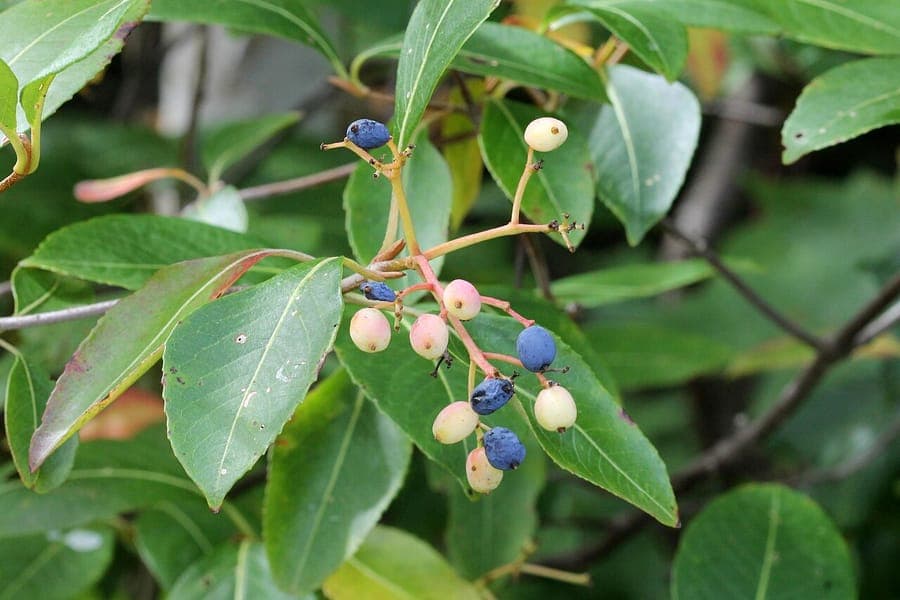
The true spectacle emerges in late summer and autumn. Berries transform from green to red, then to dark blue-black, creating weeks of visual interest. Simultaneously, foliage shifts through brilliant yellows, oranges, and deep reds - a stunning seasonal display.
Ideal Location
Witherod performs best in 6+ hours of sunlight daily but adapts to partial shade. In southern growing zones, afternoon shade prevents leaf scorch during intense summer heat.
This shrub excels in:
- Wildlife and bird gardens (berries attract migratory species)
- Naturalistic landscape designs
- Hedgerows and informal screens
- Water garden margins and wetland restoration
- Foundation plantings with mixed borders
Soil Requirements
Witherod adapts to various soil types, from acidic to neutral (pH 6.0-7.5). Ideal soil is consistently moist but well-draining. Pure sand or compacted clay requires amendment.
Soil preparation:
- Incorporate 5-8 cm of compost into planting area
- Break up clay with sand and organic matter
- Add peat moss to very sandy soils for water retention
- Apply 5 cm mulch layer to regulate moisture
Watering
Water regularly during the first year (2-3 times weekly, adjusted for rainfall). Once established (year two onward), Witherod is drought-tolerant but performs better with moderate moisture.
Watering guidelines:
- Deep soaking less frequently beats shallow daily sprinkling
- Target 40-60% soil moisture for optimal growth
- Increase watering during extended dry periods
- Water early morning or evening, never in midday heat
Free design
Want to see Witherod: complete guide to this elegant North American shrub in your garden? Make a free design now.
Pruning
Witherod requires minimal pruning. Remove dead branches immediately after flowering (July-August). Renewal pruning is best conducted in March-April before new growth.
Pruning practices:
- Remove all dead, diseased, or damaged wood promptly
- Thin congested shrubs by removing one or two oldest canes at soil level annually
- Cut lanky shoots in half after flowering for compact form
- Avoid heavy autumn pruning to maintain winter hardiness
Maintenance Calendar
March-April: Inspect for winter damage, prune as needed May-June: Enjoy flowering display; minimal maintenance required July-August: Remove spent flowers, monitor watering September-November: Observe berries and fall color; rake leaves for mulch December-February: Minimal care; enjoy winter berries and structure
Winter Hardiness
Viburnum cassinoides is extremely hardy in zones 3-8, tolerating temperatures to -35 degrees Celsius. This makes it ideal for cold and temperate climates. In zone 9 and warmer, growth is less vigorous.
Winter preparation:
- Discontinue fertilizing after August
- Apply 5-8 cm mulch layer around base
- Protect young plants in zones 3-4 with windbreaks
- Wire down heavy branches if snow load threatens breakage
Companion Plants
Witherod pairs beautifully with:
- Native groundcovers: Creeping Phlox, Bergenia, Autumn Fern
- Screening shrubs: Aronia, Ilex verticillata, Lindera
- Perennials: Rudbeckia, Echinacea, Joe-Pye Weed
- Ornamental grasses: Panicum, Festuca, Calamagrostis
- Wildlife plants: Sambucus nigra, Cornus sericea
Closing Thoughts
Viburnum cassinoides is a reliable, multi-season workhorse worthy of every temperate garden. From white spring blooms to stunning autumn colors and bird-magnetizing berries, this North American native deserves prime placement.
Visit gardenworld.app for more inspiration integrating native shrubs into your garden design. Purchase Witherod specimens from quality nurseries, garden centers, or trusted online retailers.
With minimal maintenance and maximum seasonal interest, Witherod is an easy, ecologically intelligent choice for responsible gardeners.
Want to see Witherod: complete guide to this elegant North American shrub in your garden? Make a free design now.
Upload a photo, pick a style, and get a photorealistic design with plant list in under a minute.
No credit card required


Similar plants
Squashberry: complete guide
Viburnum edule
Grow mooseberry (Viburnum edule): ultra-hardy North American shrub with fragrant white flowers and red autumn berries. Perfect for boreal gardens. Zone 3.
Buddlejaleaf viburnum: complete guide
Viburnum buddleifolium
Elegant evergreen shrub with delicate foliage and white spring flowers. Perfect for sheltered borders in temperate gardens.
Himalayan viburnum: complete guide
Viburnum grandiflorum
Enchanting semi-evergreen shrub with highly fragrant white-pink flowers in winter. Perfect for sheltered gardens.