
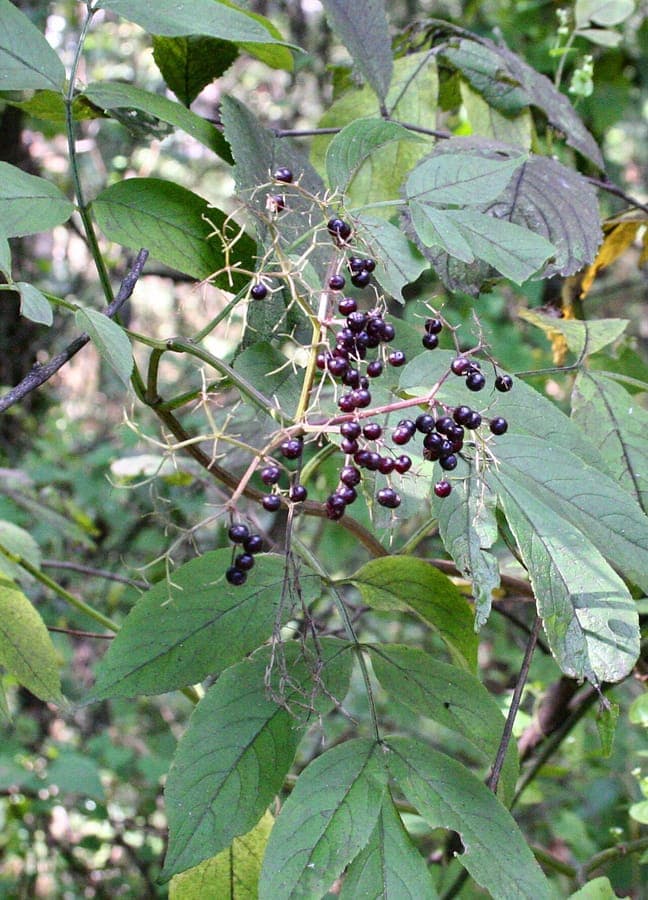
Wikimedia Commons / CC BY 2.5, via Wikimedia Commons
Canadian elder: complete guide
Sambucus canadensis
Want to see Canadian elder: complete guide in your garden?
1 minute, no credit card
Overview
Sambucus canadensis, commonly known as Canadian elder, is a tough and rewarding shrub that brings life to gardens across North America and beyond. Native to regions stretching from Alabama to Arizona and as far south as Bolivia, this hardy plant thrives in moist, open woodlands and along stream banks. Unlike its European cousin Sambucus nigra, Canadian elder has a more open, airy habit and produces slightly larger flower clusters. It grows 8 to 12 feet tall and wide, forming a multi-stemmed shrub or small tree that fits well in naturalistic landscapes.
Hardy in USDA zones 4 through 8, Canadian elder handles cold winters down to -34°C without protection. It's a fast grower, gaining 2 to 3 feet per year under good conditions. This species spreads gently by root suckers, which can be managed or encouraged depending on your garden goals. It's not invasive like some elder species, making it a responsible choice for modern gardens.
On gardenworld.app, you can design a planting scheme that accounts for its suckering habit and places it where it can spread without crowding other plants.
Appearance & bloom cycle
Canadian elder features pinnately compound leaves with 5 to 9 lance-shaped leaflets that turn yellow in fall. In early summer-typically late June to early July-it produces large, flat-topped clusters of creamy white flowers up to 8 inches across. These blooms have a light, sweet fragrance that draws in pollinators like bees, butterflies, and hoverflies.
By late summer, the flowers develop into drooping clusters of dark blue-black berries. These berries are rich in antioxidants but must be cooked before consumption-never eat them raw. Cooking neutralizes the cyanogenic glycosides present in raw berries. Once processed, they're excellent for syrups, jams, and immune-boosting tonics.
The plant's winter silhouette is attractive too, with gray stems and subtle bark texture adding structure to the dormant garden.
Ideal location
Plant Canadian elder in full sun to partial shade. It blooms most prolifically in full sun (6+ hours daily), but tolerates light shade, especially in hotter climates. It performs best in areas with consistent moisture-ideal spots include rain gardens, low-lying areas, or near ponds and streams. Avoid dry, sandy soils or exposed, windy sites.
This shrub works well as a background plant, in shrub borders, or as part of a wildlife hedge. In urban gardens, it can soften fences or act as a natural screen. Make sure it has room to spread-about 6 to 8 feet from other plants.
On gardenworld.app, you can preview how this shrub will fill out over time and whether your garden layout supports its growth pattern.
Free design
Want to see Canadian elder: complete guide in your garden? Make a free design now.
Soil requirements
Canadian elder is adaptable to a wide pH range-5.0 to 8.9-but prefers moist, loamy, or clay-loam soils rich in organic matter. It tolerates occasional flooding but doesn't like stagnant water. If your soil is sandy, amend it with compost or well-rotted manure to improve moisture retention. No special fertiliser is needed; a spring top-dressing of compost is usually sufficient.
Watering
Keep the soil consistently moist, especially during the first two growing seasons. Once established, it shows moderate drought tolerance, but growth and flowering suffer in prolonged dry spells. Water deeply once a week during droughts. Rainwater is preferred-this plant can show sensitivity to high-chlorine tap water over time.
Pruning
Prune in late winter or early spring before new growth starts. Remove dead, damaged, or crossing stems. For better air circulation and larger flower clusters, cut out one-third of the oldest stems at ground level. This rejuvenation pruning encourages vigorous new shoots. If you want a tighter shape, tip-prune in early spring.
Avoid heavy pruning during flowering or fruiting-this reduces yield and stresses the plant.
Maintenance calendar
- January: Inspect for winter damage
- February: Begin light pruning if weather permits
- March: Apply compost; monitor for pests
- April: Watch for aphids; keep soil moist
- May: Growth accelerates; no fertiliser needed
- June: Bloom time; pollinators active
- July: Berries begin forming; water during dry spells
- August: Berries ripen; harvest when fully dark
- September: Finish harvest; leave some for birds
- October: Leaves drop; leave debris for habitat
- November: Check for disease; minimal care
- December: Dormant period; avoid pruning
Winter hardiness
Canadian elder is fully hardy in zones 4–8. In zone 4, young plants may suffer tip dieback in harsh winters, but they rebound quickly in spring. Mature plants require no winter protection. Mulching is optional but can help retain moisture and suppress weeds in colder regions.
Companion plants
Pair with moisture-loving perennials like Joe-Pye weed (Eutrochium maculatum), cardinal flower (Lobelia cardinalis), or native grasses such as Panicum virgatum. It also grows well near serviceberry (Amelanchier) or chokeberry (Aronia). Avoid drought-tolerant plants like lavender or Russian sage, which have opposing water needs.
In edible landscapes, plant near rhubarb or hardy kiwi, ensuring shared irrigation.
Closing
Canadian elder is a low-maintenance, high-reward shrub that supports wildlife, offers edible harvests, and adapts to tough garden spots. It's increasingly available at garden centres in late spring. With its bold blooms and ecological benefits, it's a standout choice for modern gardeners. Remember: always cook the berries. With proper siting and occasional pruning, this elder will thrive for decades. Use gardenworld.app to visualize how it fits into your long-term garden design and track its seasonal changes year after year.
Want to see Canadian elder: complete guide in your garden? Make a free design now.
Upload a photo, pick a style, and get a photorealistic design with plant list in under a minute.
No credit card required


Similar plants
Squashberry: complete guide
Viburnum edule
Grow mooseberry (Viburnum edule): ultra-hardy North American shrub with fragrant white flowers and red autumn berries. Perfect for boreal gardens. Zone 3.
Witherod: complete guide to this elegant North American shrub
Viburnum cassinoides
Discover Viburnum cassinoides: an elegant North American shrub with white flowers, yellow fall foliage, and blue berries. Perfect for temperate garden zones.
Buddlejaleaf viburnum: complete guide
Viburnum buddleifolium
Elegant evergreen shrub with delicate foliage and white spring flowers. Perfect for sheltered borders in temperate gardens.