
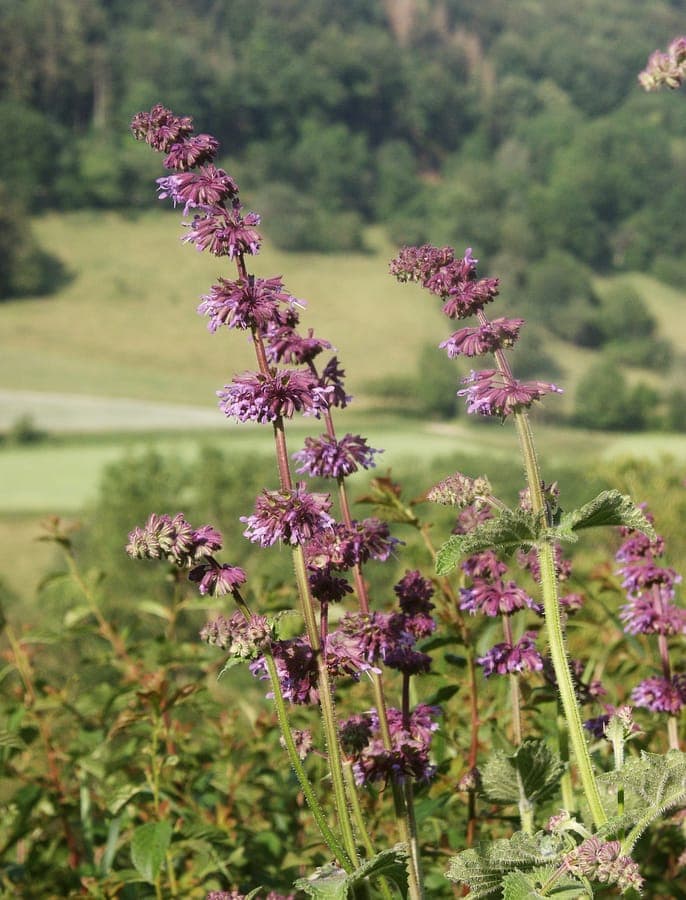
Bernd Haynold / CC BY 2.5, via Wikimedia Commons
Lilac sage: complete guide
Salvia verticillata
Want to see Lilac sage: complete guide in your garden?
1 minute, no credit card
Overview
Lilac sage (Salvia verticillata) isn't the flashy type, but it's the kind of plant that earns your respect over time. Native to parts of Eastern and Central Europe, this upright herbaceous perennial handles heat, drought, and poor soil like a pro. It's not fussy, doesn't flop, and blooms reliably from late spring into late summer. Whether you're designing a cottage border or a low-maintenance front yard, Lilac sage holds its own. On gardenworld.app, you can map out a planting scheme that maximizes its long bloom season and pollinator appeal.
Appearance & bloom cycle
Standing 60–80 cm tall with a spread of about 40 cm, Lilac sage grows in neat clumps with square, slightly hairy stems and lance-shaped green leaves that release a subtle herbal scent when brushed. The real show starts in May, when whorls of soft blue flowers begin forming in tight, tiered rings along the upper stems. These blooms continue through June, July, and into August. If you deadhead or cut back by half after the first flush, you'll often get a second, slightly shorter bloom in late summer. The color is a true, clear blue - rare among salvias, which usually trend purple or magenta.
Ideal location
Plant Lilac sage where the sun hits hardest. It needs a 9 out of 10 on the light scale, which means at least 6–8 hours of direct sun daily. It thrives in hot, exposed borders, rock gardens, or against south-facing walls that radiate warmth. Avoid shady or damp corners - it'll stretch, lean, and bloom poorly. In cooler climates, full sun is non-negotiable for flowering. Containers work well too, as long as they're placed on sunny patios or balconies. Use gardenworld.app to simulate sun exposure in your yard and see if your spot is suitable.
Soil requirements
This plant prefers lean, well-drained soil - think sandy or gravelly, even rocky. It tolerates poor fertility and doesn't need rich compost. The ideal pH is neutral to slightly alkaline (7.0–7.5). Heavy clay or water-retentive soil is its enemy, especially in winter. If your soil is dense, amend it with grit or coarse sand to improve drainage. A top dressing of gravel around the base helps keep moisture away from the crown and prevents rot.
Free design
Want to see Lilac sage: complete guide in your garden? Make a free design now.
Watering
Once established, Lilac sage is drought-tolerant and rarely needs watering. During its first growing season, give it a deep soak once a week if there's no rain. After that, it survives on rainfall alone in most UK and US zones. Overwatering leads to root rot and weak, leggy growth. Only water when the top 5–7 cm of soil feels dry. In pots, check more often - containers dry out faster, especially in full sun.
Pruning
Cutting back after the first bloom is the secret to reblooming. In early July, trim the flowered stems by half, cutting just above a leaf node. This encourages bushier growth and new flower spikes. In late winter or early spring (February to March), cut all old stems back to 10–15 cm above ground level before new shoots emerge. Use clean, sharp pruners to avoid disease.
Maintenance calendar
- Jan: Dormant; no action needed
- Feb: Start clearing old stems if weather permits
- Mar: Cut back to 10–15 cm; prepare for growth
- Apr: Watch for new shoots; plant new specimens
- May: First blooms appear; keep soil dry
- Jun: Peak flowering; monitor container plants
- Jul: Cut back after bloom; encourage second flush
- Aug: Second bloom possible; enjoy pollinators
- Sep: No feeding; reduce watering
- Oct: Let seed heads stand for birds or collect seed
- Nov: Leave standing for winter structure
- Dec: Fully dormant; protect only in wet soils
Winter hardiness
Lilac sage is hardy to USDA zones 5–9 (-20°C to -15°C). In most temperate regions, it overwinters without protection. The key is dry feet - wet winter soil causes crown rot. In areas with heavy rainfall or clay, a light mulch of gravel or straw can help, but avoid organic mulches that retain moisture. The dried stems provide insulation, so don't cut back too early.
Companion plants
Pair Lilac sage with other sun-loving, drought-tolerant perennials. Good matches include Lavandula angustifolia, Echinacea purpurea, Nepeta racemosa, and Sedum spectabile. The blue flowers contrast beautifully with yellow Rudbeckia or white Shasta daisies. In a herb garden, it grows well alongside thyme, oregano, and rosemary. Avoid moisture-hungry plants like Astilbe or ferns - their needs clash.
Closing
Lilac sage earns its place in the garden through reliability, not razzle-dazzle. It's tough, long-blooming, and a favorite of bees and hoverflies. Once planted, it asks for little and gives back season after season. Buy young plants in spring from garden centres like local independents or larger chains. For inspiration, check gardenworld.app to see how to group it with textures and colors that enhance its quiet charm.
Want to see Lilac sage: complete guide in your garden? Make a free design now.
Upload a photo, pick a style, and get a photorealistic design with plant list in under a minute.
No credit card required


Similar plants
Apple mint (Mentha x villosa): complete guide
Mentha x villosa
Meet apple mint (Mentha x villosa): a fruity-scented kitchen herb with woolly leaves, perfect for tea and mojitos.
Salvia peyronii: complete guide
Salvia peyronii
Discover Salvia peyronii, a rare Lebanese mountain sage. Growing tips, hardiness, and companion planting for a Mediterranean gravel garden.
Bigleaf mint (Mentha x rotundifolia): complete guide
Mentha x rotundifolia
Discover bigleaf mint: cultivation, care tips, and garden uses. Learn how to grow this aromatic herb with soft, hairy leaves.