
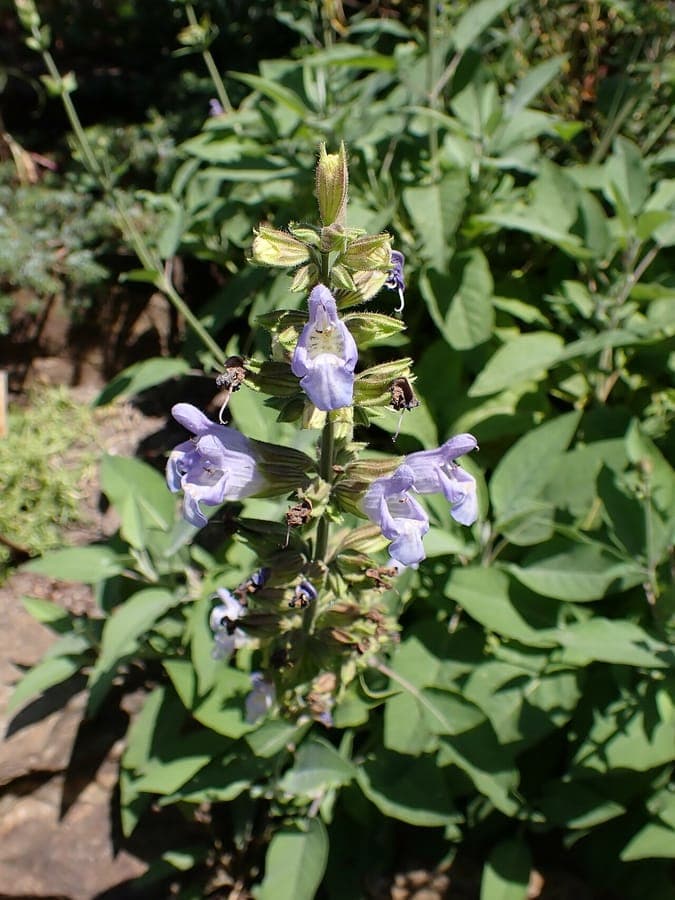
Krzysztof Ziarnek, Kenraiz / CC BY-SA 4.0, via Wikimedia Commons
Salvia tomentosa: complete guide
Salvia tomentosa
Want to see Salvia tomentosa: complete guide in your garden?
1 minute, no credit card
Overview
Salvia tomentosa is an elegant herbaceous sage native to Southeast Europe extending to the Caucasus. This plant is particularly noted for its distinctive velvety foliage and beautiful violet flowers. In modern garden design, this sage plays an important role in Mediterranean styles due to both its aesthetic value and practical drought and maintenance minimization. It is a plant for connoisseurs of texture and subtle color accents.
Appearance and bloom
Salvia tomentosa forms an upright, graceful shrub with notably velvety gray-green foliage. The leaves are broadly lanceolate and covered with fine hairs that give the plant a soft, silky texture. The flowers are beautiful purple to lavender and appear in dense spikes from mid-summer onward. This contrast between soft foliage and beautiful flowers makes the plant visually very attractive throughout its growing season.
Ideal location
Select a very sunny site with at least 6-8 hours of direct sunlight daily. Salvia tomentosa thrives in full sun and develops its best foliage and flower texture there. Avoid shade which leads to poor growth. The plant tolerates wind well and truly grows well in exposed, windy locations. This sage feels at home on southern slopes where heat and sunlight are intense during the day.
Soil
This sage prefers very well-draining soil with minimal moisture retention. Heavy clay soils are unsuitable and must be significantly amended with sand and gravel. A pH of 7.0-8.5 is preferred, somewhat alkaline. Organic matter is not necessary and can even be detrimental by causing waterlogging. The plant thrives on poor, stony soils where many other plants struggle.
Watering
Once well-established, Salvia tomentosa is very drought-tolerant and requires minimal water. During the growing season, only water in extreme drought when the plant visibly wilts. The plant prefers dry feet. During autumn and winter, provide virtually no water. Excessive water is the most likely cause of root rot and death in this Mediterranean species.
Free design
Want to see Salvia tomentosa: complete guide in your garden? Make a free design now.
Pruning
Pruning helps keep the plant dense and bushy. In spring, carefully trim back after frost. Promptly remove spent flowers to encourage new blooming. Summer pruning can help keep the plant more compact and flower-rich. Avoid heavy pruning as this weakens the plant. In autumn, only light prune in preparation for winter.
Maintenance calendar
Spring: careful pruning to shape, do not fertilize. Summer: enjoy blooming, optionally remove spent flowers. Autumn: gradually reduce watering, no fertilizing. Winter: keep dry, maintenance pruning only when necessary.
Winter hardiness
Salvia tomentosa is hardy to about -12 degrees Celsius in very well-draining conditions. In wet winters, frost can be more damaging as ice can penetrate plant tissues. This sage is suitable for all southern and central European gardens, but in northern regions requires protected, very well-draining sites. In container cultivation, overwintering in protected space is recommended above approximately 55 degrees north latitude.
Companion plants
Salvia tomentosa combines beautifully with other Southern European drought plants: lavender, cistus, santolina, and rosemary. Plant well with drought-tolerant grass-like accent plants and colorful sedums. Add contrast with silvery foliage plants such as artemisia. In the footzone, plant thyme, oregano, and stonecrop for texture.
Closing
Salvia tomentosa is a highly satisfying plant for those seeking texture, refinement, and drought-tolerance in the same package. With its beautiful velvety foliage and elegant flowers, plus minimal maintenance needs, this sage deserves a place in every Mediterranean front garden. Available at major garden centers. Consult gardenworld.app or gardenworld.app for more inspiration.
Want to see Salvia tomentosa: complete guide in your garden? Make a free design now.
Upload a photo, pick a style, and get a photorealistic design with plant list in under a minute.
No credit card required


Similar plants
Apple mint (Mentha x villosa): complete guide
Mentha x villosa
Meet apple mint (Mentha x villosa): a fruity-scented kitchen herb with woolly leaves, perfect for tea and mojitos.
Salvia peyronii: complete guide
Salvia peyronii
Discover Salvia peyronii, a rare Lebanese mountain sage. Growing tips, hardiness, and companion planting for a Mediterranean gravel garden.
Bigleaf mint (Mentha x rotundifolia): complete guide
Mentha x rotundifolia
Discover bigleaf mint: cultivation, care tips, and garden uses. Learn how to grow this aromatic herb with soft, hairy leaves.