
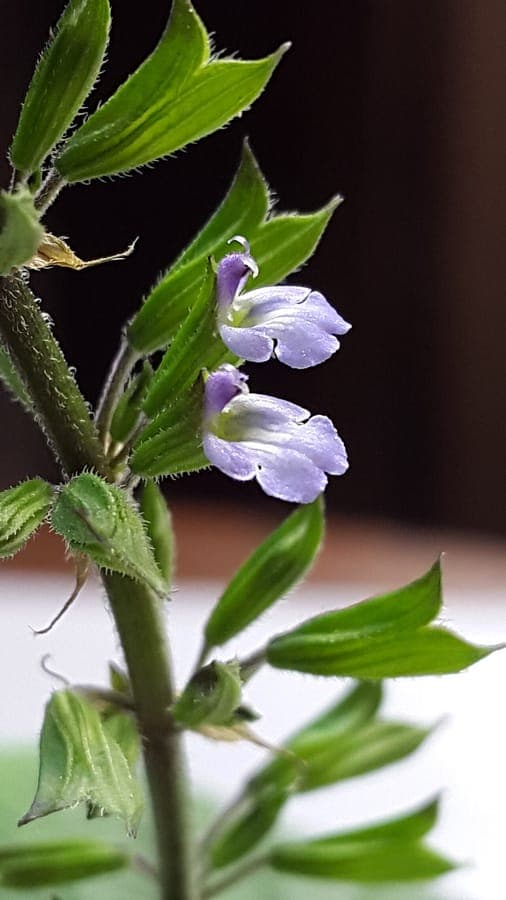
Paul venter / CC BY-SA 4.0, via Wikimedia Commons
Lindenleaf sage: complete guide
Salvia tiliifolia
Want to see Lindenleaf sage: complete guide in your garden?
1 minute, no credit card
Overview
Lindenleaf sage (Salvia tiliifolia) is a fascinating sage species originating from Central America to Peru. This plant is especially prized for its unique, heart-shaped leaves that closely resemble linden leaves. With red to purple-red flowers, it is a real showstopper in warm gardens.
Appearance and Bloom
Lindenleaf sage distinguishes itself through its striking, large heart-shaped leaves with soft texture and distinct leaf-vein patterns. The leaves are deep green and have a pleasant herbal aroma when touched. The flowers are vibrant red to red-purple and appear in long flower spikes.
The plant grows to a height of 60-100 cm and forms an elegant, upright form. The flowering period is long, typically running from summer through autumn, providing continuous color.
Ideal Location
Lindenleaf sage requires a sunny to partially shaded location with at least 5-6 hours of direct sunlight daily. In very warm climates, light afternoon shade may be preferable. The plant appreciates shelter from cold winds and strong wind gusts.
Planting distances should be generous, with at least 45-60 cm between plants to ensure good ventilation and air circulation. Provide ample space around each plant.
Soil
Lindenleaf sage grows optimally in nutrient-rich, well-draining soil. The plant accepts both acid and neutral soils provided they drain well. Add organic matter such as compost or peat to improve structure and nutrition.
For container cultivation, use a special herbal potting mix or seed-raising blend. The plant is sensitive to waterlogging and therefore requires excellent drainage.
Watering
Lindenleaf sage requires regular moisture during the growing season. Ensure the soil remains evenly moist but avoid oversaturation that causes root rot. In winter, watering can be substantially reduced.
For container cultivation, water sparingly and let the top layer dry somewhat between waterings. In very hot periods, daily watering may be needed. Water early morning or late evening to prevent leaf diseases.
Free design
Want to see Lindenleaf sage: complete guide in your garden? Make a free design now.
Pruning
Lindenleaf sage responds well to regular pruning. Pinch back growing tips to encourage bushier, more compact growth. This also promotes richer flower production. Remove spent flowers regularly (deadheading) for continuous blooms.
In early spring, you can prune more severely for rejuvenation. This helps older plants regain vigor and maintain compact habit.
Maintenance Calendar
In spring, once frost danger has passed, begin feeding. May and June are ideal for pruning and shaping. July through October is the normal intensive flowering period, so increase feeding.
In autumn, gradually reduce watering needs. Complete seed harvest can occur before moving the plant indoors. In winter, keep cool with minimal feeding and water.
Winter Hardiness
Lindenleaf sage is not winter hardy and can only overwinter outdoors in warm areas (zones 9-11). In temperate climates, the plant must be brought indoors before winter. Keep the plant in a cool, bright location with temperatures above 5 degrees Celsius.
Cuttings can be taken for plant propagation.
Companion Plants
Lindenleaf sage combines beautifully with other warm-loving plants in mixed borders. The red flowers contrast nicely with silver foliage or purple-leaved plants. The plant attracts hummingbirds and butterflies.
The plant may suffer frost damage at temperatures below -5 degrees Celsius. Provide shelter or move indoors when frost threatens.
Closing
Lindenleaf sage is a beautiful, special plant for those who love unique, warm-loving herbs. With regular care, this plant will continue blooming for many years and bring much beauty.
Visitors to gardenworld.app can use this rare sage in their designs for Mediterranean garden themes or tropical planting schemes. In cooler climates, a sunny window as a houseplant works best.
Source this plant from specialized herb nurseries or plant centers. Enjoy the heart-shaped leaves and rich red flowers that this species provides!
Want to see Lindenleaf sage: complete guide in your garden? Make a free design now.
Upload a photo, pick a style, and get a photorealistic design with plant list in under a minute.
No credit card required


Similar plants
Apple mint (Mentha x villosa): complete guide
Mentha x villosa
Meet apple mint (Mentha x villosa): a fruity-scented kitchen herb with woolly leaves, perfect for tea and mojitos.
Salvia peyronii: complete guide
Salvia peyronii
Discover Salvia peyronii, a rare Lebanese mountain sage. Growing tips, hardiness, and companion planting for a Mediterranean gravel garden.
Bigleaf mint (Mentha x rotundifolia): complete guide
Mentha x rotundifolia
Discover bigleaf mint: cultivation, care tips, and garden uses. Learn how to grow this aromatic herb with soft, hairy leaves.