
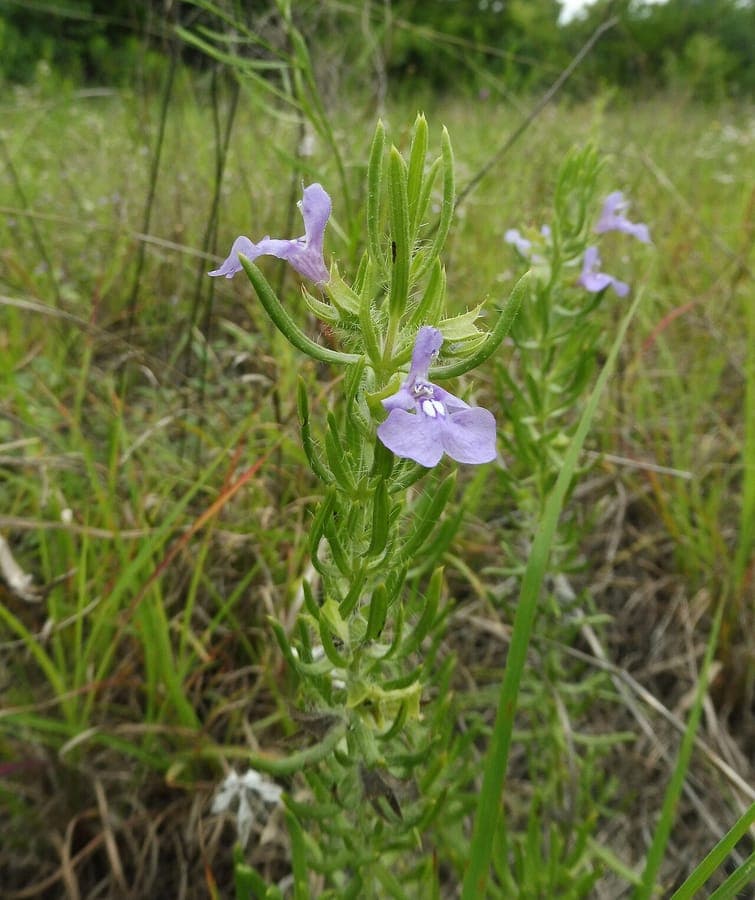
Mason Brock (Masebrock) / Public domain, via Wikimedia Commons
Texas sage: complete guide
Salvia texana
Want to see Texas sage: complete guide in your garden?
1 minute, no credit card
Overview
Salvia texana, commonly called Texas sage, is a herbaceous native plant from the southwestern United States. This species from the Lamiaceae family occurs naturally in Texas, New Mexico and northeastern Mexico. It represents an important component of native flora in arid regions of south-central America and remains valued for warm-climate gardens.
First described scientifically in 1858, Texas sage is classified as an accepted herbaceous species. Its natural range extends across semi-arid habitats of the south-central region.
Appearance & bloom
Texas sage forms a loosely branched herbaceous plant reaching 60 centimeters or more in height. The stems are green to reddish with elongated leaves clustered densely near the plant base. This texturing creates visual character in the landscape.
Flowers appear in late summer through autumn, typically August to October. They are white to pale pink in color, arranged in loose spikes atop the stems. Despite their modest appearance, they attract numerous insects. The extended blooming period makes this valuable for late-season interest.
The plant is herbaceous and typically dies back after flowering in temperate climates.
Ideal location
Texas sage thrives in full to partial sun, requiring three to six hours of direct sunlight daily. The plant tolerates light shade but performs most vigorously in sunny locations.
Select a site with excellent drainage and protection from cold winter winds. The plant grows actively during warm months. Group multiple specimens together for mass effect and visual impact.
This plant excels in warm-climate gardens, late-season borders and Mediterranean-style landscapes.
Soil
Texas sage performs best in well-draining, fertile soil with a pH between 6.0 and 7.5. Unlike many desert plants, it tolerates somewhat more organic material in the soil.
Amending with compost at planting time promotes vigorous growth. The plant still performs adequately in lean soil, though growth will be slower. Good drainage remains essential to prevent root disease from waterlogged conditions.
Avoid heavy clay soils without amendment.
Free design
Want to see Texas sage: complete guide in your garden? Make a free design now.
Watering
Once established, Texas sage remains reasonably drought-tolerant. Water regularly during the first growing season to encourage root development, approximately twice weekly.
After establishment, reduce watering. The plant responds well to natural rainfall. During extreme drought, supplemental water may improve flowering and vigor.
Monitor soil moisture during the growing season. Water when the top 3-5 centimeters become dry. Avoid waterlogging.
Pruning
Texas sage requires minimal pruning, as it naturally assumes a full form. Remove dead stems and spent flowers for neatness. Deadheading may extend the blooming period.
After hard frost, the plant typically dies back. This is normal. In spring, cut back to living tissue when new growth appears.
In warm climates where the plant survives winter, light pruning for shape suffices.
Maintenance calendar
Spring: Site preparation, transplanting in early spring. May-June: Regular watering, apply mulch, weeding. July-August: Intensive watering, continued weeding. September-October: Observe flowering, reduce water. Winter: No maintenance needed in most climates.
Winter hardiness
Texas sage is hardy to USDA zone 8, tolerating temperatures around -12 degrees Celsius. This limits it to warmer regions or sheltered microclimates in temperate zones.
In cold climates, treat as annual or tender perennial. The plant will die in hard winters but may regenerate from seed the following year.
Young plant protection is beneficial in borderline-hardy zones.
Companion plants
Combine Texas sage with other warm-climate plants:
- Echinacea purpurea (purple coneflower): Similar drought tolerance
- Helenium autumnale (sneezeweed): Synchronized autumn bloom
- Desmodium spp (tick-clover): Deep roots, compatible bloom
- Monarda didyma (bee balm): Pollinator attraction, form contrast
- Achillea spp (yarrow): Fine textural elements
Plant in groups of three or more for maximum visual impact.
Closing
Salvia texana offers authentic representation of southwestern flora in warm-climate gardens. Its vigorous autumn bloom and relatively low maintenance make it valuable for gardens seeking late-season color.
While not reliably hardy in most temperate regions, it may be treated as annual in cooler climates or maintained as tender perennial in warm protected locations. Container cultivation allows gardeners in cold zones to enjoy this species indoors during winter. Explore more warm-climate plants and landscape design tips at gardenworld.app.
Want to see Texas sage: complete guide in your garden? Make a free design now.
Upload a photo, pick a style, and get a photorealistic design with plant list in under a minute.
No credit card required


Similar plants
Apple mint (Mentha x villosa): complete guide
Mentha x villosa
Meet apple mint (Mentha x villosa): a fruity-scented kitchen herb with woolly leaves, perfect for tea and mojitos.
Salvia peyronii: complete guide
Salvia peyronii
Discover Salvia peyronii, a rare Lebanese mountain sage. Growing tips, hardiness, and companion planting for a Mediterranean gravel garden.
Bigleaf mint (Mentha x rotundifolia): complete guide
Mentha x rotundifolia
Discover bigleaf mint: cultivation, care tips, and garden uses. Learn how to grow this aromatic herb with soft, hairy leaves.