
Wikimedia Commons / CC BY-SA 3.0, via Wikimedia Commons
Clary: complete guide
Salvia sclarea
Want to see Clary: complete guide in your garden?
1 minute, no credit card
Overview
Clary, or Salvia sclarea, is a striking biennial or short-lived perennial herb that brings height, texture, and fragrance to the garden. Native to southern Europe and the Mediterranean, it thrives in sunny, well-drained spots and fits perfectly in cottage gardens, herb plots, or naturalistic planting schemes. In the UK and US, gardeners appreciate Clary for its architectural form and ability to attract beneficial insects. It typically reaches 60–120 cm in height and forms a rosette of broad, fuzzy leaves in its first year, followed by tall flower spikes in the second.
On gardenworld.app, you can design a garden layout that highlights Clary's vertical structure, pairing it with plants like lavender or Echinacea for a bold, pollinator-rich border.
Appearance & bloom cycle
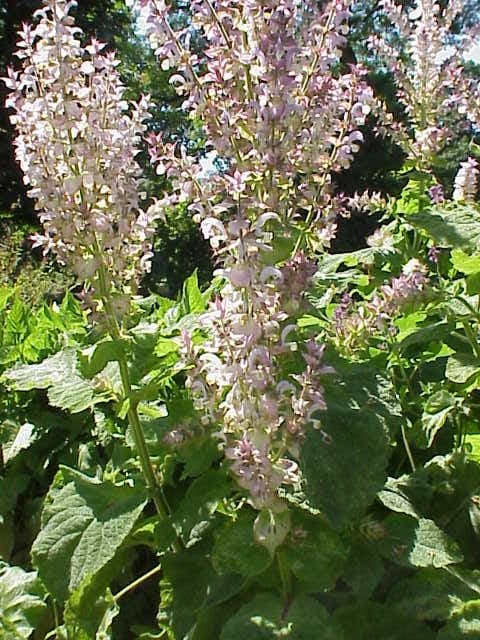
Clary has an upright, bushy habit with stout, square stems typical of the Lamiaceae family. The leaves are large, wrinkled, and covered in fine hairs, giving them a soft, grey-green appearance. When touched or brushed, they release a sweet, musky aroma - the reason behind its common name. The flowering period runs from June to September, peaking in midsummer. Though technically white-flowered, cultivated forms often display pale pink, lilac, or creamy bracts, especially in the bud stage. The calyces are particularly showy, glossy, and persistent, adding ornamental value long after the petals drop.
These blooms are a magnet for bees, butterflies, and hoverflies, making Clary a valuable addition to any wildlife garden. After flowering, seed heads form and can self-sow readily in suitable conditions, ensuring new plants the following year.
Ideal location
Clary needs full sun - aim for at least 8 hours of direct light daily (light level 8/10). A south- or southwest-facing spot is ideal, whether in a border, rock garden, or gravel bed. It performs best in warm, sheltered locations where air circulates freely. Avoid shady or damp areas, as these encourage fungal diseases and weak growth. In cooler climates like the UK (USDA zone 8), a sunny wall or raised bed can provide the extra warmth it appreciates.
Soil requirements
This Salvia prefers light, alkaline soils with excellent drainage. Sandy or loamy soils with a pH of 7.5–8 are perfect. It tolerates poor, rocky, or chalky ground but struggles in heavy clay or acidic conditions. If your soil is too acidic, amend it with lime or grow Clary in raised beds or containers using a mix of compost, grit, and horticultural sand. Avoid rich, nitrogen-heavy soils - they promote leafy growth at the expense of flowers.
Free design
Want to see Clary: complete guide in your garden? Make a free design now.
Watering
Once established, Clary is highly drought-tolerant. Water young plants regularly during their first few weeks, especially in dry spells. After that, deep but infrequent watering (every 10–14 days) is sufficient. Always let the top few centimetres of soil dry out between waterings. Overwatering is a common mistake and can lead to root rot. In a typical summer, rainfall is often enough.
Pruning
Pruning isn't essential but helps maintain shape and prolong blooming. Deadhead spent flower spikes to encourage a second flush. For seed collection, leave a few stems intact. In late autumn, cut back all flowering stems to 10–15 cm above ground. As a biennial, the parent plant usually dies after seeding, but self-sown seedlings often appear in spring.
Maintenance calendar
- Jan: Check for overwintering rosettes; remove debris
- Feb: Start seeds indoors at 15–18°C under lights
- Mar: Sow seeds directly or transplant seedlings after frost risk
- Apr: Protect young plants from late frosts
- May: Weed regularly; watch for slugs
- Jun: Blooms begin; reduce watering gradually
- Jul: Peak flowering; deadhead for repeat bloom
- Aug: Attracts pollinators; monitor for aphids
- Sep: Harvest seeds; allow some self-seeding
- Oct: Cut back spent stems; tidy beds
- Nov: Leave seed heads for winter interest
- Dec: Minimal care; plan next year's sowing
Use gardenworld.app to generate a custom care calendar for Clary that syncs with your local climate and garden size.
Winter hardiness
Clary is hardy in USDA zones 6–9. In zone 8 and above, young rosettes often survive mild winters with minimal protection. In colder areas, mulch lightly with dry straw or leaves. However, as a biennial, most plants complete their life cycle in two years. In colder zones, treat it as a short-lived perennial or reseed annually. It's widely available at garden centres in spring, including major retailers in the UK and US.
Companion plants
Clary pairs beautifully with other sun-loving, drought-tolerant plants. Excellent companions include lavender, Russian sage (Perovskia), yarrow (Achillea), and sedum. These combinations create low-maintenance, wildlife-friendly borders with long seasonal interest. Avoid moisture-loving plants like astilbe or ferns, which require different conditions.
Closing
Clary is an underrated gem for gardeners seeking structure, scent, and ecological value. Its tall, graceful form and fragrant foliage make it stand out in any planting scheme. With minimal care - full sun, lean soil, and little water - it rewards you with months of blooms and buzzing pollinators. Let it self-seed, and you'll enjoy its presence year after year. Whether in a herb garden or a wildflower meadow, Clary earns its place with quiet elegance.
Want to see Clary: complete guide in your garden? Make a free design now.
Upload a photo, pick a style, and get a photorealistic design with plant list in under a minute.
No credit card required


Similar plants
Apple mint (Mentha x villosa): complete guide
Mentha x villosa
Meet apple mint (Mentha x villosa): a fruity-scented kitchen herb with woolly leaves, perfect for tea and mojitos.
Salvia peyronii: complete guide
Salvia peyronii
Discover Salvia peyronii, a rare Lebanese mountain sage. Growing tips, hardiness, and companion planting for a Mediterranean gravel garden.
Bigleaf mint (Mentha x rotundifolia): complete guide
Mentha x rotundifolia
Discover bigleaf mint: cultivation, care tips, and garden uses. Learn how to grow this aromatic herb with soft, hairy leaves.