
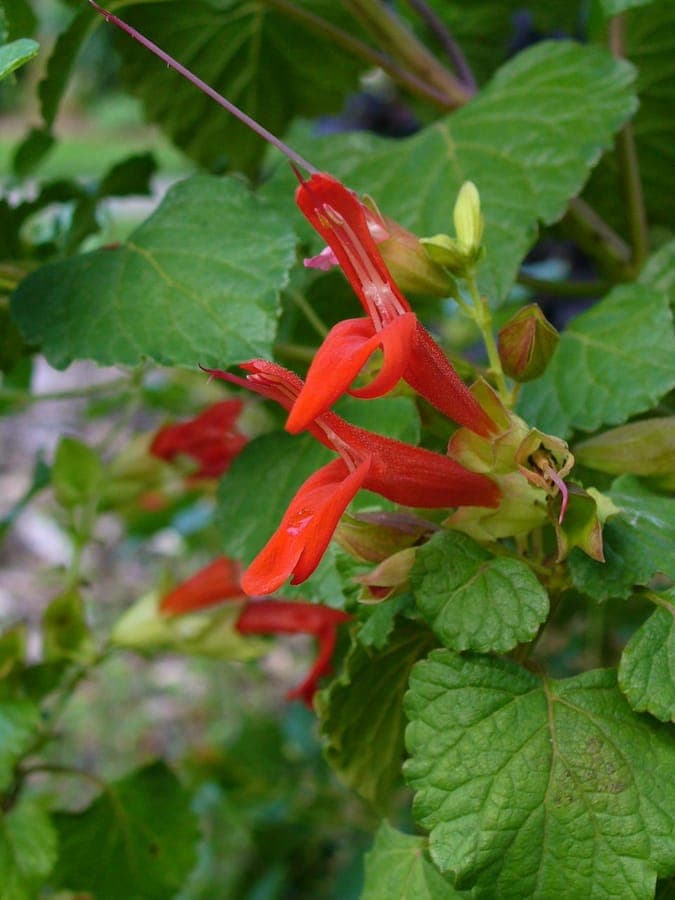
Scott Zona / CC BY 2.0, via Wikimedia Commons
Mountain Sage: complete guide
Salvia regla
Want to see Mountain Sage: complete guide in your garden?
1 minute, no credit card
Overview
Mountain Sage (Salvia regla) is a spectacular, medium-sized shrub from the mountains of Mexico and Texas. This plant is renowned for its intensely red flowers that stand out vividly against green foliage. The plant grows naturally on steep mountain slopes where water is scarce and drainage is excellent.
For gardeners wanting something colorful and characterful without much effort, Mountain Sage is a top choice. The red flowers attract hummingbirds and butterflies, creating a live spectacle in the garden.
Appearance and Bloom
Mountain Sage grows to about 1.5 meters high and wide, making it a generous shrub. The stems are strong, initially green, later turning purple-brown. The leaves are medium-sized, dark green, roughly textured and highly aromatic.
The flowers are the hallmark of this plant: intensely red, tubular flowers about 2.5 centimeters long. They appear in dense, upright spikes from June to October, with July-August being the peak. The red color remains intense throughout the blooming period.
The leaf aroma is warm and spicy, very attractive. Butterflies and hummingbirds love the nectar, so the plant will have regular visitors.
Ideal Location
Full sun is essential for optimal blooming. With at least 8 hours direct sunlight daily, the plant flowers abundantly. In partial shade, it blooms poorly.
The plant tolerates strong wind, which is useful as its mountain origin has adapted it to this. Place it in a prominent location where the red flowers are optimally visible.
Soil
Mountain Sage grows best in dry, lean soil. In its natural habitat, it grows on rocky mountain slopes with minimal nutrition. Ideal soil base:
- Well-draining, sandy or rocky soil
- Low nutrient content
- pH 6.5 to 8.0 (chalky is fine too)
- Absolutely no waterlogging
Rich garden soil leads to more leaf growth, less blooming. Keep soil consciously poor.
Watering
Once well-established (after 1-2 seasons), Mountain Sage is extremely drought-tolerant. Deep roots tap water from deep soil layers. In normal European summers, rainfall is almost completely sufficient.
In the first season after planting, water regularly. After that, only in extreme drought in July-August.
Ensure water soaks deeply and does not pool. The plant hates boggy feet.
Free design
Want to see Mountain Sage: complete guide in your garden? Make a free design now.
Pruning
Mountain Sage requires light formative pruning. After the first bloom passes (August-September), aging stems can be shortened somewhat to stimulate branching.
In very cold winters, growing tips may die back, but the root system survives in most cases. Dead stems can be removed in spring.
Wilted flowers can be continuously removed, although this is not necessary for more blooms.
Maintenance Calendar
March: Planting time for young specimens; no pruning needed. April-May: Growth; minimal watering; establish watering schedule. June: Blooming begins; water during drought; enjoy it. July-August: Peak bloom; thirsty plant = weekly water; watch for hummingbirds. September: Continued blooming; reduce water slightly; first pruning possible. October: Blooming stops; no water needed (only in extreme drought). November-February: Frost-sensitive in very cold areas; winter protection; no water.
Winter Hardiness
Mountain Sage is frost-sensitive and can overwinter outdoors to about minus 8 degrees Celsius. In mild climate (south Netherlands, Belgium, southern France), it can stay outside with protection. In cold climates (northern Germany, very cold winters), winter storage is recommended.
Winter protection:
- Dry mulch around base of 10 centimeters
- No pruning until spring: dead stems insulate roots
- In very cold zones: pot in unheated greenhouse or cellar
Alternative: Many gardeners take cuttings for winter and propagate young specimens.
Companion Plants
Mountain Sage combines well with other dry, sun-loving plants.
Co-plants:
- Other red-flowering sages (Salvia greggii, Salvia spathacea)
- Lavender (Lavandula species)
- Rosemary (Rosmarinus officinalis)
Under-plantings (lower, less sun):
- Bergamot (Monarda didyma) for secondary bloom
- Scarlet Geum (Geum coccineum)
- Red Valerian (Centranthus ruber)
Grass transitions:
- Hare's-tail grass (Lagurus ovatus)
- Blue Fescue (Festuca glauca)
Closing
Mountain Sage is a spectacular flowering shrub for those wanting to stand out with intense colors. A plant for the ambitious gardener not afraid of contrast. The red flowers and hummingbirds make this a must-have for warm locations. Available from specialized nurseries.
For garden design with exotic, flowering accents, visit gardenworld.app.
Want to see Mountain Sage: complete guide in your garden? Make a free design now.
Upload a photo, pick a style, and get a photorealistic design with plant list in under a minute.
No credit card required


Similar plants
Apple mint (Mentha x villosa): complete guide
Mentha x villosa
Meet apple mint (Mentha x villosa): a fruity-scented kitchen herb with woolly leaves, perfect for tea and mojitos.
Salvia peyronii: complete guide
Salvia peyronii
Discover Salvia peyronii, a rare Lebanese mountain sage. Growing tips, hardiness, and companion planting for a Mediterranean gravel garden.
Bigleaf mint (Mentha x rotundifolia): complete guide
Mentha x rotundifolia
Discover bigleaf mint: cultivation, care tips, and garden uses. Learn how to grow this aromatic herb with soft, hairy leaves.