
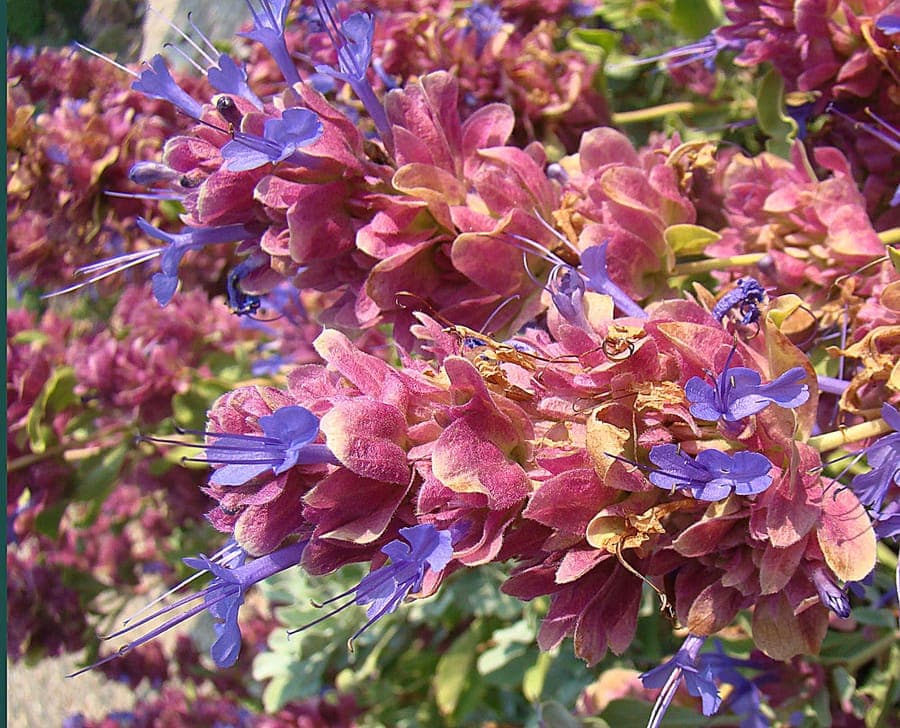
Dick Culbert from Gibsons, B.C., Canada / CC BY 2.0, via Wikimedia Commons
Blue Sage: complete guide
Salvia pachyphylla
Want to see Blue Sage: complete guide in your garden?
1 minute, no credit card
Overview
Blue Sage (Salvia pachyphylla), also known as Rose Sage, is a compact, drought-loving shrub from southwestern America. This sage is renowned for its sturdy flowers in blue-purple hues and extremely low maintenance requirements. The plant grows wild in deserts of Arizona, California and northern Mexico, where it thrives despite extreme heat and drought.
For gardeners seeking a resilient, flower-rich plant that endures for years without major intervention, Blue Sage is a perfect choice. This shrub offers continuous blooming throughout the growing season, attracts pollinators and fits seamlessly into modern, low-maintenance gardens.
Appearance and Bloom
Blue Sage grows to about 60 centimeters high and equally wide, making it a medium-sized perennial. The leaves are paper-thin, grey-green and densely packed along slender stems, giving the plant a fine, delicate texture.
Flowers appear from May to September in dense, upright spikes. The color ranges from bright blue to purple, depending on light and nutrition. Each flower is approximately 1 centimeter and forms a characteristic sage flower with upper and lower lips. Color intensity increases in full sun.
After blooming, dry fruits form that are extremely light. In warm climates, the plant rebloom after summer rains. In moderate climates, blooming is continuous from early summer until first frost.
Ideal Location
Full sun is absolutely essential for Blue Sage. The plant needs at least 8 hours direct sunlight daily. In partial shade, the plant becomes thin, leggy and blooms poorly.
Choose a warm, very well-draining location. Avoid puddles and places where water pools after heavy rains. A sunny slope is ideal. The plant tolerates wind, which actually helps limit moisture exchange.
Soil
Blue Sage strongly prefers dry, lean soils. Rich soil promotes leaf growth at the expense of flowering. The ideal soil base is:
- Sand or gravel mixture, extremely well-draining
- Low to very low nutrient content
- pH 6.5 to 8.0 (also chalky)
- Absolutely no waterlogging
If your garden has heavy clay, work sand and gravel into the planting area to significantly improve drainage. A plant in poor soil flowers better than in nutrient-rich soil.
Free design
Want to see Blue Sage: complete guide in your garden? Make a free design now.
Watering
Blue Sage is one of the most drought-loving sages. Once established (after several months), it needs virtually no water. In normal European summers, rainfall suffices.
During intense summer drought in July-August, supplemental watering can help, especially for young plants in their first year. Water deeply, then leave dry for a long time: roots love to search deep.
Ensure soil dries between waterings. Moisture buildup increases fungal risk and is fatal. The plant will sooner die from excess water than drought.
Pruning
Blue Sage requires minimal pruning. After winter, as new growth begins (March-April), light formative pruning suffices. Cut stems back to about 15-20 centimeters to encourage compact growth.
Wilted flowers can be continuously removed to encourage more blooms. Leave growth in September: a frost shock makes the plant more compact.
Remove completely dead stems in spring. In very cold winters, stems may die back, but the root system survives and regrows.
Maintenance Calendar
March: Formative pruning; remove old stems; no fertilizer needed. April-May: Planting new specimens; follow watering rules. June-July: Water during drought; remove wilted flowers for more bloom. August-September: Light watering; enjoy continuous blooming. October: Collect seeds for sowing next spring if desired. November-February: Virtually no work; plant rests; no winter protection needed.
Winter Hardiness
Blue Sage is hardy to about minus 12 degrees Celsius. In milder climates (Netherlands, Belgium, France), the plant survives normal winters without protection. In cold areas (northern Germany, very cold winters), winter protection is recommended.
Protection:
- Mulch around base with dry leaves or compost
- Do not cut back dying stems until spring
- In very cold zones, moving to pots and winter storage may be necessary
Companion Plants
Blue Sage is excellent for Mediterranean planting concepts.
Co-plants:
- Other drought-tolerant sages (Salvia officinalis, Salvia greggii)
- Lavender (Lavandula species)
- Rosemary (Rosmarinus officinalis)
Ground covers:
- Stonecrop (Sedum species)
- Sea Holly (Eryngium planum)
- Purple Verbena (Verbena bonariensis)
Grass transition:
- Hare's-tail grass (Lagurus ovatus)
- Blue Fescue (Festuca glauca)
Closing
Blue Sage is a tough, reliable flowering shrub for sunny, dry spots. No fuss, no fertilizer, no spraying: just plant and enjoy. This is true Mediterranean magic in your garden. Available at major retailers.
For garden design featuring drought-tolerant plants, visit gardenworld.app.
Want to see Blue Sage: complete guide in your garden? Make a free design now.
Upload a photo, pick a style, and get a photorealistic design with plant list in under a minute.
No credit card required


Similar plants
Apple mint (Mentha x villosa): complete guide
Mentha x villosa
Meet apple mint (Mentha x villosa): a fruity-scented kitchen herb with woolly leaves, perfect for tea and mojitos.
Salvia peyronii: complete guide
Salvia peyronii
Discover Salvia peyronii, a rare Lebanese mountain sage. Growing tips, hardiness, and companion planting for a Mediterranean gravel garden.
Bigleaf mint (Mentha x rotundifolia): complete guide
Mentha x rotundifolia
Discover bigleaf mint: cultivation, care tips, and garden uses. Learn how to grow this aromatic herb with soft, hairy leaves.