
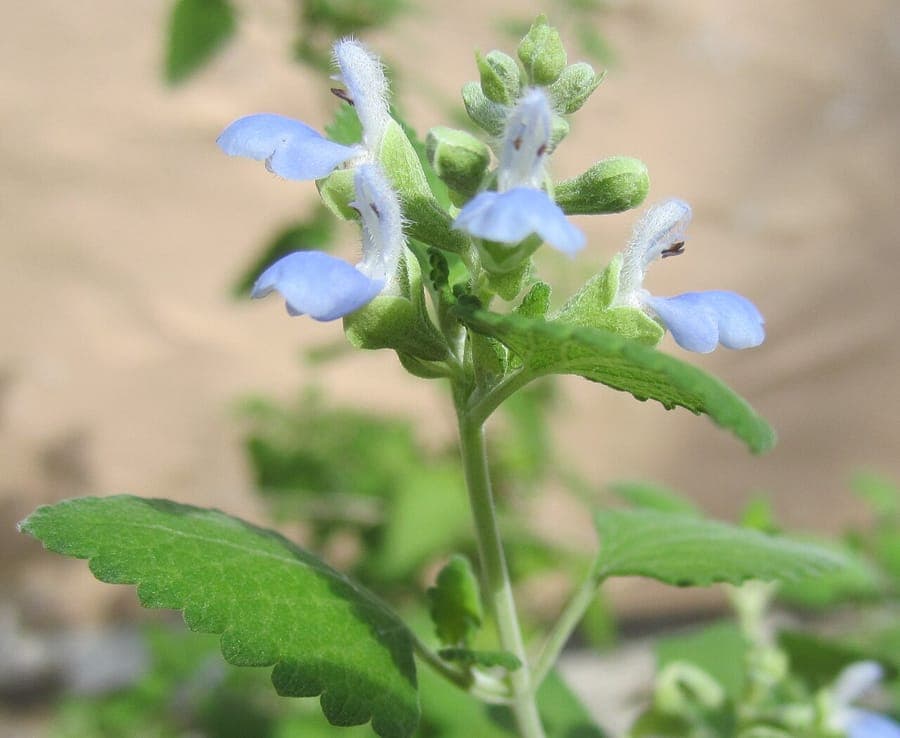
TDogg310 / CC BY-SA 3.0, via Wikimedia Commons
Shrubby blue sage: complete guide
Salvia ballotiflora
Want to see Shrubby blue sage: complete guide in your garden?
1 minute, no credit card
Overview
Salvia ballotiflora, commonly known as shrubby blue sage, is a practical shrub native to Texas and northeastern Mexico. This hardy plant is known for its compact, bushy growth habit and beautiful blue to purple flowers that appear throughout the summer. The plant is well-suited to drier gardens and requires far less care than many popular garden plants.
As a member of the Lamiaceae family, Salvia ballotiflora shares many characteristics with Mediterranean salvias, though this species is more tolerant of both heat and humidity than its European cousins. With a natural height of 60 to 150 centimeters, this shrub offers a valuable mid-size option for garden designers.
Appearance and bloom
The leaves of shrubby blue sage are greenish to gray-green, smooth, and elongated. They reach a length of approximately 1.5 to 3 centimeters and emit only light fragrance when damaged, much less aromatic than white sage.
The flowers are probably the most striking feature. These appear in dense, garden-piercing spikes in shades of blue, purple, or even nearly white. Each individual flower is small, about 1 centimeter, but they grow in clusters that bloom from June through October. The delicate flowers attract numerous pollinators, particularly bees.
After flowering, small fruits form. The plant retains its foliage throughout the year except in very cold climates where some leaf drop occurs.
Ideal location
Shrubby blue sage thrives in full sun to light partial shade. For best results, ensure at least 5 to 6 hours of direct sunlight. In very hot regions, some afternoon shade can help maintain brighter, more vibrant foliage.
The plant is very drought-resistant and thrives in windy, well-drained locations. In home settings and borders, protection from very strong winds can help. Avoid full shade, as this results in lanky, long stems with fewer flowers.
Shrubby blue sage functions excellently as a container plant and is ideal for patios, terraces, and roofs with limited ground space. Provide pots of at least 30 centimeters diameter.
Soil
Regarding soil requirements, Salvia ballotiflora is very flexible. It grows on virtually all soils provided they drain reasonably well. Clay soils, sandy soils, even gravelly soils: anything can work.
The ideal pH is neutral to slightly acidic (6.0-7.5). Heavy soils can be improved by adding sand or gravel. However, unlike some Salvia species, this plant can tolerate a bit more moisture without serious damage.
Fertilization needs are minimal. Once per season, a light organic feeding is sufficient. In very poor soils, annual application of compost or slow-release fertilizer can be helpful.
Free design
Want to see Shrubby blue sage: complete guide in your garden? Make a free design now.
Watering
During the first growing season, water regularly until the plant is well established (approximately 2-3 times per week). Once established, water can be drastically reduced.
During dry periods, watering once every two weeks is usually sufficient. In climates with regular summer rain, supplemental water may not be needed at all. The plant can tolerate some drought, though regular watering leads to better foliage.
In autumn and winter, give virtually no water. Waterlogging leads to problems. Use drip irrigation for optimal moisture management.
Pruning
Shrubby blue sage responds well to regular pruning. In early spring, the plant can be cut back to about two-thirds to maintain a more compact form and promote flowering.
After flowering, faded stems can be removed to encourage new growth. This leads to longer-blooming plants. A few gray, old stems can be carefully removed.
Avoid pruning in late autumn, as this can damage winter hardiness. Mid-summer pruning also helps make the plant fuller.
Maintenance calendar
Winter: Minimal irrigation. Prune in early spring after frost danger passes. Spring: Water as growth begins. Light feeding. Check for pest damage. Summer: Regular, moderate watering. Remove faded flowers. Possibly provide light afternoon shade. Autumn: Gradually reduce watering as temperatures drop. Winter preparation.
Winter hardiness
Salvia ballotiflora is winter-hardy in many areas to approximately -5 to -10 degrees Celsius (USDA zones 8-11). In climates colder than -10 degrees Celsius, the plant deserves protection or winter preparation.
In very cold zones, larger specimens can be heavily damaged or killed. Container cultivation with relocation to sheltered, warm locations during winter is advisable.
Even when above-ground parts are destroyed by frost, the plant can often recover through new growth from underground parts.
Companion plants
Shrubby blue sage combines well with:
- Lavender (Lavandula species) for additional purple tones
- Geranium species for mid-size height
- Artemisia stellariana for gray foliage
- Sedum and other succulents
- Salvia greggii (autumn sage) for extra color
- Drought-resistant grasses
The blue flower color contrasts nicely with yellow flowers of Coreopsis or golden grasses.
Closing thoughts
Shrubby blue sage is a reliable, attractive choice for gardens in warm climates. Its blue flowers, compact growth habit, and drought tolerance make it valuable. Many gardens in North America and Europe benefit from this plant.
Best to look for hardy specimens at local garden centers worldwide. With structural, regular pruning and moderate watering, this specimen will bloom for many seasons. Visit gardenworld.app for more inspiration with Salvia ballotiflora and other Mediterranean plants. Make your garden a blooming oasis with this beautiful blue sage.
Want to see Shrubby blue sage: complete guide in your garden? Make a free design now.
Upload a photo, pick a style, and get a photorealistic design with plant list in under a minute.
No credit card required


Similar plants
Apple mint (Mentha x villosa): complete guide
Mentha x villosa
Meet apple mint (Mentha x villosa): a fruity-scented kitchen herb with woolly leaves, perfect for tea and mojitos.
Salvia peyronii: complete guide
Salvia peyronii
Discover Salvia peyronii, a rare Lebanese mountain sage. Growing tips, hardiness, and companion planting for a Mediterranean gravel garden.
Bigleaf mint (Mentha x rotundifolia): complete guide
Mentha x rotundifolia
Discover bigleaf mint: cultivation, care tips, and garden uses. Learn how to grow this aromatic herb with soft, hairy leaves.