
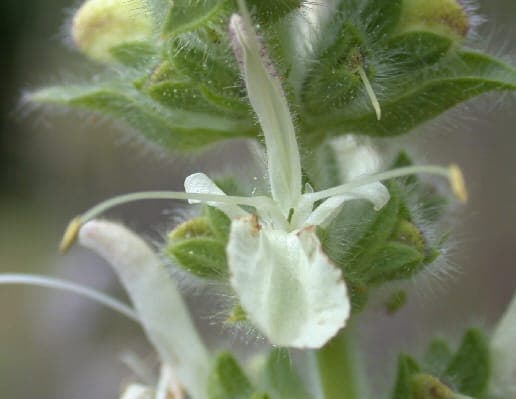
Norbert Holstein / CC BY-SA 3.0, via Wikimedia Commons
Austrian sage: complete guide
Salvia austriaca
Want to see Austrian sage: complete guide in your garden?
1 minute, no credit card
Overview
The Austrian sage (Salvia austriaca) is an elegant herbal plant native to Central and South-Eastern Europe. This Mediterranean species occurs from Austria through the Balkans and is invaluable in dry garden designs. With beautiful purple flowers and aromatic foliage, it makes an outstanding addition to herb gardens and Mediterranean planting schemes.
Appearance and Bloom
The Austrian sage displays elegant, branching stems with aromatic, fine-textured leaves. Purple flowers emerge throughout the growing season, attracting bees and butterflies. The plant maintains ornamental appeal during extended blooming periods. The growth habit is compact and orderly.
Ideal Location
This sage thrives in full sun on dry sites. Plant it on south-facing slopes or against warm walls. Performance is optimal with direct sunlight for at least six hours daily. Protection from cold winds is beneficial in harsh climates.
Soil
The plant demands well-draining soil with moderate fertility. Heavy, waterlogged soils should be amended with sand or gravel. pH can range from neutral to slightly alkaline. Poor soils are often better tolerated than excessively fertile ones.
Free design
Want to see Austrian sage: complete guide in your garden? Make a free design now.
Watering
Once established, Austrian sage is extremely drought tolerant. Provide regular watering until the root system is firmly established. Thereafter, watering can be significantly reduced. Overwatering must be avoided as it causes root rot. In wetter regions, rainfall often suffices.
Pruning
Light pruning after flowering encourages compact growth. Remove spent flowers regularly to promote further blooming. Heavy spring pruning can be performed to renew form. Never prune during frost periods.
Maintenance Calendar
April-May: Initial growth phase. June-September: Abundant flowering period. October-November: Blooming declines. December-March: Winter dormancy. Regular deadheading during the growing season.
Winter Hardiness
Austrian sage is hardy in temperate regions with good drainage. In very cold areas, winter protection may be beneficial, especially in excessively wet conditions. Plant on dry sites for best winter survival.
Companion Plants
Satisfactory plant partners include other Mediterranean herbs, lavender, thyme, and cotton lavender. Succulents create attractive combinations. Drought-tolerant perennials establish harmonious plant groups.
Closing Remarks
Austrian sage is essential for dry Mediterranean gardens. Its elegant flowers, aromatic qualities, and pollinator value provide true garden worth. Explore more Mediterranean species at gardenworld.app/en. Available from Truffaut and Jardiland in France.
Want to see Austrian sage: complete guide in your garden? Make a free design now.
Upload a photo, pick a style, and get a photorealistic design with plant list in under a minute.
No credit card required


Similar plants
Apple mint (Mentha x villosa): complete guide
Mentha x villosa
Meet apple mint (Mentha x villosa): a fruity-scented kitchen herb with woolly leaves, perfect for tea and mojitos.
Salvia peyronii: complete guide
Salvia peyronii
Discover Salvia peyronii, a rare Lebanese mountain sage. Growing tips, hardiness, and companion planting for a Mediterranean gravel garden.
Bigleaf mint (Mentha x rotundifolia): complete guide
Mentha x rotundifolia
Discover bigleaf mint: cultivation, care tips, and garden uses. Learn how to grow this aromatic herb with soft, hairy leaves.