
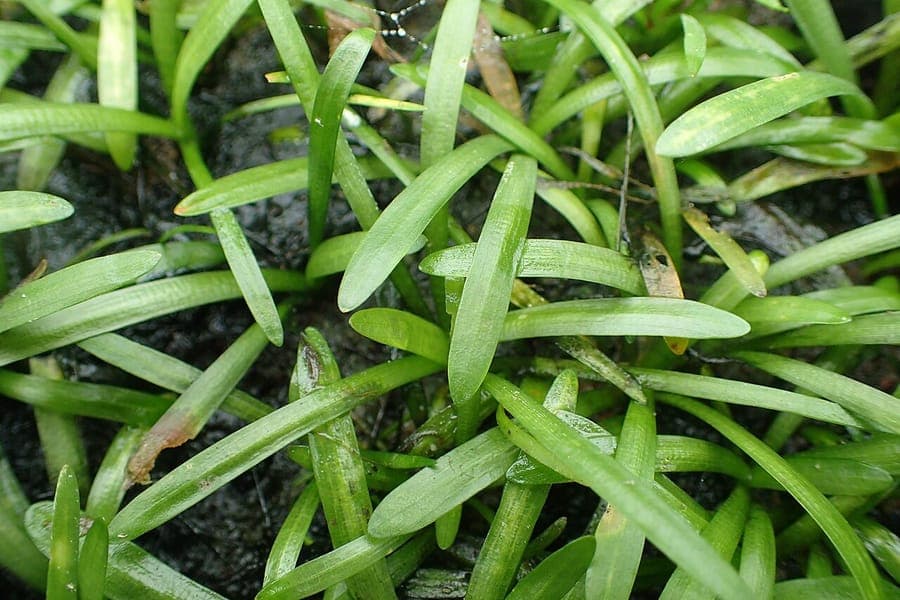
Krzysztof Ziarnek, Kenraiz / CC BY-SA 4.0, via Wikimedia Commons
Sagittaria subulata: complete guide
Sagittaria subulata
Want to see Sagittaria subulata: complete guide in your garden?
1 minute, no credit card
Overview
Sagittaria subulata, commonly called narrow-leaf arrowhead or dwarf sagittaria, is an aquatic plant native to eastern North America and parts of Central America. This Alismataceae family member grows in shallow waters, marshes, and waterways. In the Netherlands and Belgium, the plant is popular in water garden design, aquaria, and biofilter systems due to its fine structure and ecological value.
Sagittaria subulata grows both submerged and emergent, making it flexible for various water garden situations.
Appearance and flowering
The plant forms ground-level dense rosettes of narrow, linear leaves with arrow-shaped outline. Leaves are long and thin (usually 30-60 centimeters) with bright green coloring. In submerged form, leaves are more fibrous and twisted. In emergent form, leaves create more linear pattern.
Flowering period is June through September. Flowers are small, three-petaled white blooms held in pseudo-umbels. The plant reproduces via seed and via vegetative division (runner plantlets). These seedlings grow quickly into new plants.
Ideal location
Sagittaria subulata grows best in shallow water (5-40 centimeter depth). Position in sunny to semi-shaded location with minimum 3-4 hours sunlight daily. In water gardens, it forms excellent midground planting, not too tall but not too low positioned.
The plant suits ponds, water features, marshes, aquaria, and even wet-meadow zones. It works well in biofilter systems and constructed wetlands.
Soil
Sagittaria subulata is not strongly demanding regarding soil substrate. In aquatic conditions, it grows well in sand, loam, or gravel substrates. For pond planting, incorporate organic sediment (aged compost, aquatic potting soil) at placement. This provides nutrients and stability.
For aquarium use, plant sand with nutrient-layer is recommended. The plant has shallow roots so good substrate drainage is important.
Free design
Want to see Sagittaria subulata: complete guide in your garden? Make a free design now.
Watering
As an aquatic plant, Sagittaria subulata lives permanently in water or very moist soil. For pond and water garden use, maintain water depth between 5-40 centimeters. In aquaria, depth of 20-30 centimeters works well.
Water quality should be clean with pH between 5.5-7.5. Regular water changes (25-30% weekly) help maintain healthy conditions.
Pruning
Sagittaria subulata requires regular pruning to maintain compact growth. Remove older, dying leaves at the base. In aquaria and small water systems, also remove excess-growing runner plantlets (stolon plantlets) reproducing rapidly.
Regular pruning promotes forming full, attractive rosettes.
Maintenance calendar
May-June: Growth impulse, regular water changes. June-September: Flowering and seed-setting, runner plantlets emerge, regular pruning. October-November: Growth accelerates, remove old leaves. December-March: Growth slow, minimal pruning. April-May: Season preparation, possible fertilization.
Winter hardiness
Sagittaria subulata is semi-hardy and can reasonably survive winters in Netherlands and Belgium in shallower ponds (25-40 centimeters). Deeper ponds where water doesn't freeze to bottom protect the plant better. In very cold years, above-ground growth dies back, but roots survive and produce new growth in spring.
For maximum safety in aquaria: place in indoor systems without frost risk.
Companion plants
Sagittaria subulata pairs well with other aquatic plants such as water lily, moss-green, water thistle, and rainbow fern. Also stunning combinations with marginal perennials like irises and water valerian.
Conclusion
Sagittaria subulata offers water garden owners and aquarium enthusiasts a simple, elegant choice for freshwater compositions. The plant is low-maintenance, grows rapidly, and provides structure to water gardening. Via GardenWorld, find inspiration for water gardens and aquatic planting schemes.
Want to see Sagittaria subulata: complete guide in your garden? Make a free design now.
Upload a photo, pick a style, and get a photorealistic design with plant list in under a minute.
No credit card required

