
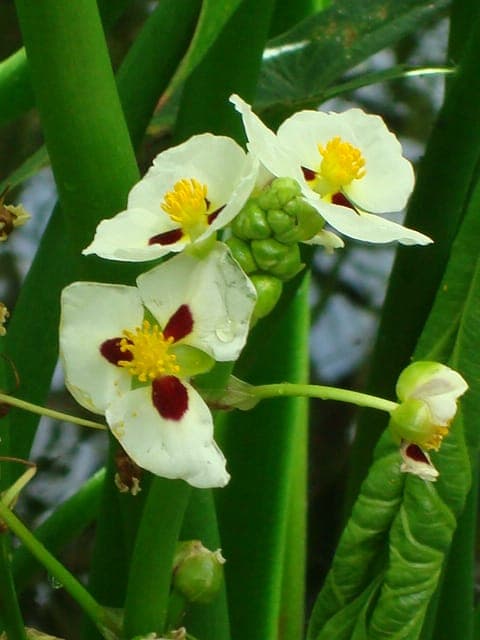
Oeropium / CC BY 3.0, via Wikimedia Commons
Sagittaria montevidensis: complete guide to giant arrowhead
Sagittaria montevidensis
Want to see Sagittaria montevidensis: complete guide to giant arrowhead in your garden?
1 minute, no credit card
Overview
Sagittaria montevidensis, commonly known as giant arrowhead or California arrowhead, is a stunning emergent aquatic plant native to the Americas. Belonging to the Alismataceae family (the same as water plantains), this plant has become a garden center favorite for creating dramatic water garden displays.
This spectacular plant grows as an emergent aquatic, with leaves rising above the water surface on distinctive petioles. The arrow-shaped foliage and delicate white flowers make it a visually striking centerpiece for any water garden or pond.
Appearance and Bloom
Sagittaria montevidensis is instantly recognizable by its characteristic arrowhead-shaped leaves rising vertically from the water. Leaves typically range from 15 to 60 centimeters in length, depending on water depth and nutrient availability. Some submerged leaves appear narrow and ribbon-like.
Flowers emerge from June through September in tall inflorescences rising well above the water surface. Each spike carries hundreds of delicate white flowers with yellow centers arranged in whorls. These nectar-rich blooms attract bees and aquatic insects.
Following pollination, the plant produces distinctive star-shaped seed capsules containing numerous tiny seeds. The plant also reproduces vegetatively through tuber formation at the base of petioles.
Ideal Location
Sagittaria montevidensis thrives in shallow waters with full to partial sunlight. The plant grows best in water depths of 15-60 centimeters as an emergent plant, though it can grow deeper as a fully submerged aquatic.
Select a pond location receiving 4-6 hours of direct daily sunlight. Plants tolerate partial shade but flower far more profusely in full sun. The water should be relatively still - avoid strong water currents or fountain spray that damage delicate leaves.
The plant also grows well in permanently moist marsh-like pond margins where the substrate stays waterlogged but not submerged.
Water and Substrate
Sagittaria montevidensis grows best in nutrient-rich muddy or sandy substrates. For pond planting, use heavy clay-based pond soil amended with aquatic plant fertilizer and well-decomposed compost.
Ideal water parameters:
- pH: 6.5 to 8.5 (neutral to slightly alkaline)
- Water temperature: 10-25 degrees Celsius year-round
- Preference for moderately nutrient-rich water (500-1000 ppm dissolved solids)
- Avoid heavily polluted or extremely stagnant water
The plant adapts to various water compositions but thrives in waters with moderate organic loading that slowly breaks down into plant-available nutrients.
Free design
Want to see Sagittaria montevidensis: complete guide to giant arrowhead in your garden? Make a free design now.
Planting and Propagation
Plant Sagittaria montevidensis in spring or early summer. Place young plants or tubers in baskets filled with pond soil at the appropriate water depth for your chosen form.
The plant reproduces through multiple methods:
- Seed dispersal - mature seed capsules dehisce and seeds sink to the substrate
- Vegetative runners - small tubers form along horizontal shoots
- Division - established plants can be carefully divided
To collect seed: wait for seed capsules to brown and begin splitting open. Sow seeds in wet mud or sand for best germination.
Care and Maintenance
Sagittaria montevidensis requires minimal maintenance once established. Regularly remove senescent (yellowing) leaves to prevent fungal issues and maintain the plant's appearance.
During peak growth (May-October), apply a slow-release aquatic plant fertilizer monthly to encourage robust flowering. Pruning is generally unnecessary.
Inspect the plant occasionally for leaf-clogging debris that might accumulate in filter systems. The plant itself rarely requires intervention beyond basic cleaning.
Water Quality Management
While very tolerant, Sagittaria montevidensis actively contributes to pond water purification by absorbing excess nutrients. This competition with algae helps maintain water clarity.
Perform water changes of 25-30% monthly to maintain mineral balance and remove accumulated waste products.
Avoid chemical treatments in ponds containing these plants - employ biological pest management instead for any issues.
Companion Aquatic Plants
For a balanced water garden composition:
- Pontederia cordata (Pickerel rush) - similar emergent habit, blue-purple flowers
- Nymphaea species (Water lilies) - contrasting surface coverage
- Acorus gramineus (Japanese sweet flag) - submerged interest
- Ludwigia repens (Red ludwigia) - submerged color accent
Maintain balance between emergent and submerged vegetation for optimal water quality.
Seasonal Tasks
May-June: Plant after last frost, monitor establishment.
July-August: Scout for pests, remove senescent foliage.
September: Harvest seed for propagation, prepare for winter.
October-April: Dormant season. Remove dead material, provide frost protection as needed.
Winter Hardiness
Sagittaria montevidensis shows moderate cold tolerance in temperate regions. In areas with temperatures dropping below -5 degrees Celsius, above-water foliage dies back, but root tubers survive in unfrozen water.
In very cold zones: move baskets to frost-free water or indoor storage during winter months.
Conclusion
Sagittaria montevidensis brings dramatic architectural form and ethereal white flowers to water gardens. With basic care, this arrowhead plant thrives for years, attracting aquatic insects and waterside birds.
Start with healthy tubers or young plants from reputable aquatic plant suppliers on gardenworld.app for custom water garden design.
Find pond supplies and accessories at Intratuin and Gamma or specialty aquatic garden centers.
Want to see Sagittaria montevidensis: complete guide to giant arrowhead in your garden? Make a free design now.
Upload a photo, pick a style, and get a photorealistic design with plant list in under a minute.
No credit card required


Similar plants
California damsonium: complete guide
Damasonium californicum
Full guide to Damasonium californicum (California damsonium): shallow water, bog soil, care and companion plants for this rare western aquatic.
Yellow water lily: complete guide
Limnocharis flava
Discover the yellow water lily. Everything you need to know about cultivation, care and water placement.
Sagittaria subulata: complete guide
Sagittaria subulata
Discover narrow-leaf arrowhead (Sagittaria subulata), an aquatic plant for ponds and water gardens. Complete cultivation and care guide.