
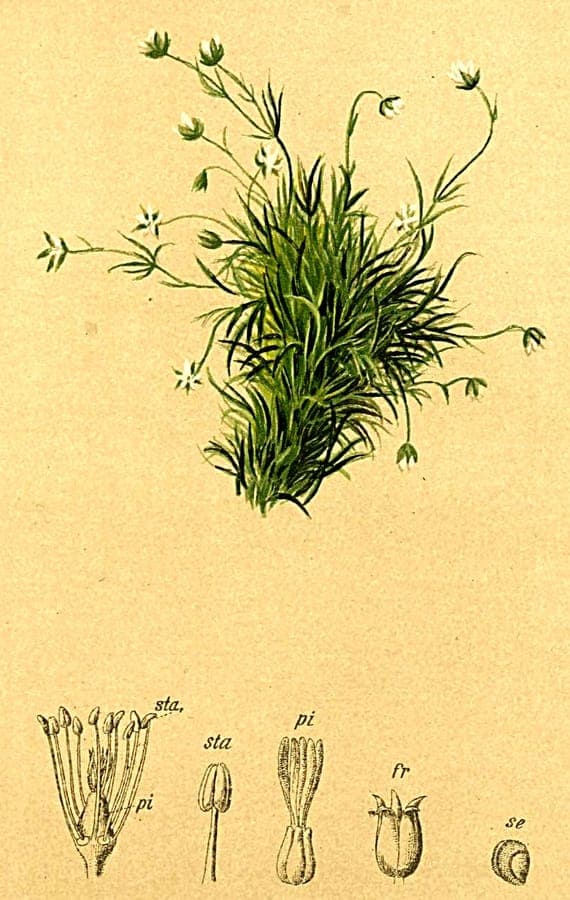
Anton Hartinger / Public domain, via Wikimedia Commons
Alpine pearlwort: complete guide
Sagina saginoides
Want to see Alpine pearlwort: complete guide in your garden?
1 minute, no credit card
Overview
Sagina saginoides, commonly known as Alpine pearlwort, is a dependable little herb that thrives in tough spots most plants avoid - think rock crevices, gravel paths, and dry stone walls. It's not flashy, but it's tough, neat, and quietly effective. Native to high-altitude regions from Alaska to the Alps, it's built to handle cold, wind, and thin soils. In garden design, it's a go-to for softening hard edges without smothering other plants. Whether you're building an alpine trough or filling gaps between stepping stones, this 5 cm-tall forb brings texture and order. On gardenworld.app, you can explore garden plans that highlight where this plant fits best in your space.
Appearance & bloom cycle
This low-growing herb forms a creeping mat of bright green, needle-like foliage, rarely exceeding 5 cm in height. By midsummer - July through August - it produces countless tiny white flowers, each just 3–5 mm across, with five delicate petals. They don't last long individually, but the bloom period stretches over several weeks, giving your rock garden or pathway a subtle sparkle. Up close, the effect is charming; from a distance, it's a soft haze of green with flecks of white. It's not a plant for those seeking drama, but for gardeners who appreciate detail, it's a quiet win.
Ideal location
Alpine pearlwort wants sun - a 7 out of 10 on the light scale means it needs at least 5–6 hours of direct sunlight daily. Full morning sun with light afternoon shade works well, especially in hotter zones. It thrives in open, airy spots where air circulates freely, like rockeries, stone walls, or alpine containers. Avoid enclosed, humid corners where moisture lingers. If your garden slopes gently or has gravel beds, you've found its sweet spot. Check gardenworld.app to see how your garden's sun exposure matches this plant's needs.
Soil requirements
It needs sharp drainage. A gritty, sandy, or rocky mix with a pH between 6.0 and 7.5 is ideal. Avoid heavy clay or rich compost-heavy soils - they hold too much moisture and can rot the roots. A mix of topsoil, coarse sand, and perlite or pumice works well in containers. In the ground, amend with gravel to improve drainage. This plant actually performs better in lean soils; feeding it too well leads to floppy, weak growth.
Free design
Want to see Alpine pearlwort: complete guide in your garden? Make a free design now.
Watering
Once established, it's drought-tolerant but not drought-loving. Water weekly during dry spells in the first growing season. After that, natural rainfall is usually enough unless you're in a prolonged dry period. Water at the base, not overhead, to keep foliage dry and prevent fungal issues. In containers, check the top 2 cm of soil - if it's dry, it's time to water.
Pruning
No pruning needed. If the mat gets thin or patchy, a light trim in early spring with scissors encourages denser growth. Remove any dead or damaged stems by hand. Don't cut into old wood - this plant doesn't regenerate from bare stems.
Maintenance calendar
- Jan: Check for signs of rot in wet weather; ensure drainage is clear.
- Feb: Lightly inspect for new growth; protect containers from freeze-thaw cycles.
- Mar: Clear away debris; prepare soil around plants if needed.
- Apr: Monitor for early growth; water if spring is dry.
- May: Watch for pests like aphids; ensure airflow.
- Jun: Growth accelerates; check moisture in containers.
- Jul: Peak bloom; avoid overwatering.
- Aug: Flowers fade; keep an eye on heat stress.
- Sep: Reduce watering; no fertiliser needed.
- Oct: Clear fallen leaves from mats.
- Nov: Minimal care; ensure beds aren't waterlogged.
- Dec: Protect container plants from hard freezes.
Winter hardiness
Hardy in USDA zones 4–8. In zone 8, it survives mild winters with ease. The real threat is wet soil during freeze-thaw cycles, which can heave roots or cause rot. In colder zones, a light mulch of gravel helps insulate without trapping moisture. Potted plants should be elevated to prevent waterlogging.
Companion plants
Pair with other alpine lovers: Thymus praecox, Sedum spurium, or Arabis caerulea. It works well in mixed troughs with Sempervivum or Draba. Avoid vigorous spreaders like Ajuga or Lamium, which will overwhelm it. In rock gardens, it plays a supporting role - a green frame that lets bolder plants shine.
Closing
Sagina saginoides won't grab attention, but it earns respect over time. It's the kind of plant you plant once and forget - until you notice how perfectly it fills that awkward gap between stones. It's low on demand, high on reliability. For gardeners who value structure and subtlety, it's a hidden gem. Try it in a crevice or along a pathway edge. And when you're planning your next garden update, use gardenworld.app to visualise how Alpine pearlwort can enhance your rock garden or wall planting scheme.
Want to see Alpine pearlwort: complete guide in your garden? Make a free design now.
Upload a photo, pick a style, and get a photorealistic design with plant list in under a minute.
No credit card required


Similar plants
Dianthus karami: complete guide
Dianthus karami
Dianthus karami is a rare Lebanese mountain pink with fringed pink blooms on limestone cliffs, ideal for rock gardens and troughs.
Sicilian pink: complete guide
Dianthus siculus
Discover Dianthus siculus, an elegant purple bloomer from Sicily. Cultivation, June-September flowering and garden combinations.
Alpine mouse-ear chickweed: complete guide
Cerastium pedunculatum
Full growing guide for Cerastium pedunculatum: ideal location, soil, watering, winter hardiness, and companion plants for rock gardens.