
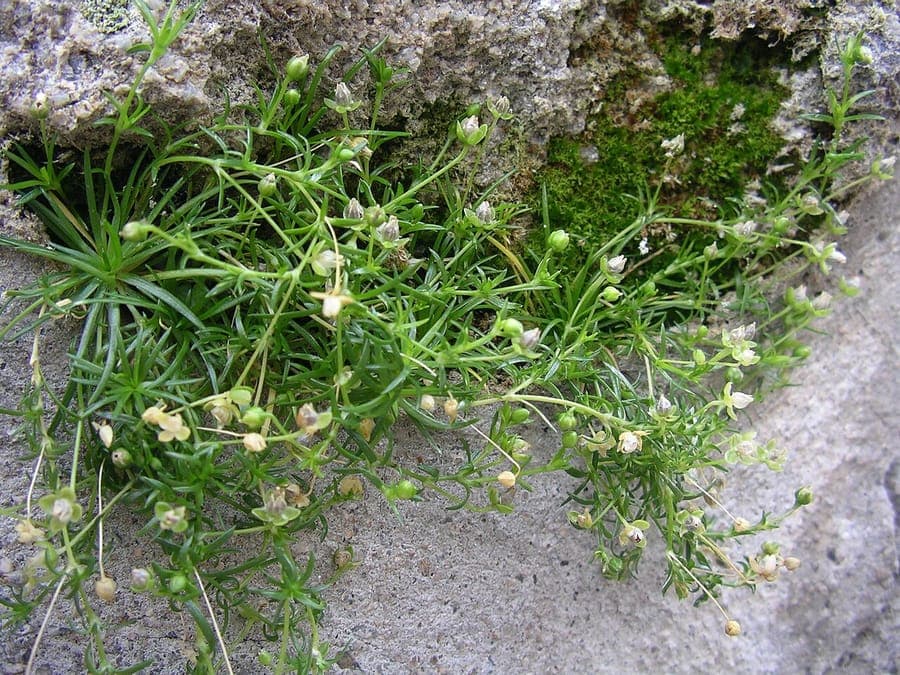
Sylvain Piry / CC BY-SA 2.0 fr, via Wikimedia Commons
Bird-eye pearlwort: complete guide
Sagina procumbens
Want to see Bird-eye pearlwort: complete guide in your garden?
1 minute, no credit card
Overview
Bird-eye pearlwort (Sagina procumbens) is a humble yet resilient creeping herb that thrives in the quiet corners of the garden. Native to Europe and parts of North Africa, it's commonly found in damp crevices, between flagstones, and along the edges of woodland paths. As a member of the Caryophyllaceae family, it shares traits with pinks and carnations but lacks their flamboyance - instead offering a quiet, moss-like presence that stabilizes soil and supports micro-ecosystems. Growing just 2–5 cm tall, it forms dense mats that slowly spread up to 30 cm across.
This plant isn't sold everywhere, but specialist garden centres often stock it for use in rock gardens or natural paving designs. On gardenworld.app, you can simulate how Bird-eye pearlwort weaves between stones in a dry-laid path, helping you visualize its subtle texture before planting.
Appearance & bloom cycle
Bird-eye pearlwort has fine, thread-like stems that creep along the ground, rooting at nodes. The leaves are linear, bright green, and arranged in tight whorls. From May to August, tiny greenish flowers appear - so small (2–3 mm) they're nearly invisible unless you crouch down. Each bloom has four or five sepals but rarely develops true petals, giving them a modest, almost unfinished look.
Despite their lack of showiness, these flowers attract tiny pollinators like hoverflies and minute beetles. The plant blooms sporadically under consistent moisture, and in mild coastal areas, it may even flower lightly in autumn. Seed capsules form quickly, dispersing fine seeds that germinate in damp cracks.
Ideal location
This plant loves bright, open spaces with at least 6–8 hours of light daily (rated 8/10 for light). It performs best in full sun to light shade, especially in cooler climates. In hot southern zones (USDA 7+), afternoon shade prevents scorching. Ideal spots include gravel paths, stone steps, wall crevices, or between pavers where moisture lingers but drainage is sharp.
Avoid deep shade or heavy foot traffic - it tolerates light stepping but won't survive constant trampling. In exposed, windy areas, it may dry out unless mulched or paired with moisture-retaining stones. Use gardenworld.app to model sun exposure in your yard and pinpoint where this plant will thrive without extra irrigation.
Soil requirements
Bird-eye pearlwort prefers well-drained, humus-rich soil with a neutral pH between 6.5 and 7.0. It struggles in heavy clay unless amended with sand or grit. Sandy loam works best, especially when enriched with leaf mould or compost. Avoid highly acidic soils (below 6.0) or overly alkaline conditions (above 7.5), as both limit nutrient uptake.
It doesn't need fertile soil - in fact, too much nitrogen leads to leggy growth. A thin layer of compost in spring is sufficient. Never use salt-based de-icers nearby; this plant is sensitive to salinity and will brown quickly if exposed.
Free design
Want to see Bird-eye pearlwort: complete guide in your garden? Make a free design now.
Watering
Water regularly during establishment (April–June), keeping the surface moist but not waterlogged. Once settled, it tolerates short dry spells but looks best with consistent moisture. In summer, water 2–3 times per week in containers or fast-draining spots. Use rainwater when possible - tap water with high chlorine content can stress the delicate foliage.
In winter, reduce watering significantly. In USDA zones 5–8, rainfall is usually enough. If grown in alpine troughs or raised beds, check monthly for drying out, especially under snowless freezes.
Pruning
Pruning isn't necessary, but light trimming in late spring or early autumn keeps it tidy. Use scissors to snip back straggly stems or patchy areas. Avoid cutting into old wood, as regrowth is slow. Remove dead or yellowed material by hand to improve airflow and reduce fungal risk.
You can also pinch stems to encourage denser growth. The cuttings root easily in damp soil - just press them into a shaded tray and keep moist for 2–3 weeks.
Maintenance calendar
- Jan: Dormant; check for frost heave
- Feb: Monitor for early growth
- Mar: Prepare soil; divide clumps if needed
- Apr: Plant or transplant; begin regular watering
- May: Flowers emerge; maintain moisture
- Jun: Light trim if overgrown; watch for pests
- Jul: Continue watering in dry spells; no feeding
- Aug: Flowering tapers off; collect seeds if desired
- Sep: Replant divisions; top up with compost
- Oct: Let dieback occur naturally; leave seed heads
- Nov: Reduce watering; protect alpine setups
- Dec: Fully dormant; avoid walking on frozen mats
Winter hardiness
Bird-eye pearlwort is hardy in USDA zones 5 to 8 (-20°C to -10°C). It remains semi-evergreen in mild winters but may brown in harsh freezes. No mulch is needed in most gardens, but in exposed sites, a thin layer of straw or pine needles helps. Avoid heavy coverings that trap moisture and encourage rot.
It handles snow cover well but struggles in areas with repeated freeze-thaw cycles. In containers, move pots to a cold frame or unheated greenhouse for extra protection.
Companion plants
Pair it with low-growers like creeping thyme (Thymus serpyllum), baby's tears (Soleirolia soleirolii), or dwarf sedums. It blends well with small ferns (Polystichum setiferum 'Proliferum') or woodland saxifrages. Avoid aggressive spreaders like ground ivy (Glechoma hederacea).
In gravel gardens, combine with Campanula poscharskyana or Aubrieta. These pairings create layered textures that support biodiversity. Sketch your ideal planting scheme on gardenworld.app to test spacing and light conditions before buying.
Closing
Bird-eye pearlwort won't win any beauty contests, but it earns its place through resilience and ecological function. It's not a plant for those seeking drama - no bold colors or towering stems here. But for gardeners who value quiet integration, soil stabilization, and habitat support, it's a quiet hero. Find it at garden centres that specialize in rock garden plants or native species. Use it thoughtfully in tight spaces, and you'll find it adds a living, breathing texture that ties the garden together.
Want to see Bird-eye pearlwort: complete guide in your garden? Make a free design now.
Upload a photo, pick a style, and get a photorealistic design with plant list in under a minute.
No credit card required


Similar plants
Dianthus karami: complete guide
Dianthus karami
Dianthus karami is a rare Lebanese mountain pink with fringed pink blooms on limestone cliffs, ideal for rock gardens and troughs.
Sicilian pink: complete guide
Dianthus siculus
Discover Dianthus siculus, an elegant purple bloomer from Sicily. Cultivation, June-September flowering and garden combinations.
Alpine mouse-ear chickweed: complete guide
Cerastium pedunculatum
Full growing guide for Cerastium pedunculatum: ideal location, soil, watering, winter hardiness, and companion plants for rock gardens.