
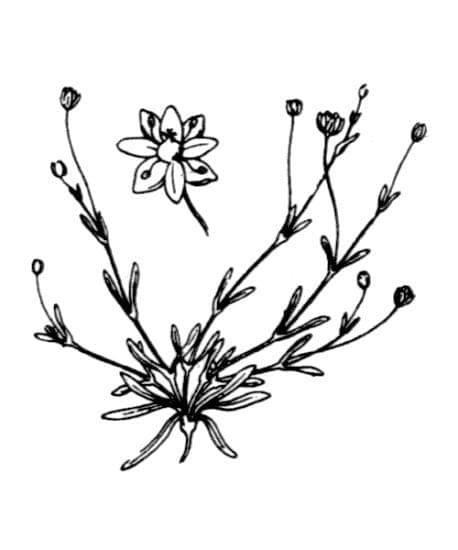
Hippolyte Coste / Public domain, via Wikimedia Commons
Sea pearlwort: complete guide
Sagina maritima
Want to see Sea pearlwort: complete guide in your garden?
1 minute, no credit card
Overview
Sea pearlwort, or Sagina maritima, is a rugged little creeper that thrives where other plants struggle. Native to coastal zones across Western and Southern Europe, it's built for harsh conditions – wind, salt spray, thin soil, and baking sun. In gardens, it forms dense, moss-like mats that stay low and spread steadily. It's not flashy, but its reliability and neat appearance make it a favorite for rock gardens, crevices in stone walls, and between stepping stones. If you're planning a seaside garden or a drought-tolerant design, Sea pearlwort deserves a spot. On gardenworld.app, you can generate a custom layout that integrates this plant seamlessly into gravel paths or coastal borders.
Appearance & bloom cycle
This plant grows in tight, cushion-forming mats, rarely exceeding 3 cm in height. The stems sprawl horizontally, rooting at the nodes and creating a dense green carpet. Leaves are tiny, linear, and bright green, about 5–15 mm long. From May through August, it produces minuscule white flowers – just 3–5 mm across – with five petals and five sepals. They don't last long individually, but because flowering is staggered, the plant often looks lightly frosted with white for weeks. The effect is subtle but charming, especially when backlit by morning sun.
Ideal location
Sea pearlwort loves full sun – aim for a light level of 9 or higher. It performs best in south or southwest-facing spots where it gets at least 6–8 hours of direct sunlight daily. It's perfect for coastal gardens, rockeries, gravel beds, or cracks in dry stone walls. Avoid shaded areas; in low light, it becomes leggy and sparse. It also struggles in humid, poorly ventilated spots. If you've got a hot, dry corner where nothing else survives, this might be your solution. Check sun exposure with the planner tool on gardenworld.app to find the best spot for Sea pearlwort in your yard.
Soil requirements
It thrives in poor, sandy, or gravelly soils with excellent drainage. The ideal pH is neutral to slightly alkaline (7.0–7.5). Avoid rich compost, heavy clay, or water-retentive mixes – these lead to rot and weak growth. For container planting, use a mix of 70% horticultural grit or sharp sand and 30% loam-based compost. Never let it sit in soggy soil. If planting in a lawn-like setting, ensure the area doesn't collect standing water after rain.
Free design
Want to see Sea pearlwort: complete guide in your garden? Make a free design now.
Watering
Once established, Sea pearlwort is extremely drought-tolerant. During the first month after planting, water lightly once a week if there's no rain. After that, it usually survives on rainfall alone, even in dry summers. Overwatering is the fastest way to kill it. If you must irrigate, do so sparingly in early morning, and avoid wetting the foliage. Use rainwater if possible – tap water with high lime content can leave deposits on leaves over time.
Pruning
Pruning isn't necessary, but you can trim back straggly growth in late summer or early autumn to keep it looking tidy. Use sharp scissors and cut just above the rooted nodes. The clippings can be used as cuttings – simply press them into moist sand and keep shaded for a few weeks. They root easily and form new patches.
Maintenance calendar
- Jan: Dormant; no action needed
- Feb: Check for fungal spots or damaged stems
- Mar: Remove dead foliage; prepare for growth
- Apr: Begin monitoring moisture; no feeding
- May: Flowers start; water only if dry
- Jun: Peak flowering; watch for slugs in wet years
- Jul: Continue blooming; avoid disturbance
- Aug: Flowering tapers off; light trim if needed
- Sep: Take cuttings; improve drainage if needed
- Oct: Stop watering; let plant harden off
- Nov: No care required
- Dec: Fully dormant
Winter hardiness
Sea pearlwort is hardy in USDA zones 6–8. It survives freezing temperatures as long as the soil drains well. In wet winters, root rot is a real risk, so elevate pots or improve drainage in garden beds. In colder zones, a light mulch of gravel or dry leaves can help protect the crown without trapping moisture. Potted plants should be raised off the ground to prevent waterlogging.
Companion plants
Pair it with other sun-loving, drought-tolerant species like Thymus serpyllum, Sedum spurium, or Arabis caucasica. These share similar needs and create a cohesive, low-maintenance planting scheme. Avoid aggressive spreaders like mint or ground ivy. For texture contrast, plant near small ferns (e.g., Pellaea rotundifolia) or ornamental grasses like Festuca glauca.
Closing
Sea pearlwort isn't a head-turner, but it's a quiet workhorse in the garden. It holds soil, fills gaps, and blooms quietly for months. It's available at most garden centres in the UK and Europe, especially those with a focus on alpines or coastal plants. Look for it at garden centres during spring planting season. Stick to the basics – full sun, sharp drainage, no extra feeding – and it'll thrive for years. For design inspiration and planting combos, head to gardenworld.app, where you can simulate how Sea pearlwort performs in your specific conditions.
Want to see Sea pearlwort: complete guide in your garden? Make a free design now.
Upload a photo, pick a style, and get a photorealistic design with plant list in under a minute.
No credit card required


Similar plants
Dianthus karami: complete guide
Dianthus karami
Dianthus karami is a rare Lebanese mountain pink with fringed pink blooms on limestone cliffs, ideal for rock gardens and troughs.
Sicilian pink: complete guide
Dianthus siculus
Discover Dianthus siculus, an elegant purple bloomer from Sicily. Cultivation, June-September flowering and garden combinations.
Alpine mouse-ear chickweed: complete guide
Cerastium pedunculatum
Full growing guide for Cerastium pedunculatum: ideal location, soil, watering, winter hardiness, and companion plants for rock gardens.