
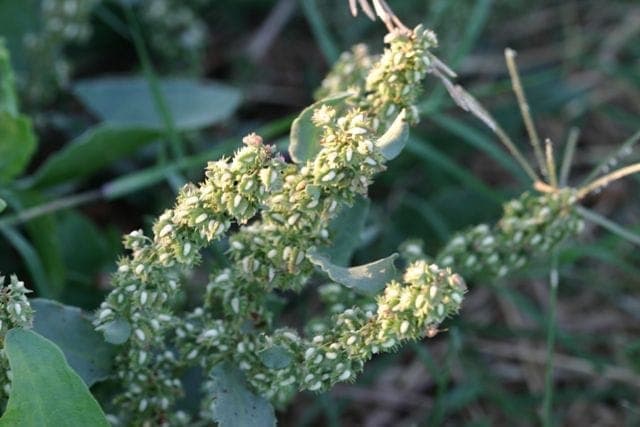
Stephen Laymon, Bureau of Land Management / Public domain, via Wikimedia Commons
Narrowleaf dock: complete guide
Rumex stenophyllus
Want to see Narrowleaf dock: complete guide in your garden?
1 minute, no credit card
Overview
Rumex stenophyllus, commonly known as narrowleaf dock or narrow-leaved field dock, is a herbaceous perennial in the family Polygonaceae - the knotweed and buckwheat family. The species was described in 1830 by the Russian botanist Ledebour in his monumental work on the flora of the Altai region. Its native range extends from eastern and southeastern Europe through temperate Asia: the plant is indigenous to Austria, Bulgaria, the Czech Republic, Hungary, Romania, the Ukrainian steppes, Russia, the Altai mountains, Siberia, Mongolia and parts of Central Asia.
In western Europe - including the Netherlands and Belgium - Rumex stenophyllus has become naturalised in places along riverbanks, dry roadsides, railway embankments and disturbed waste ground. It is related to the common sorrel (Rumex acetosa) and the broad-leaved dock (Rumex obtusifolius), but is distinctly set apart by its notably narrow, linear-lance-shaped leaves and the serrated margins of its fruiting perianth segments - the feature behind the name 'serrate-valve dock'.
Ecologically, this species is a pioneer plant that thrives on disturbed, dry to moderately moist ground. In the wild it serves as a larval food plant for various butterfly and moth caterpillars and as a seed source for seed-eating birds. In the garden it is not commonly grown as an ornamental plant, but it has genuine merit in naturalistic garden designs and wildlife-friendly planting schemes. At gardenworld.app you can explore how native pioneer plants like this one can contribute to an ecologically designed garden.
The epithet stenophyllus derives from the Greek stenos (narrow) and phyllon (leaf), precisely describing the most distinctive characteristic of this species: the elongated, narrow leaves that immediately separate it from broader-leaved dock relatives.
Appearance & bloom cycle
Rumex stenophyllus is an upright, herbaceous plant reaching 60 to 120 cm in height, occasionally taller on fertile, moist soils. The stem is sturdy and erect, light green to reddish-tinged at the base, with leaves placed alternately.
The leaves are the most striking feature. The lower basal leaves are oblong-lanceolate, 10 to 30 cm long but only 1 to 3 cm wide - substantially narrower than other dock species. Leaf margins are smooth to very slightly wavy. The upper leaf surface is matt green; the underside is paler. Stem leaves become progressively smaller and narrower further up the plant.
Flowering occurs from June through August. The flowers are small, greenish, and clustered in dense whorls that crowd the branching flower stems. The individual flowers are inconspicuous but functional: the plant is wind-pollinated and produces large quantities of pollen. After flowering, small, three-angled nutlets develop, each enclosed by three heart-shaped fruiting perianth lobes. These perianth lobes carry a serrated margin - the toothed edge that gives the English name 'serrate-valve dock' and serves as one of the clearest identification features of this species.
The ripe fruits are brown to rusty-coloured and give the plant a warm, decorative tone in autumn that contrasts attractively with surrounding green vegetation. The fruiting spikes are dense, cylindrical and tightly packed, giving the plant an elegant, upright silhouette. The seeds are light and can be dispersed by both wind and water.
Ideal location
Rumex stenophyllus is a highly adaptable species that occupies a wide range of habitats across its natural distribution. The plant does best in open, sunny to lightly shaded positions with at least four hours of direct sun per day. In its Eurasian range it colonises road verges, the banks of rivers and canals, ruderal ground, arable field margins and dry grassland.
In the garden, narrowleaf dock is best suited to a naturalistic, semi-wild area or a deliberately informal part of the plot. Think of a wild corner at the back of the garden, the margin of a pond or ditch, or a road verge that you want to plant with native species. The plant is less suited to a formal border or ornamental bed unless you are deliberately pursuing an ecological garden style.
In urban gardens, Rumex stenophyllus can function as a ground-covering plant on rough ground while simultaneously supporting biodiversity as a food plant for insects and birds. It is also suitable for planting beside water features, provided the ground is not permanently waterlogged.
Soil requirements
Narrowleaf dock is undemanding in terms of soil and is a true pioneer plant in this respect. It grows on sandy, loamy, clay and even moderately stony soils. The preference is for dry to moderately moist, moderately fertile ground with a pH between 5.5 and 7.5 - from slightly acid to slightly alkaline.
On nutrient-poor, dry sandy soil the plant is less productive but survives. On richer, slightly moister ground the plant develops more vigorously and reaches its maximum height. Waterlogging is not tolerated: the roots rot in persistently saturated conditions.
In a garden setting, no special soil preparation is needed. If the site is reasonably open, sunny and not too wet, the plant will establish itself. Heavy clay soils can be improved by working in some sand and compost, but large-scale soil improvement is not necessary. Rumex stenophyllus actually benefits from a degree of neglect - in overly rich, well-cultivated garden soil it may find itself outcompeted by vigorous weeds such as nettles or thistles.
On building sites, brownfield land or post-remediation sites, narrowleaf dock often establishes itself spontaneously as a pioneer, underscoring its character as a robust, self-sufficient species.
Watering
Once well established, Rumex stenophyllus needs virtually no supplementary watering. The plant is well adapted to periods of drought, particularly when growing on its preferred, freely draining soils. In the first year after sowing or planting, some additional watering during extreme dry spells lasting more than three weeks is advisable to help establishment.
In a fully naturalistic setting where the plant is allowed to self-seed and establish at its own pace, no additional watering whatsoever is necessary - the plant manages entirely on natural rainfall. On dry, sandy soil in a hot summer it may temporarily droop or suspend growth early in the season, but the rootstock remains intact and the plant recovers as soon as rain arrives.
Avoid excessive watering in container culture or when sowing in a herb or vegetable bed: too much moisture encourages fungal infections at the stem base and weakens the plant's structural rigidity. In winter, normal rainfall is entirely sufficient.
At bankside locations beside ponds or ditches, the plant benefits from capillary moisture rising from the water table, but the roots themselves should not stand permanently in water. A distance of 30 to 50 cm from the water's edge is ideal.
Free design
Want to see Narrowleaf dock: complete guide in your garden? Make a free design now.
Pruning
Rumex stenophyllus requires little to no active pruning in a naturalistic setting. If you want to leave the plant standing for its ecological value - seeds for birds, structural interest in the autumn and winter garden - simply leave the stems in place until early spring. The dry fruiting spikes are decorative in autumn and winter and provide food for seed-eating birds including finches and buntings.
If you want to limit spontaneous seed dispersal, cut the flowering stems back before the fruits are fully ripe - typically in August or early September. Cut the stems at a height of 20 to 30 cm above the ground. This maintains the compact basal rosette but prevents excessive self-seeding.
In early spring - from February to March - you can cut the entire aerial part of the plant back to just above ground level. New shoots appear promptly once the soil warms up. This annual cut-back keeps the plant fresh and prevents older stems from becoming woody and falling over.
Removed stems and leaves can be composted. Seed-laden fruiting spikes are best not composted unless the heap reaches temperatures high enough to kill the seeds.
Maintenance calendar
January - February: The plant is dormant. Dry stems and seed spikes can remain standing for birds and winter structure. No action required.
March: Cut back all aerial growth to ground level as new shoots become visible. First growth begins once the soil has warmed sufficiently.
April - May: Strong vegetative growth. The plant builds its leaf rosette. No fertiliser or special care needed. Check for unwanted self-seeding in areas where the plant is not welcome.
June - July: Flowering period. The flowers are inconspicuous but functionally wind-pollinated. Leave the plant to flower for ecological value, or cut flower stems back if you want to prevent seed set.
August - September: Fruits ripen and dry. Decision point: leave for birds or cut back to limit dispersal. For desired self-seeding, allow seeds to drop in the target area.
October - November: Aerial parts wither and dry. Stems can remain standing for winter structure.
December: Dormant period. No maintenance needed. The rootstock overwinters safely in the ground without any protection.
Winter hardiness
Rumex stenophyllus is fully hardy across the Netherlands, Belgium and northern Europe. The plant is native to areas with severe continental winters - the Altai mountains and the Siberian steppe - where temperatures of -30 degrees Celsius or lower are common. In garden cultivation in the Benelux region (USDA zones 6-8), the plant overwinters effortlessly without any protection whatsoever.
The aerial stems and leaves die back in autumn after the first frost, but the sturdy taproot and associated rootstock survive completely intact underground. In early spring, as the soil warms, new shoots emerge spontaneously from the rootstock. In this respect the plant is as reliably perennial as common sorrel or broad-leaved dock.
No winter protection of any kind is needed. Mulching is not necessary, but a light layer of leaves or straw around the plant base does no harm. On freely draining soils there is no risk of winter losses even in the harshest Dutch winters.
Late-summer seedlings also survive winter without difficulty and develop into fully mature plants the following year. The species thus renews itself regularly by seed, which in a naturalistic garden is a positive attribute. At gardenworld.app you can see how native plants like narrowleaf dock fit into an ecological garden design that provides structure throughout the year.
Companion plants
In a naturalistic or ecological garden, Rumex stenophyllus combines well with other native plants that prefer similar growing conditions. Suitable companions include:
- Rumex acetosa (Common sorrel) - a close relative with a similar ecological role; the edible leaves add a culinary dimension alongside the purely ornamental-ecological contribution of narrowleaf dock.
- Achillea millefolium (Yarrow) - the same preference for dry, open positions; white flat-topped flower clusters bloom at the same time as Rumex and attract a wide range of insects.
- Daucus carota (Wild carrot) - a similar roadside and bankside plant; airy white umbels provide a tall, light-textured contrast to the upright seed spikes of Rumex.
- Linaria vulgaris (Common toadflax) - lower-growing with yellow and orange-tipped flowers, thriving on comparable dry, open ground and flowering from June to October.
- Melilotus officinalis (Yellow melilot) - a tall yellow-flowering species that combines with Rumex to create excellent bee-friendly communities on dry road verges.
- Phleum pratense (Timothy grass) - upright grass seed heads that harmonise beautifully with the fruiting spikes of Rumex, together giving a broad, wild character to a rough garden corner.
In an ecological verge or bankside planting, space Rumex stenophyllus 40 to 60 cm apart; the plant needs room for its branching stems and broad leaf rosette.
Conclusion
Rumex stenophyllus, the narrowleaf dock, is not a conventional ornamental plant but a genuinely valuable ecological contribution to a naturalistic garden, road verge or waterside planting. The plant requires almost no maintenance, is exceptionally hardy and makes a quiet but consistent contribution to biodiversity - as a food plant for insects, as a seed source for birds, and as a structural element in the autumn and winter garden. For anyone who sees the garden not only as a showpiece but also as a living space for native flora and fauna, narrowleaf dock is an honest, sustainable and self-sufficient choice that earns its place year after year. Specialist native plant nurseries and larger garden centres carry Rumex species alongside other ecologically valuable natives.
Want to see Narrowleaf dock: complete guide in your garden? Make a free design now.
Upload a photo, pick a style, and get a photorealistic design with plant list in under a minute.
10,000+ gardens designed already
No credit card required


Similar plants
Crosby's wild buckwheat: complete guide
Eriogonum crosbyae
Full guide to growing Eriogonum crosbyae: ideal site, soil, watering, winter hardiness and companion plants for this rare western wild buckwheat.
Spreading buckwheat: complete guide
Eriogonum effusum
Full guide to growing Eriogonum effusum: ideal site, soil, watering, winter hardiness and companion plants for this prairie subshrub from the American West.
Tall woolly buckwheat: complete guide
Eriogonum elatum
Full guide to Eriogonum elatum: siting, soil, watering, pruning and companion plants for this elegant white-flowered buckwheat from the western United States.