
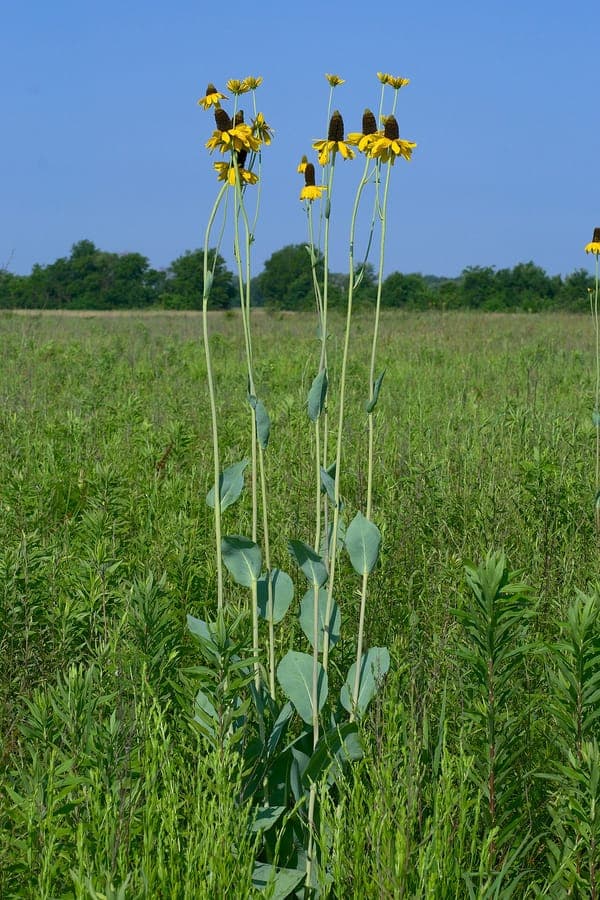
Eric Hunt / CC BY-SA 4.0, via Wikimedia Commons
Rudbeckia maxima: complete guide
Rudbeckia maxima
Want to see Rudbeckia maxima: complete guide in your garden?
1 minute, no credit card
Overview
Rudbeckia maxima, the great coneflower or cabbage coneflower, is a spectacular North American perennial that transforms gardens with enormous upright yellow blooms. This robust, long-lived specimen reaches 1.5 to 2 meters in height and flowers continuously from July through October. The plant is exceptionally hardy, tolerant of poor soils, and attracts bees and butterflies generously. Rudbeckia maxima serves as the perfect focal point for borders, cottage gardens, and naturalistic planting schemes.
Appearance & Bloom
The great coneflower produces tall, sturdy stems with an attractive purple-green tint that contrasts beautifully against glossy green, oval leaves. Each leaf measures approximately 15-20 cm long with distinctive texture. The flowers are impressive: 5-7 cm wide golden-yellow ray florets encircle a prominent brown-black rounded disc. This bulbous structure gives the plant its "cabbage" common name. Flowers appear in rich profusion from mid-July until the first hard frost, with each bloom head persisting for weeks.
Ideal Location
Rudbeckia maxima thrives in full sun with at least 6-8 hours of direct sunlight daily. In partial shade, the plant grows but flowering diminishes and stems become leggy. Avoid dense shade beneath trees where root competition and low light hinder success. The plant excels in warm, open positions receiving ample sun, resulting in robust growth and magnificent floral displays.
Soil
The cabbage coneflower grows in nearly all soil types, preferring reasonably draining, well-aerated soil. On clay-rich, compacted soils, improvement work is essential: add generous organic matter (compost, peat) and ensure adequate drainage. pH should range from 4.0 to 7.0 (neutral to slightly acidic). Poor, infertile soils present no problem; Rudbeckia maxima accepts lean ground without issue, though moderate feeding (NPK 5-5-5) in spring proves beneficial.
Watering
Once established, these plants tolerate drought remarkably well, thanks to their deep root system. Water newly planted specimens 2-3 times weekly until they develop roots; mature plants need water only during prolonged dry spells (exceeding 3 weeks without rain). Water at the base, never over foliage, to prevent fungal diseases. Excessive moisture encourages powdery mildew; always ensure good drainage.
Free design
Want to see Rudbeckia maxima: complete guide in your garden? Make a free design now.
Pruning
Pruning is optional but beneficial. In spring (March-April), remove dead previous-year stems to 10-15 cm above ground. This encourages compact, robust growth. For abundant flowers, pinch back the top 30 cm of young stems mid-July - this stimulates branching and more flower heads. After frost, leave dead plants standing until late winter for bird food, then clean up carefully.
Maintenance Calendar
March-April: Clean away dead stems to 10-15 cm. April: Plant young specimens; water well. May-June: Growth follows; pinch for compact form (optional). July-August: Full bloom; water during drought. September-October: Continue deadheading for extended flowers. November-December: Leave plant standing for bird feed. January-February: No maintenance needed; plant rests.
Winter Hardiness
Rudbeckia maxima is fully hardy to -25 degrees Celsius and thrives across the UK and northern Europe. No extra protection is necessary, even in severe winters. The plant survives harsh freezing without issue. In extremely wet winters, root rot may occur on poorly draining soils; raised beds provide a solution.
Plant Combinations
The great coneflower forms excellent partnerships with: (1) purple Salvia x sylvestris or Delphinium for color contrast; (2) silvery Artemisia or Festuca glauca for texture enhancement; (3) white Echinacea purpurea 'White Swan' or pink Asters for autumn harmony; (4) dark purple Heuchera or Tradescantia pallida as foliage contrast. Consider also late-blooming Sedum or low Rudbeckia fulgida as underplanting.
Closing Thoughts
Rudbeckia maxima is an indispensable plant for anyone seeking a robust, cheerful summer bloomer. Easy to grow, long-flowering, and birds love it, this North American beauty fits most garden styles. In larger borders, it excels as a specimen or in groups of three to five plants. Purchase your first Rudbeckia maxima today and enjoy years of magnificent display. Visit gardenworld.app for design inspiration featuring this splendid perennial.
Want to see Rudbeckia maxima: complete guide in your garden? Make a free design now.
Upload a photo, pick a style, and get a photorealistic design with plant list in under a minute.
No credit card required


Similar plants
Calendula stellata: complete guide
Calendula stellata
Complete guide to Calendula stellata, the star-flowered marigold from Sicily: location, soil, watering and companion planting tips.
Korean chrysanthemum: complete guide
Chrysanthemum x rubellum
Chrysanthemum x rubellum is a hardy autumn perennial with single pink to copper flowers from August to November. Care and combinations.
Helianthus divaricatus: complete guide
Helianthus divaricatus
Helianthus divaricatus is a North American woodland sunflower with yellow summer blooms, ideal for naturalistic borders and shady edges.