
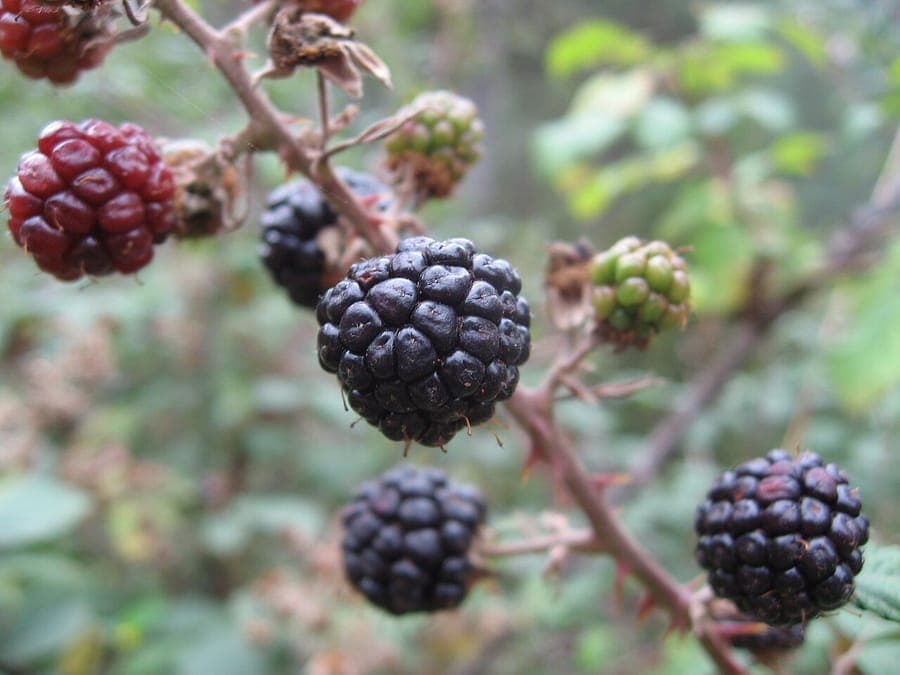
Simonjoan / CC BY-SA 3.0, via Wikimedia Commons
Elm-leaf blackberry: complete guide
Rubus ulmifolius
Want to see Elm-leaf blackberry: complete guide in your garden?
1 minute, no credit card
Overview
Rubus ulmifolius, commonly known as Elm-leaf blackberry, is a vigorous, semi-woody vine that thrives in temperate climates across Europe. It's often mistaken for common bramble but stands out with its elm-like foliage and slightly less aggressive growth. While it can naturalise easily, it's a valuable plant for wildlife gardens, producing edible berries and shelter for birds and pollinators. It's not a show-stopper in formal designs, but in cottage or wild-style gardens, it earns its place.
On gardenworld.app, you can visualise how this plant spreads over a fence or fills a neglected corner over three growing seasons. Its natural arching habit fits well in soft landscape designs.
Appearance & bloom cycle
This plant grows 2–3 metres long, with arching stems that root at the tips when they touch soil. The leaves are deeply lobed, resembling elm leaves, and have a rough texture. They're bright green above and paler underneath, turning yellow in autumn. In late spring, from May to June, clusters of white, five-petalled flowers appear, each about 2–3 cm wide. These attract bees, hoverflies, and butterflies.
From July onwards, green berries form, ripening to deep purple or black by mid-August. The fruit is juicy, slightly tart, and excellent for jams, pies, or eating fresh. Birds often beat you to the harvest, so netting may be needed if you want a decent yield.
Ideal location
Elm-leaf blackberry needs full sun to partial shade, scoring 8 on the light scale. A south- or west-facing spot with at least six hours of direct sunlight ensures strong flowering and fruiting. It tolerates light shade but produces fewer berries in such conditions.
Give it space - this plant spreads via underground runners and tip layering. It's ideal for informal hedging, woodland edges, or covering unsightly fences. Avoid planting near delicate perennials, as it can overwhelm them. On gardenworld.app, you can map out its growth radius and plan companion plants accordingly.
Soil requirements
It grows in a wide range of soils but prefers well-drained, loamy to sandy loam with a pH between 5.5 and 6.5. Heavy clay is acceptable if it doesn't stay waterlogged. Improve poor soils with compost or well-rotted manure at planting time. Avoid highly alkaline soils - this plant dislikes pH above 7.0.
While drought-tolerant once established, it fruits best with consistent moisture. Mulch around the base in spring to retain water and suppress weeds.
Free design
Want to see Elm-leaf blackberry: complete guide in your garden? Make a free design now.
Watering
Water young plants weekly during their first summer, especially in dry spells. Once established, rainfall is usually sufficient, but monitor during prolonged droughts. Water deeply once a week if no rain for 10+ days. Use rainwater if possible, as tap water can raise soil pH over time.
Avoid overhead watering to reduce fungal risk. Water at the base, especially in humid summers.
Pruning
Prune after fruiting, between September and early October. Cut back floricanes (the stems that bore fruit) to ground level. These won't fruit again. Leave the new primocanes - they'll flower next year. Trim overly long stems to keep the plant contained.
Wear thick gloves and use sharp bypass secateurs. Remove any dead, damaged, or crossing stems. Dispose of cuttings properly - don't compost if berries are present, as seeds may survive.
Maintenance calendar
- Jan: Dormant; check for winter damage
- Feb: Inspect stems, remove broken wood
- Mar: Clear debris, apply compost mulch
- Apr: Monitor for new growth
- May: Flowers appear; watch for aphids
- Jun: Peak bloom; pollinators active
- Jul: Berries form; water if dry
- Aug: Harvest berries; protect from birds
- Sep: Prune fruiting canes; control spread
- Oct: Final clean-up; mulch base
- Nov: Minimal care needed
- Dec: Dormant; avoid disturbance
Winter hardiness
Hardy to USDA zone 7 (-15°C). In colder zones, top growth may die back, but roots survive and resprout in spring. No winter protection needed in the UK or most of western Europe. In exposed gardens, a light mulch of straw or leaf litter helps insulate young plants.
Companion plants
Pair with late-summer bloomers like Echinacea, Sedum 'Autumn Joy', or Aster. These share similar sun and soil needs and attract the same pollinators. For ground cover, consider Geranium macrorrhizum or Vinca minor - both suppress weeds without competing heavily.
Avoid planting near shallow-rooted vegetables or delicate alpines. Also steer clear of invasive species like Lonicera japonica.
Closing
Elm-leaf blackberry isn't for the tidy gardener. It's a plant with attitude - spreading, thorny, and self-seeding. But for those embracing a looser, ecological style, it's a winner. The berries are a bonus; the real value is in the life it supports.
You'll find Rubus ulmifolius at garden centres across the UK. Look for cultivated stock rather than wild-dug plants to avoid introducing aggressive variants. And before planting, check gardenworld.app for design inspiration and spacing tools tailored to your garden size.
Want to see Elm-leaf blackberry: complete guide in your garden? Make a free design now.
Upload a photo, pick a style, and get a photorealistic design with plant list in under a minute.
No credit card required


Similar plants
Siberian crab apple: complete guide
Malus x robusta
Complete guide to the Siberian crab apple (Malus x robusta): location, soil, pruning, winter hardiness and the best companion plants for your garden.
Chinese flowering crabapple (Malus x spectabilis): complete guide
Malus x spectabilis
Meet the Chinese flowering crabapple (Malus x spectabilis): a classic spring bloomer with carmine buds and pink blossom.
Potentilla crassinervia: complete guide
Potentilla crassinervia
Potentilla crassinervia, the Corsican cinquefoil, grows wild on Corsica and Sardinia's peaks. Discover how to grow this hardy alpine rock garden gem.