
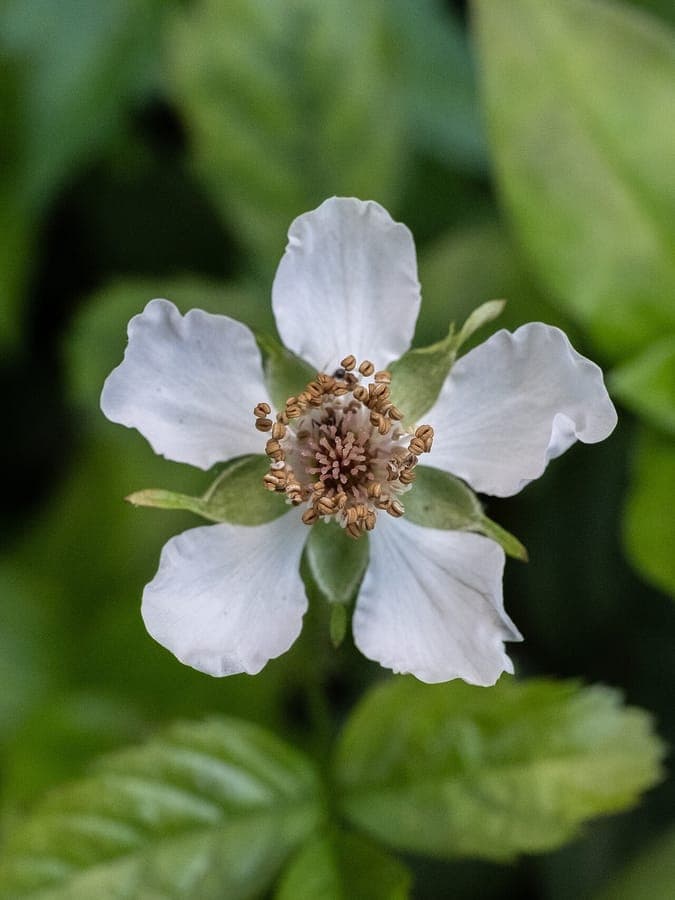
Alex Abair / CC BY 4.0, via Wikimedia Commons
Southern Dewberry: complete guide
Rubus trivialis
Want to see Southern Dewberry: complete guide in your garden?
1 minute, no credit card
Overview
The southern dewberry (Rubus trivialis) is a native species from southeastern North America, from the Gulf Coast to Virginia. This is a unique bramble because its growth habit can vary from upright to trailing.
This dewberry is known for its adaptability and its ability to adjust to different growing conditions. It offers interesting structural possibilities in garden design.
Appearance and Bloom
The southern dewberry can grow as an upright shrub 0.5 to 1 meter tall, but also as a trailing plant whose branches can spread along the ground or supports. The leaves are glossy green, composed of three leaflets.
Flowers appear from March to May in white tones with sometimes pink highlights. They are quite large for brambles and very attractive. After blooming form glossy black fruits birds adore.
Ideal Location
The southern dewberry prefers full sun to partial shade. At least 4-5 hours sun daily is needed for good blooming. In shaded places it still grows, but flowers are scarce.
The trailing characteristic makes it perfect for ground cover, slopes or as a climbing plant against structures. Plant it where its spreading branches have room.
Soil
This dewberry grows on virtually all soils, including heavy clay and sand. Prefers well-draining soil, but it accepts even moderately wet conditions better than many brambles.
A pH of 5 to 7 is ideal. Adding compost helps in poor soils.
Free design
Want to see Southern Dewberry: complete guide in your garden? Make a free design now.
Watering
After planting water regularly, especially in the first growing season. Once established it is quite drought-tolerant.
In typical growing seasons usually no extra water needed. Only during prolonged drought apply extra water.
Pruning
Pruning can be kept minimal, especially if you want to maintain trailing growth. Remove only dead or diseased branches.
If you want a more structured form, prune in March before growth begins.
Maintenance Calendar
February-March: Check health, remove dead branches. April-May: Blooming, growth, water during drought. June-July: Fruits form. August-October: Summer rest, no maintenance. November-January: Winter preparation.
Winter Hardiness
The southern dewberry is hardy down to about -10°C in most regions. In severe winters some leaf drop can occur, but the plant recovers.
In warmer climates (near the coast) it can be semi-evergreen.
Companion Plants
The southern dewberry grows well with other trailing plants and ground covers. Combine with native wild herbs.
Closing
For those seeking flexibility in growth habit, this American southern dewberry is a perfect choice. Find young plants at local nurseries.
[More ideas? Discover gardenworld.app for personalized garden designs!]
Want to see Southern Dewberry: complete guide in your garden? Make a free design now.
Upload a photo, pick a style, and get a photorealistic design with plant list in under a minute.
No credit card required


Similar plants
Siberian crab apple: complete guide
Malus x robusta
Complete guide to the Siberian crab apple (Malus x robusta): location, soil, pruning, winter hardiness and the best companion plants for your garden.
Chinese flowering crabapple (Malus x spectabilis): complete guide
Malus x spectabilis
Meet the Chinese flowering crabapple (Malus x spectabilis): a classic spring bloomer with carmine buds and pink blossom.
Potentilla crassinervia: complete guide
Potentilla crassinervia
Potentilla crassinervia, the Corsican cinquefoil, grows wild on Corsica and Sardinia's peaks. Discover how to grow this hardy alpine rock garden gem.