
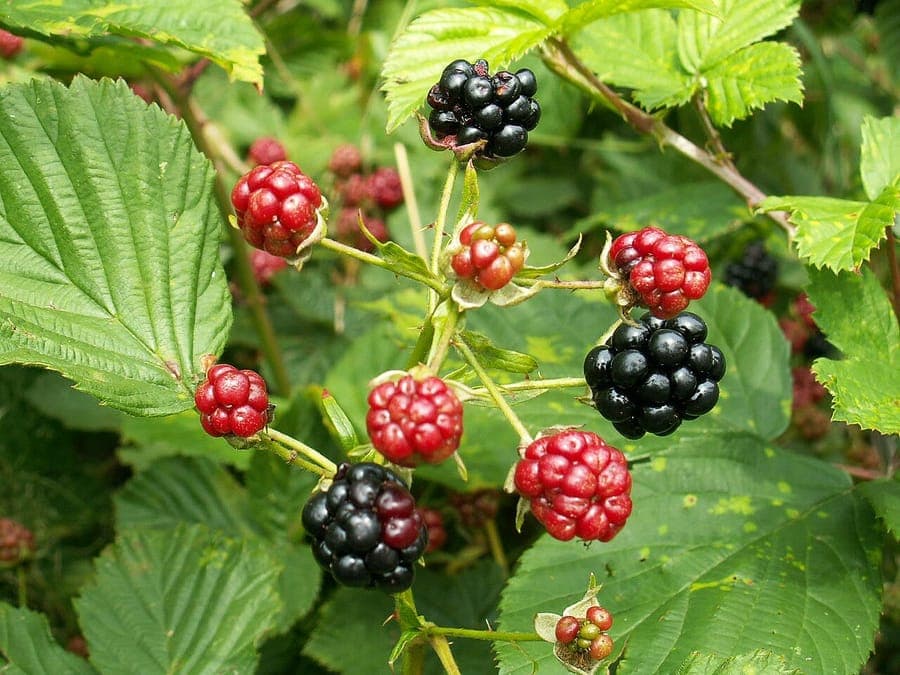
Kenraiz / CC BY-SA 3.0, via Wikimedia Commons
European blackberry: complete guide
Rubus plicatus
Want to see European blackberry: complete guide in your garden?
1 minute, no credit card
Overview
If you want a tough, productive shrub that settles in without fuss, Rubus plicatus - the European blackberry - is a solid pick. Native to woodlands, hedgerows and open areas across Western and Central Europe, it's not a tidy ornamental, but rather rugged, spreading and full of character. Perfect for gardeners who prefer a more natural look. With its strong, thorny canes and high yield, it fits well in wild corners, as a living screen, or even as an unconventional hedge. On gardenworld.app, you can design a layout that accommodates its growth habit and integrates it into a broader planting scheme.
Appearance & bloom cycle
Rubus plicatus reaches 60 to 200 cm in height, with arching or trailing canes that readily climb into nearby vegetation. The leaves are compound, made up of three to five lobed leaflets with a distinct 'pleated' appearance - hence the name plicatus. In May and June, white to pale pink flowers appear in clusters of 5–10 cm across. These are highly attractive to honeybees, bumblebees and hoverflies. From August, berries start to ripen: green at first, then red, and finally deep purple to nearly black. The fruits are edible, tart-sweet, and great for jams, pies or fresh eating - just watch the thorns when harvesting.
Ideal location
This bramble is adaptable but thrives best in full sun to light shade. Aim for at least 4–6 hours of direct sunlight daily for maximum fruiting. In deep shade, growth becomes leggy, flowering drops off, and fruiting is minimal. Give it space - canes can spread horizontally up to 1.5 meters. Use a fence, trellis or shrub for support. Ideal in a natural border, along a woodland edge, or as understory in an orchard. On gardenworld.app, you can check your garden's sun exposure to confirm it's suitable for this fruiting plant.
Soil requirements
European blackberry isn't fussy, but grows strongest in fertile, well-drained loam. Soil pH can range from slightly acidic to neutral (5.5–7.0). Heavy clay works if not waterlogged. Sandy soil is acceptable, but maintain moisture with organic mulch like wood chips or compost. When planting, mix in a bucket of compost or well-rotted manure to improve soil structure and nutrient content.
Watering
Regular watering is critical in the first growing season - especially during dry summers. Give 10–15 litres per plant per week in drought. After the first year, it's quite drought-tolerant thanks to its deep root system. Avoid waterlogged soil, which leads to root rot, especially in heavy soils. Mulching helps retain moisture and suppress weeds.
Free design
Want to see European blackberry: complete guide in your garden? Make a free design now.
Pruning
Pruning is essential to control growth and encourage fruiting wood. Rubus plicatus is biennial: new canes (primocanes) grow in the first year but don't flower. In the second year, they become floricanes and produce flowers and fruit. After harvest (late August to September), cut these spent canes down to 10–15 cm from ground level. Remove any diseased or overcrowded interior stems. Keep 6–8 healthy primocanes per plant for next year's crop. Wear thick gloves and sharp secateurs - the thorns are sharp!
Maintenance calendar
- Jan: Inspect for winter damage, remove dead wood
- Feb: No action needed
- Mar: Leave mulch in place, check for new shoots
- Apr: Start light feeding with compost or organic fertiliser
- May: Flowers begin, watch for slugs on young shoots
- Jun: Full bloom, pollinator-friendly
- Jul: Fruit ripening begins, water during dry spells
- Aug: Harvest berries, prune spent canes after picking
- Sep: Complete pruning, monitor spread via runners
- Oct: Collect seeds or take cuttings, top up mulch
- Nov: No action, plant enters dormancy
- Dec: Winter check, protect base if soil is very wet
Winter hardiness
European blackberry is highly winter-hardy, tolerating temperatures down to -20°C. It's suited to USDA zones 5 through 9. In the UK and Ireland (zone 8), it survives winters with no issues. Above-ground parts may die back, but roots remain alive. In extremely wet winters, root rot can occur in poorly drained soils. Apply a light layer of pine needles or dry straw around the base if drainage is a concern.
Companion plants
Choose companions with similar preferences: sun, fertile soil, and space. Good partners include red raspberries (Rubus idaeus), ivy (Hedera helix), wood anemone (Anemone nemorosa), and oak (Quercus robur) as an overstory. Avoid aggressive groundcovers like ground elder, which can choke young canes. The blackberry attracts beneficial insects, which can help nearby vegetables or fruit trees.
Closing
European blackberry isn't for gardeners seeking neatness - but it's a gem for those who want a dynamic, functional garden. It delivers food, structure and wildlife value. Just be aware: it spreads via runners or seed, so keep an eye on it. Growing in a container or with a root barrier works well in smaller gardens. You can find young plants at garden centres like those in the UK, often in 3-litre pots. When buying, look for healthy green canes with no signs of mildew or aphids. With proper care and placement, this shrub returns reliably year after year - and on gardenworld.app, you can plan how to include it in a resilient, low-maintenance garden design.
Want to see European blackberry: complete guide in your garden? Make a free design now.
Upload a photo, pick a style, and get a photorealistic design with plant list in under a minute.
No credit card required


Similar plants
Siberian crab apple: complete guide
Malus x robusta
Complete guide to the Siberian crab apple (Malus x robusta): location, soil, pruning, winter hardiness and the best companion plants for your garden.
Chinese flowering crabapple (Malus x spectabilis): complete guide
Malus x spectabilis
Meet the Chinese flowering crabapple (Malus x spectabilis): a classic spring bloomer with carmine buds and pink blossom.
Potentilla crassinervia: complete guide
Potentilla crassinervia
Potentilla crassinervia, the Corsican cinquefoil, grows wild on Corsica and Sardinia's peaks. Discover how to grow this hardy alpine rock garden gem.