
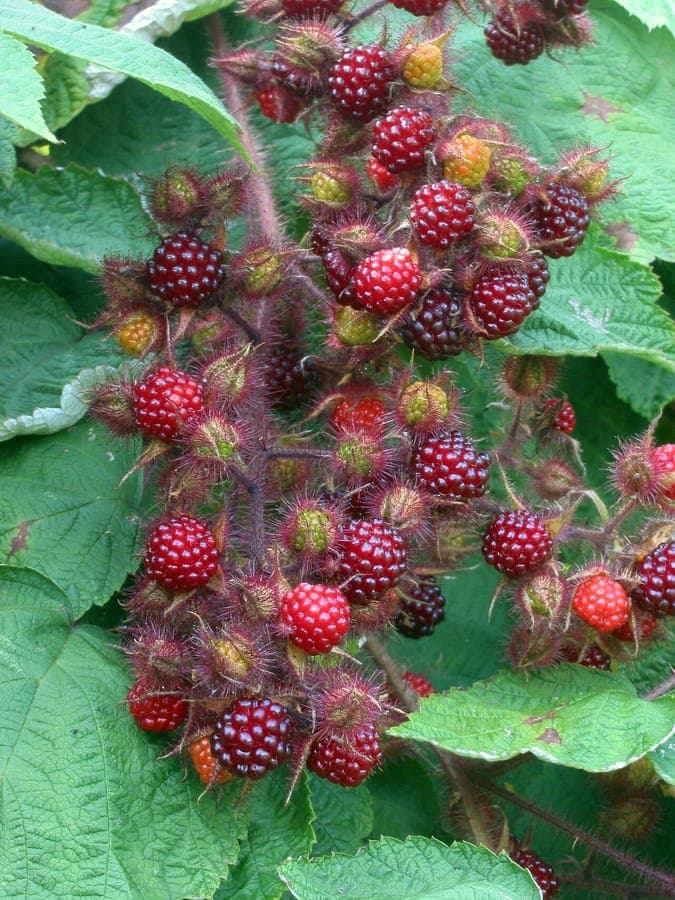
Rasbak / CC BY-SA 3.0, via Wikimedia Commons
Wine raspberry: complete guide
Rubus phoenicolasius
Want to see Wine raspberry: complete guide in your garden?
1 minute, no credit card
Overview
Wine raspberry, or Rubus phoenicolasius, is a vigorous deciduous subshrub from the Rosaceae family, native to Japan, Korea, and parts of China. It's naturalized in several regions, including the eastern United States and parts of Western Europe, often appearing along woodland edges, roadsides, and disturbed soils. Standing 4 to 6 feet tall, this plant spreads via underground rhizomes and seed dispersal, forming dense thickets if unchecked. While it can behave invasively in certain climates, with proper management it offers a rewarding harvest and ornamental value.
On gardenworld.app you can create a garden plan that integrates wine raspberry into your design with controlled spacing to prevent unwanted spread.
Appearance & bloom cycle
The wine raspberry is easily identified by its reddish-purple, bristly stems - a feature that gives it the alternative name "wineberry". The canes arch gracefully and reach up to 180 cm in length. Leaves are compound, with three leaflets, green on top and distinctly silvery-white underneath, creating a shimmering effect in the breeze. In early summer, from late May to June, clusters of small white flowers appear, each about 1.5 to 2 cm across. These attract bees, hoverflies, and other pollinators.
Fruit development follows quickly. The berries start green, turn bright pink, and finally ripen to a glossy, translucent red by mid-July. At full ripeness, they're about 1.5 cm long, hollow when picked (the receptacle stays on the plant), and have a sweet-tart flavour with a hint of wine - hence the name. Peak harvest runs from late July through September, depending on climate and sun exposure.
Ideal location
Choose a spot with partial to full sun for maximum fruit production. While wine raspberry tolerates full shade, yields drop significantly and canes become leggy. A location with 4–6 hours of direct sunlight is ideal. It thrives in woodland margins, along fences, or in edible hedges. However, due to its spreading habit, avoid planting near delicate perennials or lawns that you don't want overtaken.
Use root barriers - at least 50 cm deep - to contain rhizome spread. Alternatively, plant in large containers or raised beds with solid sides. This allows you to enjoy the plant's benefits without it taking over the garden.
Soil requirements
Wine raspberry isn't fussy about soil type. It grows well in loam, sandy loam, and even clay, as long as drainage is adequate. The ideal pH range is between 5.5 and 7.0. On heavy clay, amend with compost or coarse grit to improve structure. On sandy soils, add organic matter like composted manure or leaf mould to increase moisture retention.
Avoid waterlogged areas - prolonged wet feet lead to root rot. If your garden has poor drainage, consider planting on a raised mound of 20–30 cm to elevate the root zone.
Free design
Want to see Wine raspberry: complete guide in your garden? Make a free design now.
Watering
During the first growing season, water weekly with 10–15 litres per plant, especially during dry spells. Once established, wine raspberry is moderately drought tolerant, but fruit size and yield suffer in prolonged dry periods. From June to August, when flowers and fruit develop, consistent moisture is crucial. Mulch with straw or wood chips to retain soil moisture and suppress weeds.
Use rainwater when possible - the plant is sensitive to high levels of chlorine and fluoride in tap water.
Pruning
This species fruits on second-year canes (floricanes). New canes (primocanes) grow in the first year, remain vegetative, and overwinter. In the second year, they flower, fruit, and die after harvest. Remove all spent floricanes right after fruiting, cutting them back to ground level. This encourages air circulation and makes room for new primocanes.
In late winter or early spring, thin out weak, damaged, or overcrowded new growth, leaving 5–8 strong canes per plant. Always use clean, sharp pruners and disinfect between cuts to prevent disease transmission.
Maintenance calendar
- January–February: Inspect canes; remove any remaining dead wood.
- March: Apply a layer of compost around the base; check for escaped suckers.
- April–May: Monitor new primocanes; remove unwanted seedlings or runners.
- June: Flowering begins - avoid pruning. Watch for spider mites in hot, dry weather.
- July–September: Harvest ripe berries when fully red and glossy. Gently pinch off - don't pull.
- October–December: Clear fallen debris; apply mulch to protect roots. Watch for self-seeding in nearby borders.
Winter hardiness
Wine raspberry is hardy in USDA zones 5 to 9 (-20°C to -1°C). Top growth may die back in severe winters, but the plant reliably regrows from the roots in spring. No winter protection is needed in zones 6–9. In zone 5, a 5 cm layer of straw or shredded leaves can help insulate the crown during extreme cold. The persistent red-brown bristly canes add winter interest and structure to the garden.
Companion plants
Pair wine raspberry with shade-tolerant perennials like ferns (Dryopteris spp.), hostas, or carex. These provide ground cover and reduce competition from weeds. For sunnier spots, plant alongside herbs such as chives, mint, or oregano - but keep mint contained. Avoid aggressive spreaders like bamboo or knotweed.
Use the companion planner on gardenworld.app to find plants that match similar moisture and light needs, ensuring a balanced, productive planting scheme.
Closing
Wine raspberry isn't a typical supermarket berry, but it's a standout in the edible garden. With its unique flavour, wildlife appeal, and minimal care needs, it's worth considering - as long as you're prepared to manage its spread. Plant it in a contained area, prune diligently, and enjoy the juicy harvest. It's a bold choice for gardeners who embrace productive wildness. Available at garden centres across the UK and US, often sold as Japanese wineberry.
Want to see Wine raspberry: complete guide in your garden? Make a free design now.
Upload a photo, pick a style, and get a photorealistic design with plant list in under a minute.
No credit card required


Similar plants
Siberian crab apple: complete guide
Malus x robusta
Complete guide to the Siberian crab apple (Malus x robusta): location, soil, pruning, winter hardiness and the best companion plants for your garden.
Chinese flowering crabapple (Malus x spectabilis): complete guide
Malus x spectabilis
Meet the Chinese flowering crabapple (Malus x spectabilis): a classic spring bloomer with carmine buds and pink blossom.
Potentilla crassinervia: complete guide
Potentilla crassinervia
Potentilla crassinervia, the Corsican cinquefoil, grows wild on Corsica and Sardinia's peaks. Discover how to grow this hardy alpine rock garden gem.