
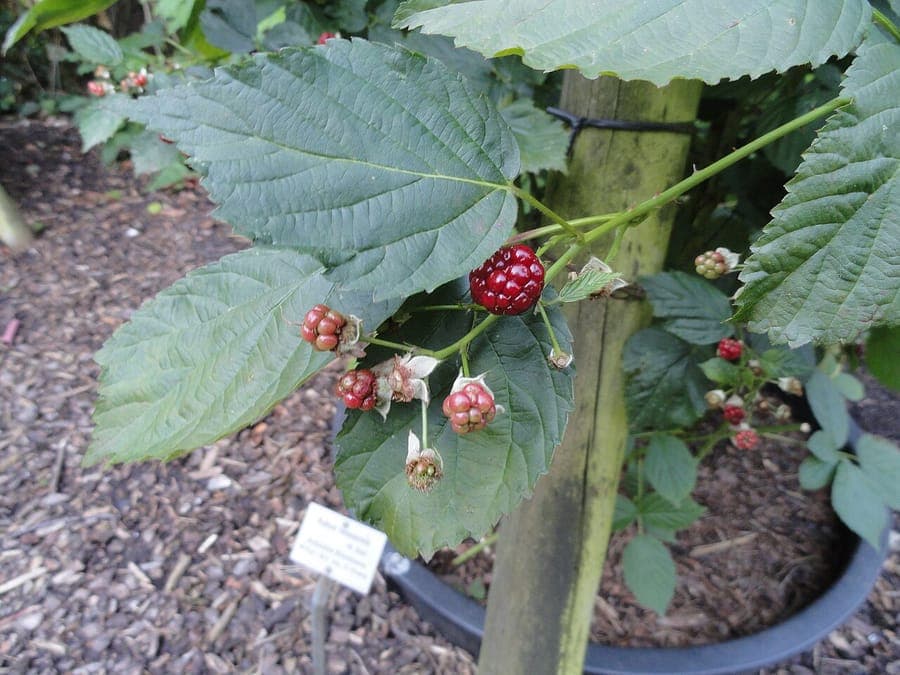
Daderot / CC0, via Wikimedia Commons
Ness bramble: complete guide
Rubus nessensis
Want to see Ness bramble: complete guide in your garden?
1 minute, no credit card
Overview
Ness bramble, or Rubus nessensis, is a reliable, upright-growing bramble that starts producing edible berries as early as June in temperate climates. Unlike many late-season blackberry varieties, this one is prized for its early yield – often three weeks ahead of standard types. For gardeners eager to taste homegrown fruit early in the season, it's a standout choice. It belongs to the Rosaceae family and shares traits with raspberries and blackberries, but stands out with its manageable growth, minimal thorns, and distinctively sweet-tart flavour.
On gardenworld.app, you can design a garden layout that perfectly accommodates Ness bramble, ensuring proper spacing and sunlight exposure.
Appearance & bloom cycle
Ness bramble grows 160 to 200 cm tall with a spread of about 120 cm. The canes are semi-erect, sturdy, and mostly spine-free – a major advantage when harvesting. Leaves are pinnate, bright green in spring, maturing to deep green. Flowering begins in May with clusters of small, white, five-petaled flowers, each about 2 cm across. These attract bees, hoverflies, and butterflies, supporting pollinators during early summer.
Fruit development starts in June. Berries begin red and ripen quickly to a glossy silvery-black. They are slightly longer and more cylindrical than typical blackberries, with a refined, juicy taste – excellent fresh, in desserts, or for jam. The harvest window runs from late June to late July.
Ideal location
Plant Ness bramble in full sun to partial shade. Aim for at least 6 hours of direct sunlight daily to maximise fruit production. While it tolerates light shade, yields drop and canes become leggy. It adapts well to small gardens and can be trained against a trellis, fence, or wall using simple horizontal wires.
Avoid fully shaded areas and exposed, windy spots – strong winds can damage blossoms and reduce pollination. It works well as a natural screen along a side fence or at the back of a vegetable bed. Check your garden's sun exposure on gardenworld.app to plan the best spot for your bramble.
Soil requirements
This bramble thrives in fertile, well-drained loam or clay-loam with a pH between 6.0 and 6.8. Avoid highly acidic or compacted soils, which hinder root development. At planting, mix in 2 buckets of compost or well-rotted manure per plant. Sandy soils need organic matter to retain moisture and nutrients – mulch heavily in spring.
A 5–7 cm layer of organic mulch (straw, wood chips, or leaf mould) helps retain moisture, suppress weeds, and regulate soil temperature. Reapply annually to prevent fungal issues.
Watering
Ness bramble is moderately thirsty. Young plants need consistent watering in their first growing season – about 10 litres per week, split into 2–3 deep soakings during dry spells. Mature plants require 15 litres weekly in prolonged dry periods, especially during fruit development.
Use rainwater when possible; brambles dislike high lime content in tap water. Water at the base to keep foliage dry and reduce the risk of fungal diseases like powdery mildew.
Free design
Want to see Ness bramble: complete guide in your garden? Make a free design now.
Pruning
Pruning is essential for productivity. Rubus nessensis is a primocane-fruiting type, meaning it produces fruit on first-year canes. After harvest (late July to August), cut all fruited canes down to ground level. Leave the new green canes – these will bear fruit next year.
Remove weak, damaged, or overcrowded shoots to improve air circulation. Use clean, sharp secateurs and disinfect between cuts to prevent disease spread. Never prune in winter – you'll remove the fruiting wood.
Maintenance calendar
- January: Inspect canes for winter damage. Remove broken stems.
- February: No action needed unless severe frost; protect young shoots with fleece.
- March: Apply a layer of compost around the base. Loosen soil gently.
- April: Begin regular watering in dry weather. Watch for aphids.
- May: Flowers appear. Avoid pruning. Mulch if not done yet.
- June: Harvest begins. Pick in dry mornings for best shelf life.
- July: Finish harvest. Cut back spent canes. Apply seaweed feed.
- August: Support new canes. Train them on wires if needed.
- September: Stop fertilising. Top up mulch.
- October: Clear fallen leaves and fruit. No pruning.
- November: Lightly fork soil around the plant.
- December: Protect root zone with a dry mulch layer.
Winter hardiness
Ness bramble is hardy in USDA zones 5 to 8, tolerating temperatures down to -23°C. In the UK and northern Europe, it survives winter without protection. Roots are resilient, but new spring growth can be damaged by late frosts. Use horticultural fleece in March if frost is forecast.
In colder microclimates (above 300 m elevation), apply a 10 cm mulch layer for root insulation.
Companion plants
Grow Ness bramble alongside herbs like thyme or sage – they attract beneficial insects and improve airflow. Yarrow and tansy deter aphids and beetles. Avoid planting near mint or comfrey, which can become invasive and compete for space.
Good vegetable companions include lettuce and leeks, which grow low and don't compete for nutrients. Keep strawberries at a distance – they share pests like spider mites.
Closing
Ness bramble is a smart addition to any fruit garden. Its early harvest, low thorn count, and consistent yields make it a practical choice. With proper pruning and care, each plant can produce 3–5 kg of berries annually.
Buy healthy stock from reputable garden centres like those found at OBI or Hornbach in Germany, or local nurseries across Europe. Look for two-year-old plants with strong canes. On gardenworld.app, you can visualise a bramble row that fits your space, sunlight, and design goals – making planting easier and more effective.
Want to see Ness bramble: complete guide in your garden? Make a free design now.
Upload a photo, pick a style, and get a photorealistic design with plant list in under a minute.
No credit card required


Similar plants
Siberian crab apple: complete guide
Malus x robusta
Complete guide to the Siberian crab apple (Malus x robusta): location, soil, pruning, winter hardiness and the best companion plants for your garden.
Chinese flowering crabapple (Malus x spectabilis): complete guide
Malus x spectabilis
Meet the Chinese flowering crabapple (Malus x spectabilis): a classic spring bloomer with carmine buds and pink blossom.
Potentilla crassinervia: complete guide
Potentilla crassinervia
Potentilla crassinervia, the Corsican cinquefoil, grows wild on Corsica and Sardinia's peaks. Discover how to grow this hardy alpine rock garden gem.