
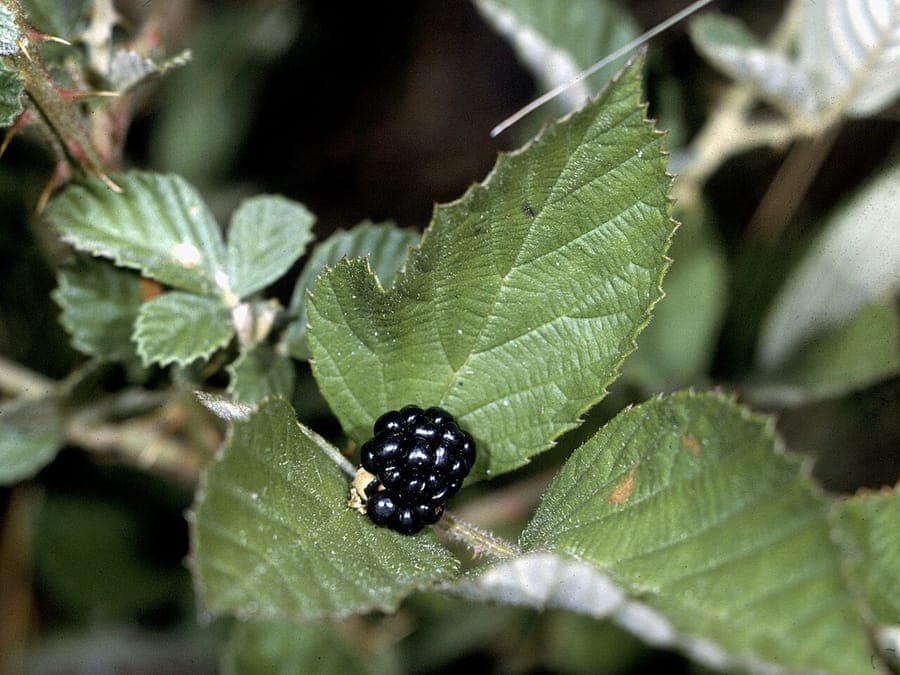
Robert H. Mohlenbrock. USDA NRCS. 1995. Northeast wetland flora: Field office guide to plant species. Northeast National Technical Center, Chester. Courtesy of USDA NRCS Wetland Science Institute. / Public domain, via Wikimedia Commons
American bramble: complete guide
Rubus cuneifolius
Want to see American bramble: complete guide in your garden?
1 minute, no credit card
Overview
The American bramble (Rubus cuneifolius) is a charming shrub native to the eastern United States. Also known as 'sand blackberry' or 'sand bramble,' this plant is valued for its robust character and bird-friendly properties. With its typical bramble characteristics - thorns, lance-shaped leaves, and delicate flowers - it brings authentic American wild character to your front yard.
The plant is quite winter hardy and drought tolerant, making it ideal for low-maintenance gardens. Combined with its ecological value as a food source for birds, this makes it an excellent choice for gardeners who want to bring more nature into their landscapes.
Appearance and bloom
The American bramble grows into a shrub about 1-2 meters high. The plant is multi-stemmed and forms dense, somewhat chaotic groupings with typical bramble thorns along the stems. This gives the plant character but requires caution when handling.
The leaves are lance-shaped and have a rough, coarse texture. Backlit against the light, they are stunningly translucent. Flowers appear in spring - small, discrete little blooms in white to pale pink tones. They are not spectacularly showy, but do attract pollinators.
Of greater importance are the fruits. These develop slowly throughout the summer into small, dark blackberries. When ripe they are black and have a pleasant, sweet taste - though they are usually plundered by birds before gardeners can harvest them.
Ideal location
American bramble thrives in sunny to partially shaded spots. The plant tolerates full sun well and blooms and fruits more abundantly with sufficient light. However, in very hot, dry climates it appreciates some afternoon shade.
Give the plant a spot where it is clearly visible, for example along a border or against a property line. Ensure it does not get too much shade from other shrubs, but do not place it in the hottest sun.
The plant is perfect for edges and wild corners - places where its bramble thorns form a natural barrier. Avoid spots with heavy foot traffic.
Soil
American bramble is not fussy about soil composition. The plant grows in both acidic and neutral soils, with a preference for pH 5 to 7. Sandy and poor soils are also no problem - the word 'sand' in its English name says enough.
Ensure reasonable drainage. Although the plant is drought tolerant, it does not like to stand permanently in waterlogged soil. In clay or heavy soils, adding sand or gravel can help. Mulching with compost or leaf litter helps maintain the soil.
The plant demands little nutrition. Too much fertilizer encourages leaf growth at the expense of flowers and fruits.
Free design
Want to see American bramble: complete guide in your garden? Make a free design now.
Watering
Once established, American bramble is fairly drought tolerant. In the first year after planting you should water regularly, especially during drier periods. As a rule of thumb: water when the top 3-4 cm of soil feels dry.
During the growing season (spring and summer) prefer deeper, less frequent watering over shallow, frequent watering. This encourages deeper roots. Once established, you only need to water during extended dry spells.
In winter the plant needs almost no water, except in exceptionally dry periods.
Pruning
American bramble grows wild and feels most comfortable with minimal pruning. However, some maintenance pruning is welcome to keep the plant compact and healthy.
Early in spring, remove dead or damaged branches. In summer, once the plant has finished flowering, you can somewhat shorten long, chaotic shoots. This promotes compact growth and stimulates branching.
Thinning is sometimes necessary: remove older, less productive stems (more than 4 years old) entirely from the base. This gives light to young shoots.
Always wear gloves and protective clothing - the thorns are relentless witnesses to thoughtless pruning.
Maintenance calendar
Spring: Remove dead wood. Begin regular watering. Mulch if not already done. This is planting time.
Summer: Monitor moisture levels. Gradually tidy up long shoots. Enjoy flowers and later the berries. Ensure birds get their share.
Autumn: Prepare the plant for winter. No more fertilizing. Water only during dry spells.
Winter: Prune dead wood. Minimal care needed.
Winter hardiness
American bramble is quite winter hardy and thrives in temperate European climates. In Dutch and Belgian gardens the plant feels completely at home.
In extremely cold winters some leaf drop may occur, but the plant typically recovers well from its underground root system. Damage is rare in normal Dutch winters.
Companion plants
American bramble associates well with other wild, bird-friendly shrubs:
- Blackthorn (Prunus spinosa): Similar growing habits, together they form an effective natural hedge
- Hawthorn (Crataegus): Beautiful spring blooms together and bird food in autumn
- Honeysuckle (Lonicera): Climbing plants that can grow through the shrub
- Wild rose (Rosa canina): Aesthetically complementary, similar care
Also combine with underplanting such as juniper, heather or bilberry for layered effects.
Conclusion
American bramble is a little champion for gardeners who value low maintenance and simultaneously wish to contribute to local fauna. The plant demands little, gives much back - not just visually but also ecologically. Purchase your American bramble from local nursery Intratuin or garden center Gamma.
Want to know more about plants for bird-friendly gardens? Visit gardenworld.app for more custom inspiration for your front yard. Discover how to create a bird paradise with the right plant choices and design.
Want to see American bramble: complete guide in your garden? Make a free design now.
Upload a photo, pick a style, and get a photorealistic design with plant list in under a minute.
No credit card required


Similar plants
Siberian crab apple: complete guide
Malus x robusta
Complete guide to the Siberian crab apple (Malus x robusta): location, soil, pruning, winter hardiness and the best companion plants for your garden.
Chinese flowering crabapple (Malus x spectabilis): complete guide
Malus x spectabilis
Meet the Chinese flowering crabapple (Malus x spectabilis): a classic spring bloomer with carmine buds and pink blossom.
Potentilla crassinervia: complete guide
Potentilla crassinervia
Potentilla crassinervia, the Corsican cinquefoil, grows wild on Corsica and Sardinia's peaks. Discover how to grow this hardy alpine rock garden gem.