
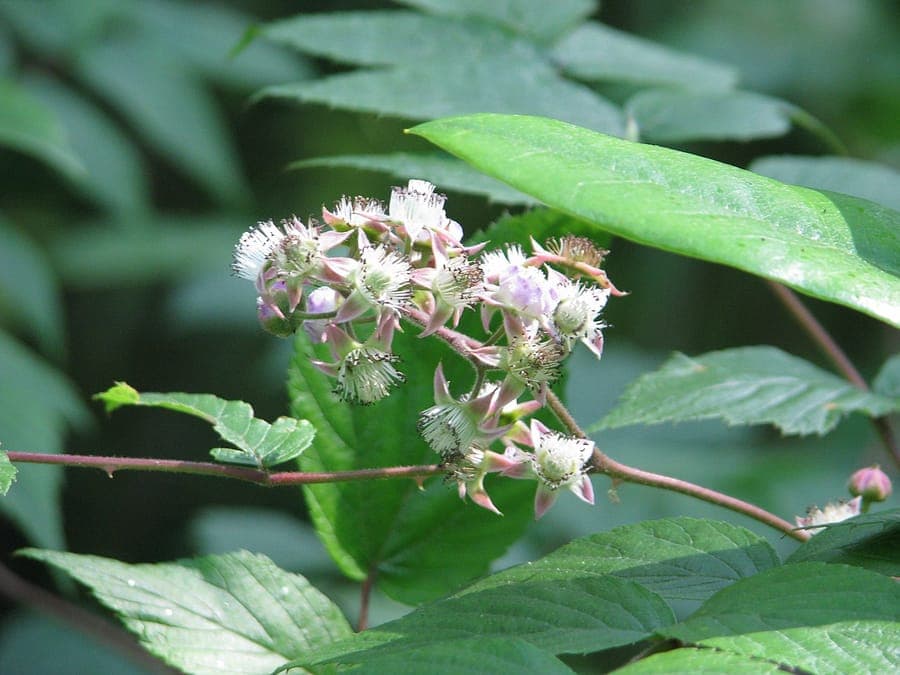
peganum / CC BY-SA 2.0, via Wikimedia Commons
White-stemmed Bramble: complete guide
Rubus cockburnianus
Want to see White-stemmed Bramble: complete guide in your garden?
1 minute, no credit card
Overview
The White-stemmed Bramble (Rubus cockburnianus) is a remarkable ornamental shrub that truly shines in winter. Its snow-white canes and elegant black fruit provide stunning contrast even during the darkest months. Originating from central and southern China, this bramble has become valued across Europe for its unique appearance and graceful growth pattern.
Appearance & bloom
The shrub reaches 1.5 to 2.5 meters tall with dense, arching canes. The stems are coated with a thick waxy white bloom that glows brilliantly in winter, especially after frost. Leaves are elongated, green, and often develop reddish tints seasonally. Small pink or white flowers appear in June in clusters, followed by black fruit persisting until October, providing wildlife food.
Ideal location
The White-stemmed Bramble thrives in full sun to partial shade, though full sun is essential for best winter cane color. Plant as a specimen or within mixed borders. Wind protection is advisable to prevent damage to the delicate white-coated canes.
Soil
This species is highly adaptable. It grows on nearly all soil types, from acidic to neutral, and tolerates chalky and limy soils. Moderately moist, well-draining soil promotes optimal growth. Avoid waterlogged conditions, especially in winter.
Watering
Once established, the plant needs minimal attention. Regular watering during the growing season (May to August) supports vegetative growth. In dry periods, leaves wilt quickly, so underwatering must be prevented. Autumn rainfall usually provides sufficient moisture for fall and winter needs.
Free design
Want to see White-stemmed Bramble: complete guide in your garden? Make a free design now.
Pruning
Annual pruning is essential, especially to maintain white canes. Each spring, cut all two-year-old canes just above ground level. This stimulates new, vigorous shoots with superior winter colors. Also remove weak, damaged, or diseased branches.
Maintenance calendar
- March-April: Cut all dead and two-year-old shoots. Add organic matter.
- May-June: Monitor bloom. Water regularly in dry periods.
- July-August: Fruit formation begins. Maintain supplemental watering.
- September-October: Fruit ripens. Reduce watering.
- November-March: Winter. Enjoy white canes. Minimal maintenance.
Winter hardiness
Fully hardy across Europe (zones 5-6). Tolerates temperatures down to -20 degrees Celsius without damage. Severe frosts actually enhance the white bloom, making the canes appear even more spectacular. Even with severe winter damage, the plant recovers quickly by producing vigorous new shoots.
Companion plants
The White-stemmed Bramble pairs well with:
- Winter-green ferns for textural contrast
- Red Rubus species for complementary wildlife appeal
- Helleborus (Christmas rose) for early winter bloom
- Hedera (ivy) as underplanting
- Cornus alba for additional seasonal colors
Conclusion
The White-stemmed Bramble is an essential winter shrub for gardens needing drama and interest when other plants lie dormant. With minimal maintenance demands and dramatic winter effects, it's an excellent choice for contemporary garden designs. Find quality specimens at major garden retailers. For more design inspiration: gardenworld.app.
Explore more woodland scenarios on gardenworld.app/en.
Want to see White-stemmed Bramble: complete guide in your garden? Make a free design now.
Upload a photo, pick a style, and get a photorealistic design with plant list in under a minute.
No credit card required


Similar plants
Siberian crab apple: complete guide
Malus x robusta
Complete guide to the Siberian crab apple (Malus x robusta): location, soil, pruning, winter hardiness and the best companion plants for your garden.
Chinese flowering crabapple (Malus x spectabilis): complete guide
Malus x spectabilis
Meet the Chinese flowering crabapple (Malus x spectabilis): a classic spring bloomer with carmine buds and pink blossom.
Potentilla crassinervia: complete guide
Potentilla crassinervia
Potentilla crassinervia, the Corsican cinquefoil, grows wild on Corsica and Sardinia's peaks. Discover how to grow this hardy alpine rock garden gem.