
Ivar Leidus / CC BY-SA 4.0, via Wikimedia Commons
European dewberry: complete guide
Rubus caesius
Want to see European dewberry: complete guide in your garden?
1 minute, no credit card
Overview
Rubus caesius, commonly known as European dewberry, isn't the flashy centerpiece of most gardens - and that's exactly why it deserves a spot. This unassuming subshrub from the Rosaceae family spreads gently via trailing stems, rarely exceeding 50 cm in height but covering up to 1.5 meters wide over time. Native to woodlands and field margins across central and eastern Europe, it's built for real-world garden conditions - not just idealized ones. If you're designing a relaxed, low-effort space, Rubus caesius fits right in. On gardenworld.app, you can generate a naturalistic garden layout that uses dewberry as soft ground cover beneath shrubs or along woodland edges.
Unlike its thuggish cousin Rubus fruticosus, the dewberry doesn't dominate. It fruits reliably, grows in partial shade, and integrates well with other perennials. The berries are edible - about 8–10 mm wide, bluish with a waxy bloom, ripening in late August to September. They're mild in flavor, not overly sweet, but fine for jams or as a foraged treat.
Appearance & bloom cycle
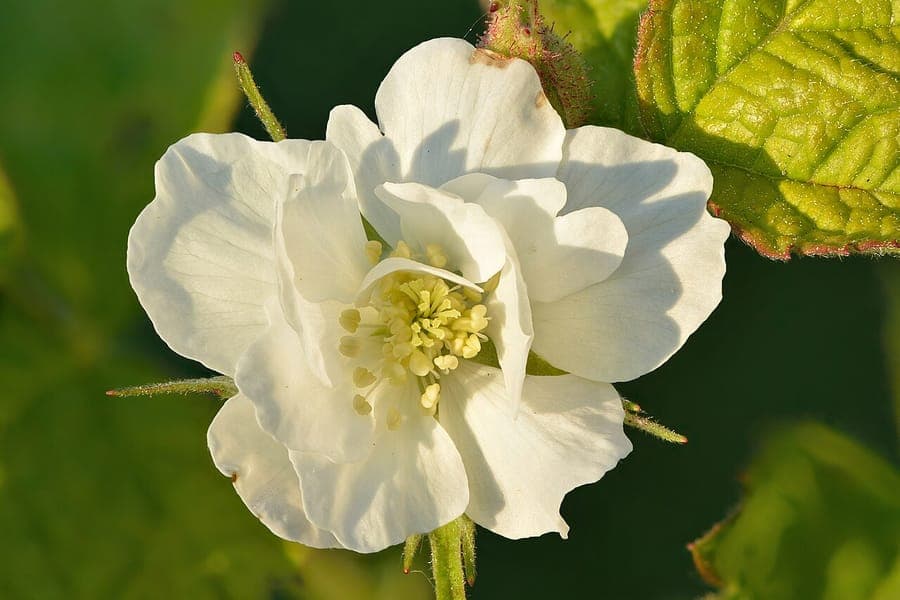
The plant produces slender, arching stems that root at the tips when they touch soil - a neat trick for steady expansion without aggression. Leaves are pinnate, typically with 3–5 leaflets, medium green above and slightly paler beneath. In early summer (June to July), small white to pale pink flowers appear - around 1–2 cm across - attracting hoverflies, bees, and small butterflies.
Fruit sets soon after, beginning green and hard, then turning a distinctive blue-grey by late August. The waxy coating gives them a frosted look - hence the name "dew" berry. Foliage turns yellow to bronze in fall, adding subtle seasonal interest. No dramatic autumn color, but a quiet dignity.
Ideal location
Aim for light to partial shade - think dappled sun under deciduous trees like birch, hornbeam, or rowan. A light rating of 6/10 (where 10 is full sun) suits it best. In full sun, soil dries too fast, stunting spread. In deep shade, flowering and fruiting drop off. This plant thrives along borders, beneath shrubs, or in areas where lawn struggles.
Avoid high-traffic zones; the trailing stems don't tolerate trampling. Instead, use it in low-maintenance corners or wildlife zones. On gardenworld.app, you can map out a shaded planting scheme where dewberry flows between ferns and spring ephemerals.
Soil requirements
Prefers well-drained, loamy to sandy loam soils with a pH between 7.0 and 7.5. It tolerates slight alkalinity but struggles in heavy clay unless amended with grit and compost. Organic matter helps - a thin layer of leaf mold or compost in spring boosts growth. Avoid rich, nitrogen-heavy soils; they produce floppy stems and fewer flowers.
No regular fertilizing needed. Once established, this plant runs on neglect. If your soil is poor, a single spring dressing of compost is enough.
Free design
Want to see European dewberry: complete guide in your garden? Make a free design now.
Watering
Water regularly the first year - especially during dry spells in April to July. Keep the top 5 cm of soil moist until new growth is solid. After that, it's drought-tolerant. Water only during extended dry periods (three weeks or more without rain). Use rainwater when possible; tap water with high lime content can affect long-term soil pH.
Mulch lightly with bark or leaf litter to retain moisture and suppress weeds - but don't pile it against the stems.
Pruning
Minimal pruning required. Cut back old, spent canes to ground level in late winter or early spring (February–March). These won't fruit again. New canes emerge from the crown each year and fruit in their second season - so never cut everything down at once.
Use hand pruners with gloves; the stems have small, hooked thorns. Remove any runners that stray too far or block paths. Otherwise, let it grow naturally.
Maintenance calendar
- Jan: inspect for winter damage
- Feb–Mar: prune old stems; clear debris
- Apr: check for new shoots; water if dry
- May–Jun: monitor flower development; watch for slugs
- Jul: fruit begins to form; keep soil moist
- Aug–Sep: harvest berries; track spread
- Oct: leave fallen leaves for soil protection
- Nov–Dec: dormant phase; no care needed
Winter hardiness
Hardy in USDA zones 5 to 8 (-25°C to -12°C). Stems die back in winter, but the rootstock survives. No winter protection needed, even in harsh conditions. The plant re-sprouts reliably each spring. Snow cover actually helps by insulating the crown.
Companion plants
Pair with shade-tolerant, non-invasive perennials:
- Athyrium filix-femina (lady fern)
- Heuchera spp. (coral bells)
- Tiarella cordifolia (foamflower)
- Carex divulsa (wood sedge)
- Euphorbia amygdaloides (wood spurge)
Avoid aggressive ground covers like ivy or periwinkle. Instead, mix with slow-spreading natives for a balanced understory.
Closing
European dewberry isn't going to win any beauty contests, but it's a quietly dependable plant for natural gardens. Low height, edible fruit, and wildlife value make it a smart pick for shaded spots. Buy bare-root or potted plants in spring from garden centres - look for stock at OBI or Hornbach in Germany, Truffaut in France, or standard UK outlets. Avoid confusing it with common blackberry, which spreads much more aggressively. With the right spot and a hands-off approach, Rubus caesius earns its place. For layout ideas, explore gardenworld.app to see how it fits into woodland-edge designs with ferns, sedges, and spring bulbs.
Want to see European dewberry: complete guide in your garden? Make a free design now.
Upload a photo, pick a style, and get a photorealistic design with plant list in under a minute.
No credit card required


Similar plants
Siberian crab apple: complete guide
Malus x robusta
Complete guide to the Siberian crab apple (Malus x robusta): location, soil, pruning, winter hardiness and the best companion plants for your garden.
Chinese flowering crabapple (Malus x spectabilis): complete guide
Malus x spectabilis
Meet the Chinese flowering crabapple (Malus x spectabilis): a classic spring bloomer with carmine buds and pink blossom.
Potentilla crassinervia: complete guide
Potentilla crassinervia
Potentilla crassinervia, the Corsican cinquefoil, grows wild on Corsica and Sardinia's peaks. Discover how to grow this hardy alpine rock garden gem.