
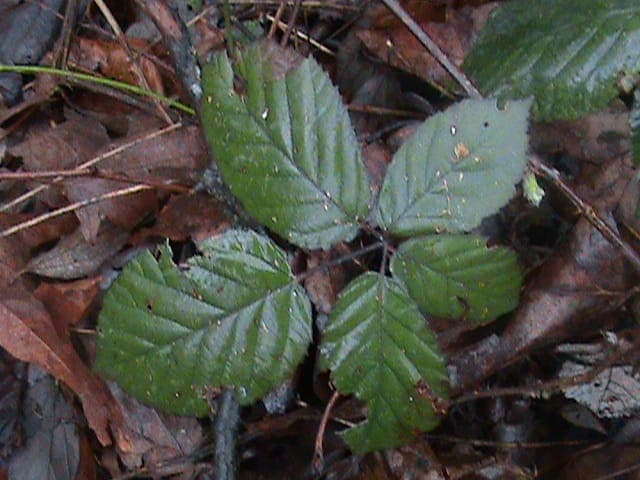
AerobicFox / CC0, via Wikimedia Commons
Himalaya blackberry: complete guide
Rubus armeniacus
Want to see Himalaya blackberry: complete guide in your garden?
1 minute, no credit card
Overview
Rubus armeniacus, commonly known as Himalaya blackberry, is a vigorous perennial bramble native to Iran and the Transcaucasus. Despite its misleading common name, it has nothing to do with the Himalayas. This plant has earned a controversial reputation-celebrated for its massive, juicy berries but often vilified for its aggressive spread. If you're considering adding it to your garden, know this: it's not a plant to toss into a border and forget. But with smart planning and consistent care, it can be a rewarding addition, especially in larger, wilder spaces.
On gardenworld.app, you can design a layout that accounts for its sprawling nature, ensuring it enhances your garden instead of taking it over.
Appearance & bloom cycle
Himalaya blackberry grows as an arching or trailing subshrub, with canes reaching 4 to 6 meters in length. The stems are thick, woody, and armed with strong, hooked thorns. Leaves are compound, usually with five leaflets, deep green and slightly hairy on the underside. In late spring (May to early June), clusters of fragrant white to pale pink flowers appear at the tips of first-year canes.
By mid-July, fruiting begins. Berries start red, then turn deep purple and finally glossy black when fully ripe. They're large-up to 3 cm-and have a rich, sweet-tart flavour perfect for jams, pies, or fresh eating. Harvest lasts from mid-July to early September, depending on sun exposure and local climate.
Ideal location
This blackberry thrives in full sun to light shade. For best fruit production, aim for at least 6 hours of direct sunlight daily. In heavy shade, growth becomes leggy and fruiting drops sharply.
Because it spreads via underground rhizomes and tip-rooting canes, location is critical. Never plant it near flower beds or lawns unless you install a root barrier at least 60 cm deep. Instead, use it as a natural hedge, boundary marker, or screen along property lines. It's excellent for erosion control on slopes, provided you can manage its expansion.
Use gardenworld.app to map out its potential spread and integrate it into your garden plan without compromising other areas.
Soil requirements
Himalaya blackberry isn't picky about soil type but performs best in moist, well-drained loam or clay-loam. It tolerates a pH range of 5.5 to 7.0. Avoid waterlogged peat soils or very sandy, nutrient-poor substrates unless amended.
Don't over-fertilize. Rich soils encourage faster spread. A single spring application of well-rotted compost around the base is usually sufficient. Avoid high-nitrogen fertilizers-they promote leafy growth at the expense of fruit.
Free design
Want to see Himalaya blackberry: complete guide in your garden? Make a free design now.
Watering
Young plants need consistent moisture in their first growing season. Water deeply once a week, delivering about 15–20 litres per plant. Use drip irrigation or a soaker hose to keep foliage dry and reduce fungal risks.
Mature plants are drought-tolerant but produce better yields when soil remains evenly moist. During prolonged dry spells, supplement with 10–15 litres weekly. Avoid overhead watering to prevent powdery mildew and cane blight.
Pruning
Pruning is essential and follows the floricane-fruiting pattern: fruit forms on second-year canes.
- After harvest (August–September): Cut all fruiting canes (now spent) down to ground level.
- In late winter (February–March): Thin new primocanes, leaving 5–6 strong canes per plant. Tip-prune them to 1.8 m to encourage lateral branching, where next year's fruit will form.
Always wear thick gloves and long sleeves-thorns are sharp and can cause deep scratches.
Maintenance calendar
- January: Dormant; check for winter damage.
- February: Start pruning; remove dead canes.
- March: Thin and tip-prune new canes; apply compost.
- April: Monitor for aphids and fungal spots.
- May: Flowers appear; stop pruning.
- June: Mulch lightly to retain moisture.
- July: Harvest begins; watch for birds.
- August: Cut down spent floricanes.
- September: Final harvest; control rhizome spread.
- October: Collect fallen leaves; take cuttings if desired.
- November: Check for stray canes rooting beyond bounds.
- December: Dormancy; no watering needed.
Winter hardiness
Himalaya blackberry is hardy in USDA zones 6–9. It tolerates winter lows down to -20°C. In zone 5, top growth may die back, but roots usually survive and resprout in spring.
No winter protection is needed, though mulching the base with straw or leaf compost in harsh climates can help insulate roots.
Companion plants
Due to its aggressive growth, pair it carefully. Suitable companions include:
- Juniper (Juniperus spp.): low-maintenance, non-competing.
- English ivy (Hedera helix): ground cover that tolerates shade.
- Stinging nettle (Urtica dioica): supports beneficial insects.
- Honeysuckle (Lonicera periclymenum): shares bloom season and pollinators.
Avoid delicate perennials like peonies or delphiniums-they'll be overwhelmed.
Closing
Himalaya blackberry isn't for every garden, but for those with space and a hands-on approach, it's a powerhouse. Its fruit is delicious, its structure bold, and its wildlife value high. Buy plants from reputable garden centres, and never underestimate its spread. With proper containment and regular pruning, you'll enjoy years of harvests. And remember: on gardenworld.app, you can create a garden plan that respects this plant's vigor-so it enriches your space instead of invading it.
Want to see Himalaya blackberry: complete guide in your garden? Make a free design now.
Upload a photo, pick a style, and get a photorealistic design with plant list in under a minute.
No credit card required


Similar plants
Siberian crab apple: complete guide
Malus x robusta
Complete guide to the Siberian crab apple (Malus x robusta): location, soil, pruning, winter hardiness and the best companion plants for your garden.
Chinese flowering crabapple (Malus x spectabilis): complete guide
Malus x spectabilis
Meet the Chinese flowering crabapple (Malus x spectabilis): a classic spring bloomer with carmine buds and pink blossom.
Potentilla crassinervia: complete guide
Potentilla crassinervia
Potentilla crassinervia, the Corsican cinquefoil, grows wild on Corsica and Sardinia's peaks. Discover how to grow this hardy alpine rock garden gem.