
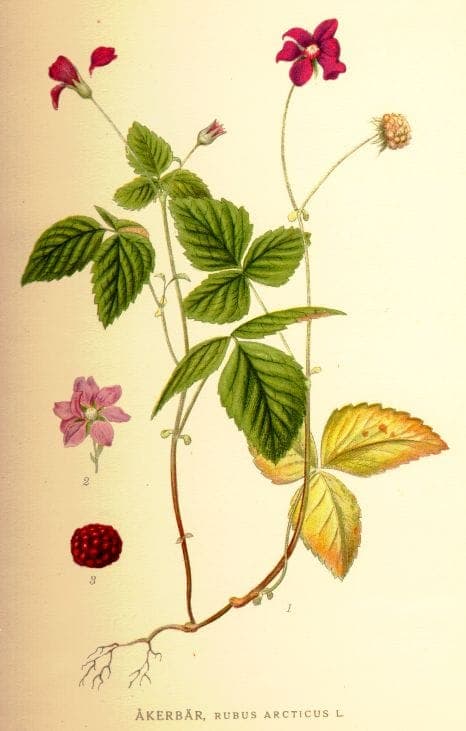
Carl Axel Magnus Lindman / Public domain, via Wikimedia Commons
Arctic bramble: complete guide
Rubus arcticus
Want to see Arctic bramble: complete guide in your garden?
1 minute, no credit card
Overview
Rubus arcticus, commonly known as Arctic bramble, is a resilient and graceful subshrub that thrives in cool, shaded environments. Native to northern regions like Alaska, Alberta, and central Russia, this plant from the Rosaceae family brings quiet elegance to gardens across USDA zones 2–6. Unlike its thorny relatives, the Arctic bramble grows low and spreads gently via underground runners, making it perfect for naturalistic plantings. While not widely sold in standard garden centres, it's gaining popularity among gardeners seeking unique, edible groundcovers. On gardenworld.app, you can design a planting scheme where Arctic bramble fits seamlessly into a woodland edge or shaded wild garden.
Appearance & bloom cycle
Growing 15–30 cm tall, the Arctic bramble forms a low, spreading patch of soft green foliage. Leaves are palmate, divided into three to five lobes, with a slightly downy underside. In late spring to early summer-typically June and July-delicate red flowers emerge, hanging slightly from short stems. These blooms, rich in nectar, attract bees, hoverflies, and small butterflies. By late summer, around August and September, deep red to purplish berries develop. They're smaller than raspberries but pack a complex flavour: sweet, tart, and slightly wine-like. The fruit is excellent for jams, desserts, or eating fresh if you beat the birds to it.
Ideal location
This plant prefers partial to full shade, especially in warmer climates. In the UK or Pacific Northwest, an east-facing spot with morning sun and afternoon shade is ideal. Avoid heavy afternoon sun, which can scorch leaves and dry out the soil too quickly. Under open-canopy trees, along a north-facing wall, or at the edge of a forested garden, Arctic bramble performs best. It spreads slowly, forming a loose mat, so give it space. Use gardenworld.app to visualise how it might fit into a shaded perennial bed or native plant border.
Soil requirements
Arctic bramble likes moist, well-drained soil rich in organic matter. A pH between 5 and 7 is optimal-slightly acidic to neutral. Amend heavy clay with leaf mould and compost to improve drainage, or boost sandy soils with humus to retain moisture. A top dressing of pine needles or rotted wood chips in spring helps maintain soil acidity and moisture. Avoid lime-heavy soils, as they can lead to chlorosis. The plant naturally grows in boreal forests, so mimic those conditions: cool, humus-rich, and consistently damp.
Free design
Want to see Arctic bramble: complete guide in your garden? Make a free design now.
Watering
Keep the soil consistently moist, especially during the first growing season and in dry spells. Water deeply once or twice a week in summer, focusing at the base to prevent fungal issues. Mulching helps retain moisture and keeps roots cool. Rainwater is preferred, as tap water can raise pH over time. During fruiting, don't let the soil dry out-this can cause berry drop or poor development.
Pruning
Minimal pruning is needed. After fruiting in autumn, cut back spent flowering stems to ground level. This encourages fresh growth next spring. In early March, remove any damaged or dead foliage. Since the plant spreads via rhizomes, you may want to install a root barrier if you're planting in a contained bed. Use clean, sharp secateurs to prevent disease spread.
Maintenance calendar
- Jan: Check for winter damage
- Feb: Prepare soil amendments
- Mar: Remove dead growth, apply mulch
- Apr: Monitor soil moisture, watch for slugs
- May: Maintain moisture, support young shoots
- Jun: Flowers appear, increase watering
- Jul: Peak bloom, pollinators active
- Aug: Berries form, keep soil damp
- Sep: Harvest fruit, cut back old stems
- Oct: Apply mulch for winter protection
- Nov: Reduce watering, observe dormancy
- Dec: Dormant; protect from extreme freeze-thaw cycles
Winter hardiness
Extremely cold-tolerant, Arctic bramble survives temperatures down to -40°C (USDA zone 2). In milder zones like 7–8, it still grows well but may benefit from a light mulch in harsh winters. The foliage often dies back naturally, but old stems can be left until spring for added insulation. No additional winter care is needed in most temperate climates.
Companion plants
Pair Arctic bramble with shade-loving perennials like ferns (e.g. Dryopteris spp.), wild ginger (Asarum canadense), or foamflower (Tiarella cordifolia). It also grows well under dwarf conifers or open shrubs like serviceberry (Amelanchier). Avoid aggressive groundcovers like pachysandra, which can outcompete it. On gardenworld.app, explore planting combinations that balance texture, height, and seasonal interest.
Closing
The Arctic bramble is a quiet achiever-low-maintenance, edible, and perfectly adapted to cool, shaded corners. With its charming flowers, tasty berries, and neat growth habit, it's a worthy addition to any thoughtful garden. Though not yet common in garden centres, it's available through specialist nurseries and online growers. Try sourcing Rubus arcticus from local suppliers or order online for spring planting. Use gardenworld.app to plan where it fits best in your garden layout, whether as a groundcover, edible feature, or part of a native planting scheme.
Want to see Arctic bramble: complete guide in your garden? Make a free design now.
Upload a photo, pick a style, and get a photorealistic design with plant list in under a minute.
No credit card required


Similar plants
Siberian crab apple: complete guide
Malus x robusta
Complete guide to the Siberian crab apple (Malus x robusta): location, soil, pruning, winter hardiness and the best companion plants for your garden.
Chinese flowering crabapple (Malus x spectabilis): complete guide
Malus x spectabilis
Meet the Chinese flowering crabapple (Malus x spectabilis): a classic spring bloomer with carmine buds and pink blossom.
Potentilla crassinervia: complete guide
Potentilla crassinervia
Potentilla crassinervia, the Corsican cinquefoil, grows wild on Corsica and Sardinia's peaks. Discover how to grow this hardy alpine rock garden gem.