
Robert H. Mohlenbrock / Public domain, via Wikimedia Commons
Rotala ramosior (Lowland Rotala): complete guide
Rotala ramosior
Want to see Rotala ramosior (Lowland Rotala): complete guide in your garden?
1 minute, no credit card
Overview
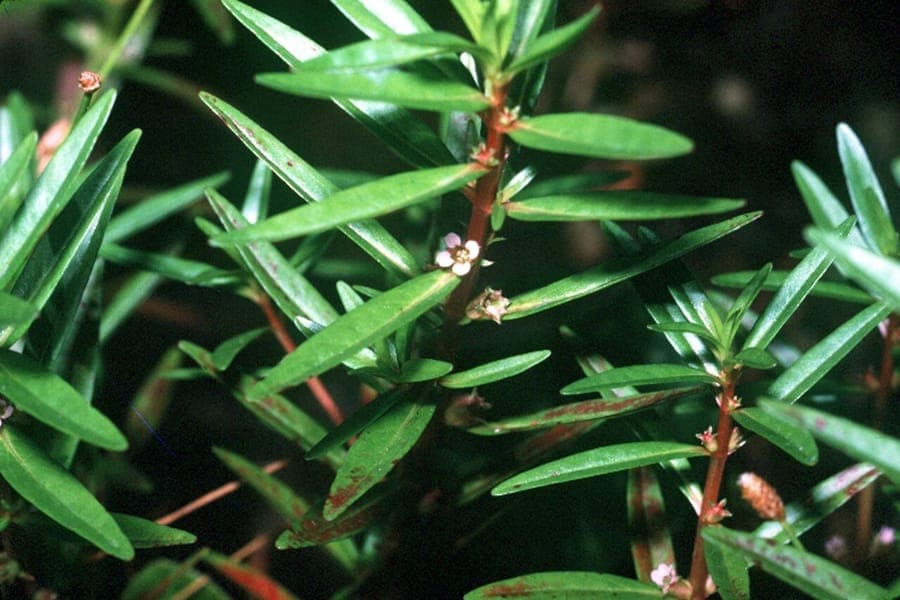
Lowland rotala (Rotala ramosior), also called toothcup, is a versatile aquatic and semi-aquatic plant native to tropical and subtropical Americas. This delicate, branching herb typically grows 15-60 cm tall with thin, light green stems often tinged reddish, particularly in high-light aquatic conditions. Foliage consists of exceedingly small, linear leaves densely arranged along slender stems, creating a filigree-like texture.
What distinguishes lowland rotala is its remarkable adaptability to both submerged aquatic growth and terrestrial wetland conditions. In terrestrial settings, tiny white to pale pink flowers appear, though blooming is rare underwater. The plant is a staple in planted aquariums and wetland gardens worldwide.
Appearance and Bloom
Lowland rotala forms a branching, herbaceous plant with thin, profusely divided stems. Foliage is exceptionally fine-textured, consisting of minute linear leaves arranged densely along the entire stem length. The plant creates a delicate, almost filamentous appearance, especially when massed.
In terrestrial conditions, microscopic white or pale pink flowers appear along the stems, though they are easily overlooked. Aquatic specimens rarely flower. Under intense light, stem color deepens to red-tinted tones, particularly in the upper shoots. This color intensification is one of the species' most attractive features.
Ideal Location
For aquatic cultivation: place in shallow water margins or swamp zones where water depth ranges from 5-15 cm. For terrestrial wetland growth: select full sun to partial shade. The plant struggles in deep water bodies without attached substrate and prefers locations where water and land interface.
Mass planting creates superior visual impact compared to isolated specimens. The filigreed texture shows best when backlit or positioned against darker background plants.
Soil
For aquatic growth: plant in nutrient-rich substrates (aquasoil or commercial aquatic soils). Rotala grows even in bare water, though more slowly.
For terrestrial cultivation: use well-drained, nutrient-rich soils. The plant tolerates wet, peat-rich substrates excellently. Amend poor soil with compost; rotala grows better in fertile conditions.
Free design
Want to see Rotala ramosior (Lowland Rotala): complete guide in your garden? Make a free design now.
Watering
For aquatic culture: use clean water with minimal chemical contamination (low chlorine). For terrestrial wetland growth: maintain consistently moist (but not waterlogged) soil. Water daily or twice weekly depending on season and weather.
Consistent moisture is essential during active growth (spring and summer). During fall and winter, reduce watering slightly. Never allow soil to dry completely.
Pruning
Lowland rotala responds excellently to regular pruning, becoming bushier with trimming. Pinch off the top 5-10 cm of new shoots to stimulate lateral branching. Remove dead material as encountered.
In aquatic culture, trimmed stem sections can be replanted and will develop into new plants, making this an effective propagation method.
Maintenance Calendar
Spring (March-May): Begin pruning to stimulate branching. Increase watering as temperatures rise.
Summer (June-August): Prune every 2-3 weeks. Enjoy vigorous growth. Add fertilizer if in aquariums.
Fall (September-October): Growth slows; reduce pruning frequency. Prepare for dormancy.
Winter: Slow growth. Minimal pruning. Continue light watering.
Winter Hardiness
Lowland rotala is not cold-hardy. Temperatures below 15 degrees Celsius significantly reduce growth; below 10 degrees causes death. In Northwestern Europe, the plant must be protected or grown indoors over winter.
For long-term cultivation: maintain in greenhouses or as houseplants during winter, or grow as annual summer specimens.
Companion Plants
Lowland rotala combines beautifully with other aquatic plants:
- Glossostigma elatinoides for carpet-like foreground effect
- Other rotala species for color variation
- Foreground aquatic plants for structural contrast
- Emergent plants like iris for height and drama
- Dryland plants like lavender just above water line
Combine aquatic and terrestrial elements for dynamic water garden scenes.
Closing
Lowland rotala is a remarkable plant for aquatic gardeners and wetland landscapers. Its fine texture and adaptability make it versatile for many applications. Though not winter-hardy in cold climates, it serves excellently as a summer specimen or houseplant. Specialized aquatic plant suppliers stock this species.
For inspiration on water gardens and aquatic design, visit gardenworld.app for personalized aquatic garden designs.
Want to see Rotala ramosior (Lowland Rotala): complete guide in your garden? Make a free design now.
Upload a photo, pick a style, and get a photorealistic design with plant list in under a minute.
No credit card required


Similar plants
Winged loosestrife: complete guide
Lythrum alatum
Everything about Lythrum alatum, the winged loosestrife. Care, location, pruning and garden pairings for this native North American wetland perennial.
Dnieper loosestrife: complete guide
Lythrum borysthenicum
Everything about Lythrum borysthenicum, the Dnieper loosestrife: location, bloom season, care in pond margins and bog gardens. Full growing guide included.
Grand redstem: complete guide
Ammannia robusta
Everything about Ammannia robusta: pond margins, bog gardens, soil, care and propagation. Practical advice for water garden enthusiasts in temperate climates.