
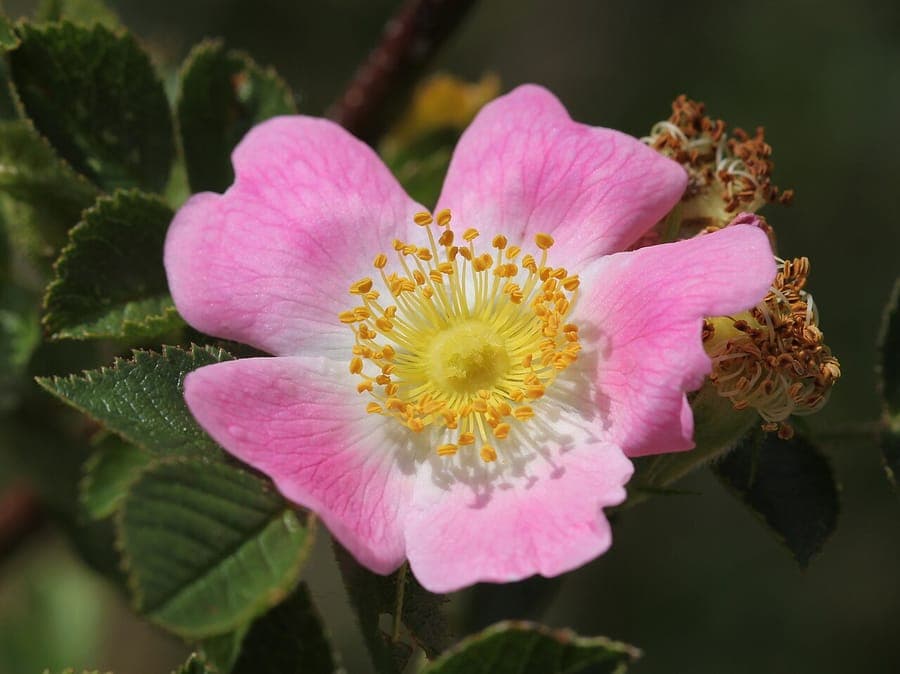
Roger Culos / CC BY-SA 4.0, via Wikimedia Commons
Apple rose: complete guide
Rosa villosa
Want to see Apple rose: complete guide in your garden?
1 minute, no credit card
Overview
Rosa villosa, commonly known as the Apple rose, is a rugged and resilient wild rose species native to much of central and eastern Europe. Unlike cultivated garden roses, this plant thrives with minimal intervention, making it a favourite among gardeners who favour naturalistic planting schemes. It's not grown for fragrance or repeat blooming, but for its hardiness, wildlife value, and striking seasonal changes - from soft pink blooms in early summer to vivid orange bottle-shaped hips in autumn.
The Apple rose spreads through underground runners, forming dense thickets over time. This makes it excellent for informal hedges or as a barrier in wildlife gardens. On gardenworld.app, you can design a planting plan that accounts for its spreading habit, ensuring it complements rather than competes with neighbouring plants.
Appearance & bloom cycle
The Apple rose typically reaches 1.2 to 1.8 metres in height with a spread of about 1 to 1.5 metres. The stems are covered in fine, soft hairs - giving the species its specific epithet villosa - and armed with curved thorns. In late spring to early summer (late May through June), it produces single, five-petalled flowers in soft pink to pale white, each about 4–6 cm wide. The flowers lack strong scent but are rich in pollen, attracting bees and hoverflies.
After blooming, the plant develops distinctive flask-shaped hips that turn bright orange by September. These persist well into winter, often lasting until February, providing visual interest and food for birds like thrushes and waxwings. The hips are also edible for humans and can be used in syrups or teas.
Ideal location
Full sun is best for optimal flowering and hip production, though the Apple rose tolerates partial shade. Aim for at least 6 hours of direct sunlight daily. It performs well in open borders, woodland edges, or as part of a mixed native hedge. Avoid planting in heavily shaded or overcrowded areas, as this reduces flowering and increases susceptibility to mildew.
Give it space - at least 1.2 metres from other plants - to accommodate its suckering growth. On gardenworld.app, you can simulate how Rosa villosa will develop over time, helping you place it wisely in your garden layout.
Soil requirements
This rose is adaptable to a wide range of soils, including clay, loam, and sandy types, as long as drainage is adequate. It prefers neutral to slightly acidic soil (pH 6.0–7.0) but tolerates mildly alkaline conditions. Avoid waterlogged soils, which can lead to root rot.
Before planting, incorporate well-rotted compost to improve soil structure. No regular fertilisation is needed - in fact, too much nitrogen can promote excessive foliage at the expense of flowers.
Free design
Want to see Apple rose: complete guide in your garden? Make a free design now.
Watering
Water thoroughly after planting, especially during the first growing season. Provide 8–10 litres per week during dry spells. Once established (after one year), the Apple rose is highly drought-tolerant thanks to its deep root system. Routine irrigation is rarely required, even during prolonged dry periods in July and August.
Pruning
Rosa villosa flowers on previous year's wood, so avoid hard pruning. The best time to prune is in late winter (February to early March), just before new growth begins. Remove dead, damaged, or crossing stems, and thin out older wood to encourage new shoots. Limit pruning to one-third of the plant to maintain structure and flowering potential.
Leave the hips on the plant throughout winter for ornamental value and to support birds. Cut back fruiting stems in early spring.
Maintenance calendar
- Jan: inspect for winter damage
- Feb: light pruning, remove dead wood
- Mar: final trim, apply compost around base
- Apr: check for aphids, monitor new shoots
- May: flowering begins, keep area weed-free
- Jun: peak bloom, avoid overhead watering
- Jul: watch for powdery mildew in humid weather
- Aug: water only if prolonged drought
- Sep: hips begin to colour, leave in place
- Oct: clear fallen leaves, do not compost if diseased
- Nov: reduce watering, prepare for dormancy
- Dec: leave hips intact, no protection needed
Winter hardiness
The Apple rose is fully winter-hardy in USDA zones 4–8. It withstands temperatures down to -30°C and requires no winter protection, even in exposed sites. The plant dies back to ground level in harsh climates but regrows vigorously in spring.
Companion plants
Pair Rosa villosa with late-summer perennials like Echinacea purpurea, Aster novae-angliae, or Sedum 'Herbstfreude'. It also combines well with native shrubs such as Cornus alba, Crataegus monogyna, and Sambucus nigra. Avoid planting aggressive ground covers nearby that may compete for root space.
Closing
The Apple rose is an unsung hero in the garden: tough, attractive, and ecologically valuable. It asks for little but gives back in spades - from pollinator support to winter food for birds. Look for it at garden centres across the UK, often labelled under its botanical name or as Apple rose. Its wild charm fits perfectly in cottage gardens, wildlife borders, or natural hedging schemes.
Want to see Apple rose: complete guide in your garden? Make a free design now.
Upload a photo, pick a style, and get a photorealistic design with plant list in under a minute.
No credit card required


Similar plants
Siberian crab apple: complete guide
Malus x robusta
Complete guide to the Siberian crab apple (Malus x robusta): location, soil, pruning, winter hardiness and the best companion plants for your garden.
Chinese flowering crabapple (Malus x spectabilis): complete guide
Malus x spectabilis
Meet the Chinese flowering crabapple (Malus x spectabilis): a classic spring bloomer with carmine buds and pink blossom.
Potentilla crassinervia: complete guide
Potentilla crassinervia
Potentilla crassinervia, the Corsican cinquefoil, grows wild on Corsica and Sardinia's peaks. Discover how to grow this hardy alpine rock garden gem.