
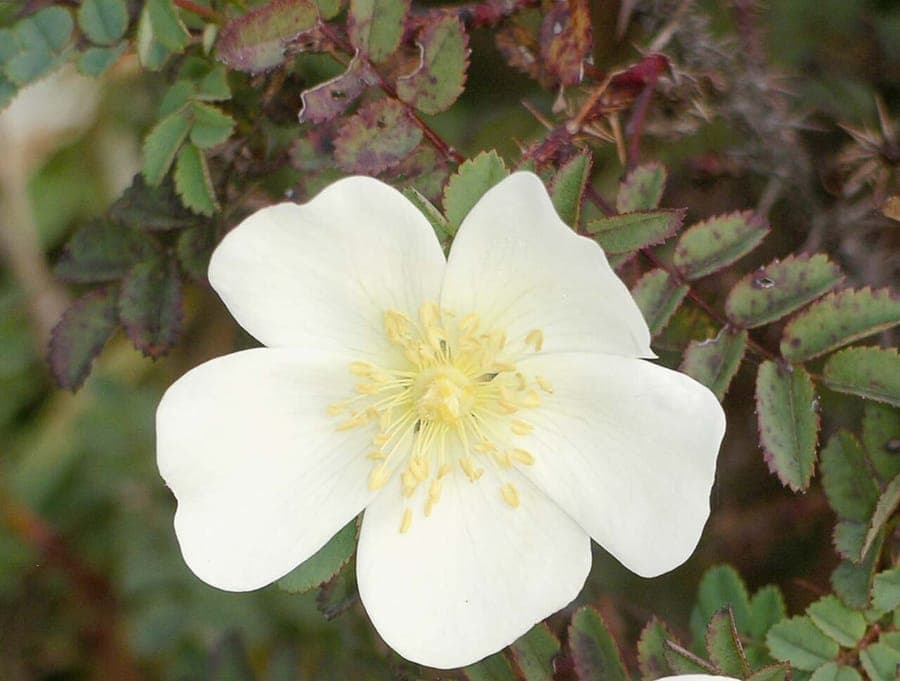
Velela / CC BY-SA 2.5, via Wikimedia Commons
Burnet rose: complete guide
Rosa spinosissima
Want to see Burnet rose: complete guide in your garden?
1 minute, no credit card
Overview
If you're looking for a rose that doesn't demand constant attention, Rosa spinosissima - better known as the Burnet rose - is a top contender. This subshrub grows 1 to 1.5 meters tall with an equal spread, forming a dense, thicket-like structure thanks to its extremely spiny stems and branchlets. Native to regions like Albania, Austria, Belarus, and Denmark, it's no surprise this plant thrives in tough conditions. It's particularly at home in coastal areas, where salt spray and wind would knock out most other shrubs.
The Burnet rose blooms in late spring to early summer, producing clusters of small, fragrant flowers that are usually white or pale yellow. By late summer, these give way to distinctive dark purple to black hips that persist well into winter. These hips are rich in vitamin C and can be used in syrups or teas. On gardenworld.app, you can design a planting scheme that highlights the seasonal interest of this rose, especially when paired with ornamental grasses or native perennials.
Appearance & bloom cycle
The foliage is one of its standout features - finely divided, fern-like leaves made up of 7 to 11 small leaflets. The leaves are dark green, slightly glossy, and turn yellow or bronze in autumn. Flowers appear from May to early July, each about 3–5 cm across, with prominent golden stamens. They last around a week and emit a soft, honey-like scent that attracts bees and hoverflies.
After flowering, the plant develops oval, velvety hips that are 1–2 cm long. These stay on the stems through winter and provide food for birds such as fieldfares and redwings. The overall habit is upright and spreading, creating a natural screen or informal hedge.
Ideal location
Give your Burnet rose at least 6 hours of direct sunlight daily (light level 6). It tolerates partial shade but will flower less. This rose handles exposed, windy sites with ease, making it a great option for coastal gardens or rural landscapes. It's fully hardy down to -30°C (USDA zone 4), so winter cold isn't an issue. Avoid planting in deep shade or under dense tree canopies where airflow is poor.
Use gardenworld.app to map out sun exposure in your garden and find the best spot for Rosa spinosissima. The platform helps you visualise how the plant will fit into your design over time, including its mature spread.
Soil requirements
The Burnet rose prefers well-drained, sandy or loamy soils with a neutral to slightly alkaline pH (7.5–8.0). It copes well with chalky or limestone soils and doesn't mind poor fertility. The key is drainage - waterlogged soil will quickly lead to root rot. If you have heavy clay, amend the planting hole with grit or sharp sand to improve drainage.
Free design
Want to see Burnet rose: complete guide in your garden? Make a free design now.
Watering
Once established, this rose is highly drought-tolerant. During the first growing season, water weekly with 5–10 liters per plant, especially in dry spells. After that, rainfall is usually sufficient. Avoid wetting the foliage when watering to reduce the risk of powdery mildew.
Pruning
Minimal pruning is needed. If you must prune, do it in late winter or early spring (February–March). Remove dead, damaged, or crossing stems using thick gloves - the thorns are sharp and numerous. Never cut back hard unless rejuvenating an old plant. The natural shape is attractive and should be preserved.
Maintenance calendar
- January: check for winter damage
- February: light pruning, remove dead wood
- March: final trim, mulch lightly around base
- April: inspect for aphids, use natural predators if needed
- May: flowering begins, no feeding required
- June: peak bloom, keep area weed-free
- July: let spent flowers remain for hip development
- August: no watering unless prolonged drought
- September: hips ripen, leave for wildlife
- October: fallen leaves can be left as natural mulch
- November: check for signs of disease, no pruning
- December: plant dormant, protect young specimens with straw if in exposed location
Winter hardiness
Rosa spinosissima is exceptionally hardy, surviving in USDA zones 4 to 7 without protection. It sheds its leaves in winter and re-sprouts vigorously in spring. No winter covering is needed, though young plants in very exposed spots may benefit from a light mulch of straw.
Companion plants
Pair the Burnet rose with drought-tolerant perennials like Echinacea purpurea, Salvia nemorosa, or Sedum 'Autumn Joy'. Grasses such as Stipa tenuissima or Deschampsia cespitosa add movement and contrast. Lavender and thyme also work well, especially in sunny, dry borders. Avoid overly vigorous groundcovers that might compete for root space.
Closing
The Burnet rose isn't flashy, but it's reliable, beautiful in its own subtle way, and a magnet for wildlife. It's perfect for gardeners who want something tough yet elegant. You can find Rosa spinosissima at garden centres across the UK and online. Look for healthy, well-rooted plants with visible buds. Once planted, it asks for little and gives back for decades. With its resilience and seasonal charm, it earns a permanent spot in any thoughtful garden design.
Want to see Burnet rose: complete guide in your garden? Make a free design now.
Upload a photo, pick a style, and get a photorealistic design with plant list in under a minute.
No credit card required


Similar plants
Siberian crab apple: complete guide
Malus x robusta
Complete guide to the Siberian crab apple (Malus x robusta): location, soil, pruning, winter hardiness and the best companion plants for your garden.
Chinese flowering crabapple (Malus x spectabilis): complete guide
Malus x spectabilis
Meet the Chinese flowering crabapple (Malus x spectabilis): a classic spring bloomer with carmine buds and pink blossom.
Potentilla crassinervia: complete guide
Potentilla crassinervia
Potentilla crassinervia, the Corsican cinquefoil, grows wild on Corsica and Sardinia's peaks. Discover how to grow this hardy alpine rock garden gem.