
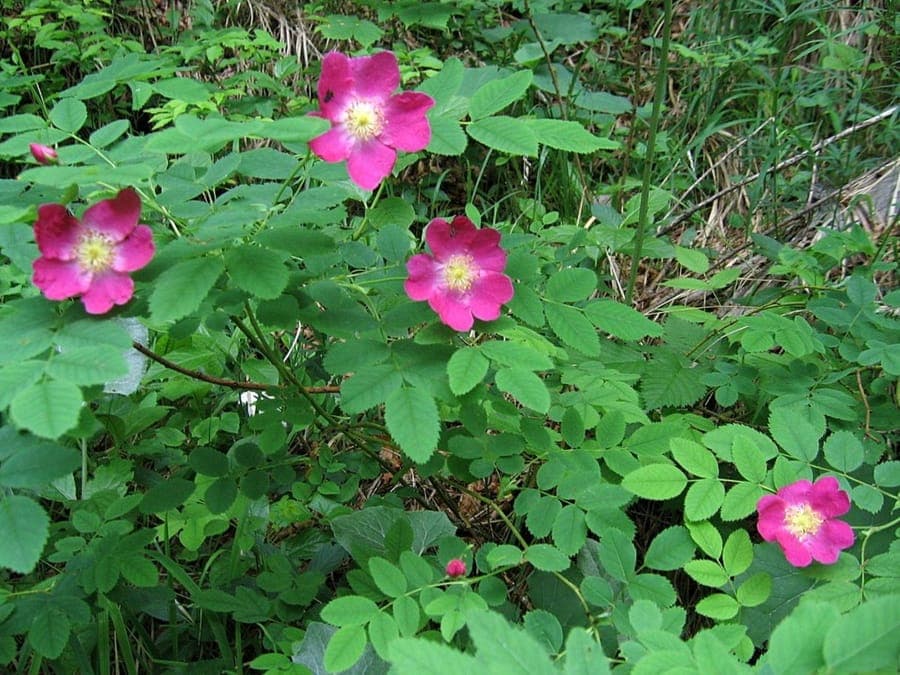
Boris Gaberšček / CC BY 2.5 si, via Wikimedia Commons
Alpine rose: complete guide
Rosa pendulina
Want to see Alpine rose: complete guide in your garden?
1 minute, no credit card
Overview
Rosa pendulina, commonly known as the Alpine rose, is a resilient shrub rose that thrives in rocky, high-altitude environments. Native to alpine regions across central and southern Europe, it naturally grows between 800 and 2200 meters in elevation. In the garden, it brings a wild elegance - not flashy, but deeply rooted in seasonal rhythm. It's perfect for rock gardens, naturalistic borders, or as a solitary feature in smaller spaces. Unlike hybrid teas, it doesn't need constant attention, making it a favorite among gardeners who value hardiness over show.
On gardenworld.app, you can design a planting scheme that highlights the Alpine rose's natural drape and seasonal berries. Use it in elevated beds or near stone walls to echo its native habitat.
Appearance & bloom cycle
This shrub reaches 120–180 cm in height with a spread of about 100 cm. Stems are slender, arching, and lightly thorny. Foliage is dark green, pinnate with 5–7 oval leaflets that turn a soft yellow in autumn. The real show starts in June and lasts through July.
Flowers are single, measuring 4–5 cm across, with five delicate purple petals and a bright yellow center. They bloom in small clusters at the tips of last year's wood. After flowering, oval, reddish-brown hips develop and hang pendulously - hence the species name pendulina. These persist well into winter, often until February, offering food for birds and visual interest in the dormant season.
Ideal location
Plant Rosa pendulina where it gets at least 6 hours of direct sun daily - a light rating of 6 out of 10. Full sun is ideal, but light afternoon shade helps in hot climates. Avoid dark, damp corners; this rose needs good air circulation to prevent fungal issues like powdery mildew.
It tolerates exposed sites and wind, which makes it suitable for open gardens or hillside plantings. However, it doesn't do well in deep shade or under dense tree canopies. Use gardenworld.app to map sun patterns in your garden and find the perfect spot - especially useful if you're working with slopes or multi-level beds.
Soil requirements
The Alpine rose prefers well-drained, moderately fertile soil with a pH of 7.0–7.5. It handles calcareous (lime-rich) soils with ease, thriving in loamy or sandy loam. Heavy clay should be amended with grit or coarse sand to improve drainage.
Avoid overly rich compost - this plant doesn't need high nutrients. Too much organic matter leads to lush foliage but fewer flowers. A thin top dressing of leaf mold in spring is sufficient to maintain soil structure without overstimulating growth.
Free design
Want to see Alpine rose: complete guide in your garden? Make a free design now.
Watering
During the first growing season, water weekly during dry spells. Once established (after 12 months), it's highly drought-tolerant and only needs supplemental watering during prolonged dry periods (3+ weeks without rain).
Water at the base to keep foliage dry. Use rainwater if possible, especially in areas with hard tap water. Drip irrigation works well in dry microclimates or gravel gardens.
Pruning
Minimal pruning is required. Since it blooms on previous year's wood, avoid hard cutting in spring. The best time is late winter (February to early March), when you can remove dead, damaged, or crossing stems. Cut back to healthy growth, just above an outward-facing bud, at a 45-degree angle.
Preserve the natural arching form. Over-pruning disrupts the pendulous fruit display and reduces flowering. Remove older stems (over 4 years) to encourage new growth from the base.
Maintenance calendar
- Jan: inspect for winter damage, protect base if needed
- Feb: light pruning, remove dead wood
- Mar: check for aphids, apply organic spray if needed
- Apr: apply light mulch, no fertilizer
- May: monitor for mildew, ensure good airflow
- Jun–Jul: main bloom period, do not prune
- Aug: water during drought, hips begin to form
- Sep: leave hips on plant for winter appeal
- Oct: leaf drop, leave fallen leaves as natural mulch
- Nov: final disease check, no pruning
- Dec: plant dormant, hips still visible
Winter hardiness
Rosa pendulina is extremely cold-hardy, surviving temperatures down to -25°C. It's suited to USDA zones 4–7. While it tolerates mild winters, ensure soil doesn't stay waterlogged - wet roots in winter cause rot.
The persistent hips add winter texture, especially when lightly dusted with snow. Birds like thrushes and redwings feed on them in late winter, making this rose ecologically valuable.
Companion plants
Pair with alpine and drought-tolerant perennials. Try Sedum spectabile (pink, Aug–Sep), Campanula carpatica (blue-white, Jul–Sep), or Thymus serpyllum for ground cover. Grasses like Festuca ovina add movement without competition.
Avoid aggressive spreaders like ivy or mint. Plant in groups of 1–3 for best effect. Use gardenworld.app's companion finder to test visual and ecological matches in your garden layout.
Closing
Rosa pendulina isn't a garden diva - it's a quiet performer with lasting appeal. Its purple blooms, graceful habit, and winter berries offer year-round interest with little demand. No heavy scent, no endless deadheading - just resilience and rhythm.
You'll find this rose at garden centres like those in the UK, often sold in 3L pots. Plant in autumn (Oct–Nov) or early spring (Feb–Mar). Give it space, sun, and time, and it will reward you for years.
Want to see Alpine rose: complete guide in your garden? Make a free design now.
Upload a photo, pick a style, and get a photorealistic design with plant list in under a minute.
No credit card required


Similar plants
Siberian crab apple: complete guide
Malus x robusta
Complete guide to the Siberian crab apple (Malus x robusta): location, soil, pruning, winter hardiness and the best companion plants for your garden.
Chinese flowering crabapple (Malus x spectabilis): complete guide
Malus x spectabilis
Meet the Chinese flowering crabapple (Malus x spectabilis): a classic spring bloomer with carmine buds and pink blossom.
Potentilla crassinervia: complete guide
Potentilla crassinervia
Potentilla crassinervia, the Corsican cinquefoil, grows wild on Corsica and Sardinia's peaks. Discover how to grow this hardy alpine rock garden gem.