
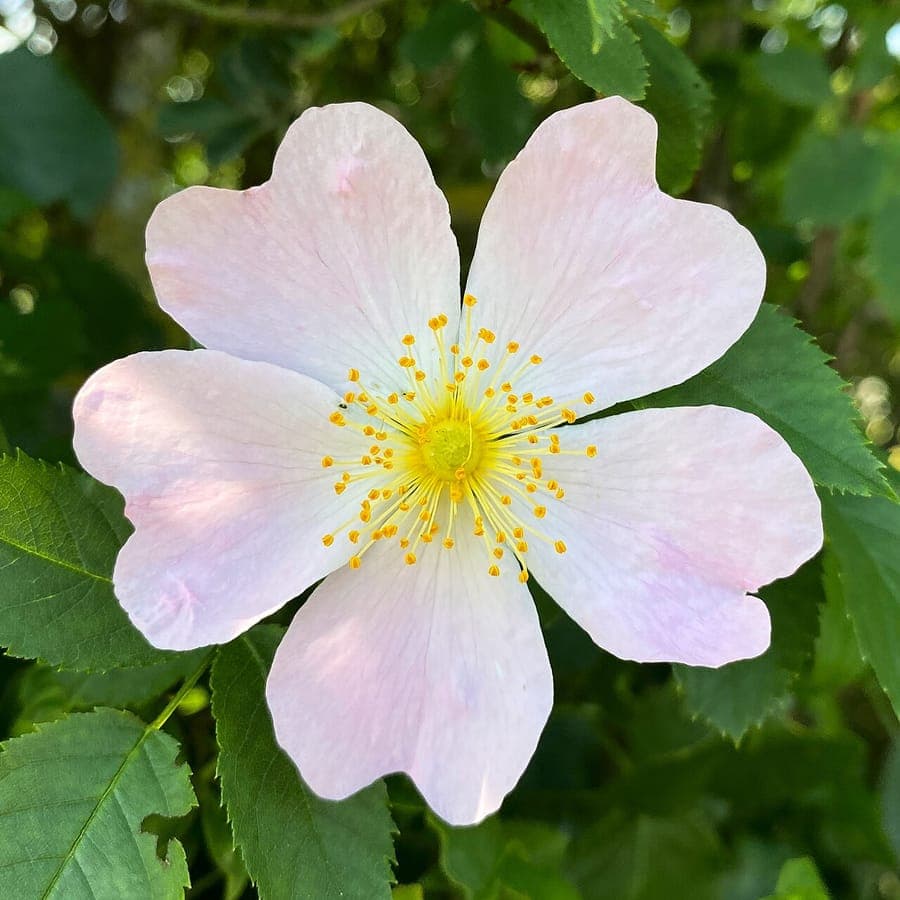
Hangman'sDeath / CC0, via Wikimedia Commons
Round-leaved dog-rose: complete guide
Rosa obtusifolia
Want to see Round-leaved dog-rose: complete guide in your garden?
1 minute, no credit card
Overview
Rosa obtusifolia, commonly known as the round-leaved dog-rose, is a tough, understated wild rose native to parts of central and southern Europe. Belonging to the Rosaceae family, it thrives in semi-shaded to sunny spots with moderate moisture. It's a great fit for gardeners in the UK and northern Europe looking to add ecological value without high maintenance. This deciduous shrub reaches up to 2 meters tall and spreads via underground runners, forming dense thickets over time. It's fully hardy down to USDA zone 4, making it suitable for most temperate climates.
What sets this rose apart is its natural, untamed growth habit. Unlike cultivated roses, it doesn't need perfect conditions to thrive. It's ideal for informal hedges, wildlife corners, or as a screening plant. On gardenworld.app, you can design a planting scheme where Rosa obtusifolia acts as a backbone species in a native shrub border.
Appearance & bloom cycle
The round-leaved dog-rose lives up to its name with nearly circular leaflets, coarsely toothed along the edges. The foliage is dark green above, slightly hairy underneath, and emerges in April, lasting until October. In June and July, it produces small, single flowers around 3–4 cm wide. The petals are soft pink to pale white, with a light, sweet scent that attracts bees and hoverflies.
After flowering, oval-shaped rose hips develop, reaching 1–1.5 cm in length. These deep red hips persist into winter, offering food for birds like thrushes and finches. The contrast of dark hips against bare stems adds winter interest, especially after leaf drop.
Ideal location
Choose a spot with partial shade to full sun. While it performs well in dappled shade-under light-canopy trees or near woodland edges-it tolerates full sun if the soil doesn't dry out completely. Avoid hot, exposed south-facing walls unless you can provide supplemental water in summer.
This rose naturally grows in transition zones between grassland and scrub, so it's perfect for recreating that wild garden feel. Place it at the back of a border or in a neglected corner where it can spread freely. On gardenworld.app, you'll find layout ideas showing how to integrate this rose into naturalistic planting schemes.
Soil requirements
Rosa obtusifolia isn't fussy about soil type but grows best in fertile, well-drained loam with a pH between 5.5 and 7.0. It tolerates clay, sandy loam, and even slightly acidic soils. If your soil is heavy clay, mix in compost or coarse grit to improve drainage. Avoid waterlogged sites-this rose hates soggy roots.
Once established, it handles short dry spells well, but consistent moisture supports stronger growth and better flowering.
Free design
Want to see Round-leaved dog-rose: complete guide in your garden? Make a free design now.
Watering
Water young plants regularly during the first growing season-about 10–15 liters per plant twice a week during dry spells. After the first year, it becomes drought-tolerant and rarely needs watering unless facing prolonged summer drought.
When you do water, soak deeply rather than spraying lightly. This encourages deeper root development and improves resilience.
Pruning
Pruning is minimal but helpful for shaping and health. Since it flowers on old wood, avoid hard pruning in spring, which could reduce blooms. The best time is late winter to early spring (February to March), when you should remove dead, damaged, or crossing stems. Limit cuts to one-third of the plant to avoid stressing it.
If you're using it for a hedge, light trimming after flowering in July helps maintain density. Always wear thick gloves-its thorns are sharp and can cause skin irritation.
Maintenance calendar
- January: Check for winter damage. Plan pruning.
- February: Begin light pruning of dead wood.
- March: Main pruning window. Remove old canes.
- April: New shoots emerge. Apply a layer of mulch.
- May: Growth accelerates. No feeding needed.
- June: Blooms begin. Watch for aphids.
- July: Peak flowering. Light trim after bloom if desired.
- August: Hips start forming. Reduce watering.
- September: Stop feeding. Plant prepares for dormancy.
- October: Leaves drop. Avoid pruning now.
- November: Top up mulch. Protect young plants.
- December: Monitor for storm damage.
Winter hardiness
This rose is extremely hardy, surviving temperatures down to -30°C (USDA zone 4). In the UK and most of Europe, it requires no winter protection. Young plants in their first year benefit from a mulch layer around the base to insulate roots from frost heave.
Companion plants
Pair Rosa obtusifolia with late-summer bloomers like Echinacea purpurea, Verbena bonariensis, and Sanguisorba officinalis. In shadier spots, add Dryopteris filix-mas or Carex elata 'Aurea'. For wildlife value, include Viburnum opulus or Cotoneaster to extend food sources into winter.
Avoid competitive groundcovers like Lamium or Vinca that might smother new suckers.
Closing
The round-leaved dog-rose is a low-maintenance, wildlife-friendly shrub that brings subtle beauty and ecological function to the garden. With its delicate flowers, persistent hips, and natural form, it's ideal for cottage gardens, wild corners, or informal hedges. Available at most garden centres, especially in spring and autumn. Try combining it with rustic fencing or native hedgerow species. And remember: gardenworld.app offers planting plans that show exactly how this rose fits into your garden's long-term design.
Want to see Round-leaved dog-rose: complete guide in your garden? Make a free design now.
Upload a photo, pick a style, and get a photorealistic design with plant list in under a minute.
No credit card required


Similar plants
Siberian crab apple: complete guide
Malus x robusta
Complete guide to the Siberian crab apple (Malus x robusta): location, soil, pruning, winter hardiness and the best companion plants for your garden.
Chinese flowering crabapple (Malus x spectabilis): complete guide
Malus x spectabilis
Meet the Chinese flowering crabapple (Malus x spectabilis): a classic spring bloomer with carmine buds and pink blossom.
Potentilla crassinervia: complete guide
Potentilla crassinervia
Potentilla crassinervia, the Corsican cinquefoil, grows wild on Corsica and Sardinia's peaks. Discover how to grow this hardy alpine rock garden gem.