
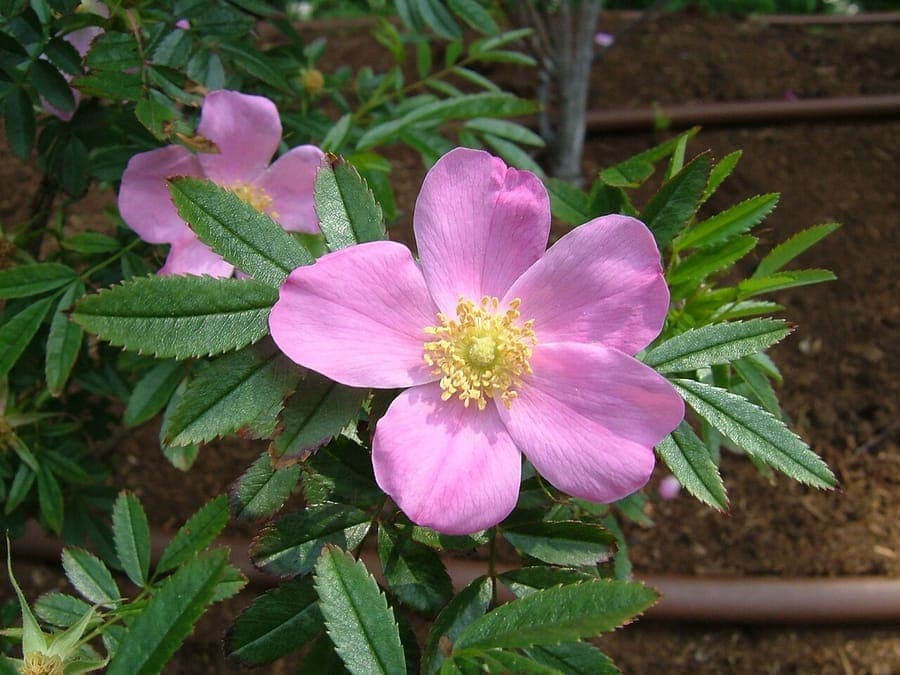
Sakurai Midori / CC BY-SA 3.0, via Wikimedia Commons
Rosa nitida (Shining Rose): complete guide
Rosa nitida
Want to see Rosa nitida (Shining Rose): complete guide in your garden?
1 minute, no credit card
Overview
Rosa nitida, the shining rose, is a compact North American wild rose prized for its unusually glossy foliage and delicate pink flowers. Growing to 0.6-1.5 meters tall, this shrub forms a dense, tidy mound. The small leaves are remarkably lustrous green, creating a striking visual contrast to its thorny stems. This exceptional foliage sheen persists through the growing season, providing value even when not in flower.
The plant is remarkably low-maintenance once established, making it an excellent choice for sustainable gardeners seeking disease-resistant, wildlife-friendly roses without the fuss of hybrid tea roses.
Appearance and Bloom
Rosa nitida grows as a compact, spreading shrub densely covered with fine thorns. Foliage is exceptionally small and intensely glossy green, lending an almost delicate, fine-textured appearance. The thorn density is remarkable, with sharp prickles clothing nearly all stems completely.
From May to July, pink to magenta single flowers appear in clusters of one to three per branch tip. These simple five-petaled blooms attract pollinators abundantly. Following flowering, the plant develops bright red, glossy hips that persist well into winter, providing bird food and extended ornamental interest.
Ideal Location
Select full sun with at least 6-8 hours direct sunlight daily for best flowering. The rose tolerates partial shade but flowers sparsely and weakly. Full shade is unsuitable. Wind exposure poses no problem, making this an excellent choice for exposed sites.
Soil exposure and humidity are not concerns, simplifying placement decisions.
Soil
Rosa nitida thrives on well-drained, moderately moist soil but is significantly more soil-tolerant than hybrid roses. It accepts acidic or alkaline conditions without complaint and even tolerates poor, dry soils, though growth becomes restricted.
Improve impoverished soils with a 10-15 cm layer of compost or leaf mold at planting time to conserve moisture and support soil biology. Ensure adequate drainage; waterlogged soil leads to root disease.
Watering
Once established, Rosa nitida is drought-tolerant and requires less water than modern roses. Water deeply but infrequently to encourage deep rooting. During the first growing season, water twice weekly at minimum; reduce frequency thereafter.
In dry, hot summers, supplemental watering encourages flowering. Check soil moisture to 10 cm depth; water thoroughly when dry. Apply 7-10 cm mulch around the base to conserve moisture and regulate temperature.
Free design
Want to see Rosa nitida (Shining Rose): complete guide in your garden? Make a free design now.
Pruning
Rosa nitida requires minimal pruning. Remove dead or damaged wood in early spring. Because the plant grows compactly, major pruning is unnecessary.
After flowering (August), lightly shorten congested or overly long shoots to encourage bushier growth, though this is optional. If the plant becomes sparse, cut some branches back to mid-length to stimulate branching.
Be cautious of the abundant thorns during pruning work; wear sturdy gloves and proceed carefully.
Maintenance Calendar
Spring (March-May): Remove dead wood. Apply compost around root zone. Begin regular watering.
Summer (June-July): Enjoy prolific flowering. Monitor for drought; water as needed. Light pruning after flowering is optional.
Fall (August-October): Admire bright red hips. Gradually reduce watering. Prepare for winter dormancy.
Winter: Plant is fully hardy without protection. No maintenance required.
Winter Hardiness
Rosa nitida is extremely hardy to zone 3 (to -40 degrees Celsius). It thrives throughout Northwestern Europe without protection, making it a reliable choice for cold climates. Even after severe frost periods, the plant reliably regrows from healthy wood each spring.
Companion Plants
Rosa nitida combines beautifully with low shrubs and groundcovers:
- Lavender for purple flowers and fragrance
- Salvias for blue and purple blooms
- Gaura lindheimeri for airy grace and height
- Summer asters for fall color
- Ornamental grasses like Festuca glauca for blue-green texture
Combinations with other wild roses like Rosa rugosa create interesting collections offering winter hips for wildlife.
Closing
Rosa nitida is a robust, disease-free wild rose far more practical than modern hybrids. Its glossy foliage, pink flowers, and red autumn hips provide multi-season interest. Drought-tolerance and minimal maintenance requirements make it an ideal choice for sustainable landscapes. Quality nurseries commonly stock this species.
For personalized garden designs featuring shining rose and other perfect plants for your space, visit gardenworld.app today.
Want to see Rosa nitida (Shining Rose): complete guide in your garden? Make a free design now.
Upload a photo, pick a style, and get a photorealistic design with plant list in under a minute.
No credit card required


Similar plants
Siberian crab apple: complete guide
Malus x robusta
Complete guide to the Siberian crab apple (Malus x robusta): location, soil, pruning, winter hardiness and the best companion plants for your garden.
Chinese flowering crabapple (Malus x spectabilis): complete guide
Malus x spectabilis
Meet the Chinese flowering crabapple (Malus x spectabilis): a classic spring bloomer with carmine buds and pink blossom.
Potentilla crassinervia: complete guide
Potentilla crassinervia
Potentilla crassinervia, the Corsican cinquefoil, grows wild on Corsica and Sardinia's peaks. Discover how to grow this hardy alpine rock garden gem.