
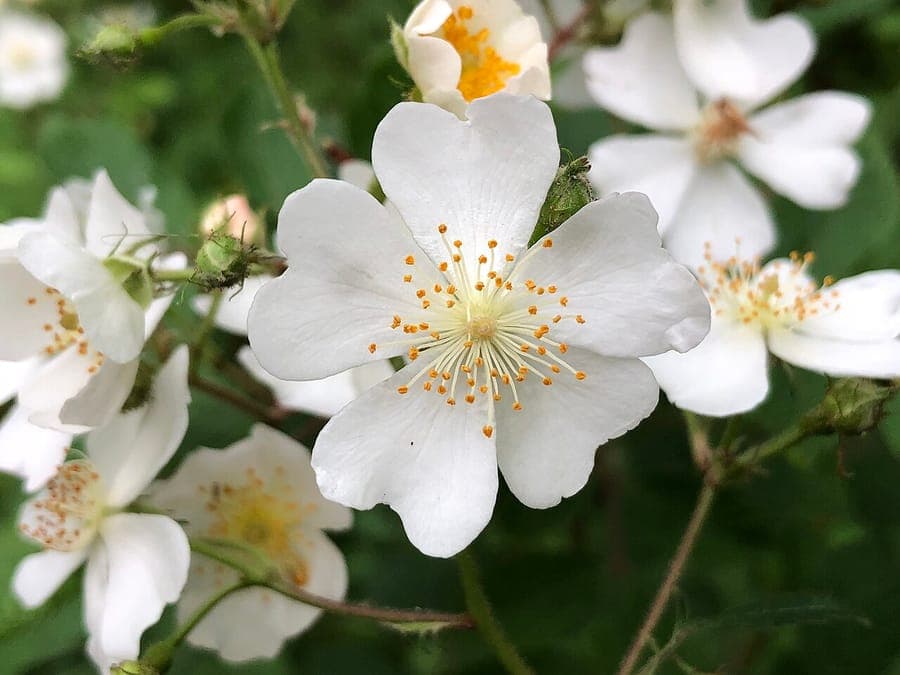
Famartin / CC BY-SA 4.0, via Wikimedia Commons
Japanese rose: complete guide
Rosa multiflora
Want to see Japanese rose: complete guide in your garden?
1 minute, no credit card
Overview
Rosa multiflora, commonly known as the Japanese rose, is a tough, fast-growing climber that's earned both praise and caution in garden circles. Native to eastern Asia - particularly central and southern China, Japan, and Korea - this species has naturalised in parts of North America and Europe, where in some areas it's classified as invasive. But in a controlled garden setting, it's a powerful performer: quick to cover structures, rich in blooms, and valuable to wildlife.
It grows as a subshrub or vine, reaching 2–4 meters in height with support. Its long, arching canes are armed with fine but sharp thorns, making it a good choice for security hedging. It's best suited as a backdrop plant, informal hedge, or climber on sturdy fences or pergolas.
Appearance & bloom cycle
The foliage is bright to dark green, pinnately compound with 5–11 toothed leaflets. Leaves emerge in late spring and persist into autumn, turning yellow before dropping. The real spectacle kicks in late May to early June, when dense panicles of small white flowers burst open. Each flower is about 1.5–2 cm wide, with five petals and a light, honey-like fragrance that pulls in bees, hoverflies, and butterflies.
After pollination, small red hips form and mature by late summer. These persist well into winter, providing food for birds like thrushes and finches. The plant's thorny nature also offers shelter, making it a mini wildlife refuge.
Ideal location
This rose thrives in full sun but tolerates partial shade. For maximum flowering, give it at least 6 hours of direct sunlight daily. In heavy shade, it becomes leggy and blooms sparsely.
Because it climbs by arching canes, it needs solid support - a wooden or metal trellis, fence, or even a tree. Avoid flimsy structures; mature canes get heavy, especially when wet. It's excellent for covering unsightly walls or creating a living screen.
On gardenworld.app, you can generate a garden design that integrates this rose with ideal support structures and companion plants based on your garden's dimensions.
Soil requirements
Rosa multiflora isn't fussy about soil type. It grows in sandy, loamy, or clay soils as long as drainage is good. Ideal pH ranges from 5.5 to 7.0. In heavy clay, amend with compost or grit to improve drainage. In sandy soils, mix in organic matter to boost moisture retention.
At planting time, enrich the hole with a shovel of compost or well-rotted manure. Avoid high-nitrogen fertilisers - they promote leafy growth at the expense of flowers.
Free design
Want to see Japanese rose: complete guide in your garden? Make a free design now.
Watering
During the first growing season, water deeply once or twice a week, depending on rainfall. Use a soaker hose or watering can with a rose to target the root zone and avoid wetting foliage, which can encourage fungal diseases like black spot.
Once established, it's drought-tolerant and handles dry spells well. However, during prolonged drought (over two weeks without rain), supplemental watering keeps it healthy. Rainwater is preferred - this rose dislikes hard, alkaline tap water.
Pruning
Pruning is essential to keep growth in check and encourage flowering. The best time is late winter to early spring (February to early March), before new growth starts. Remove dead, damaged, or crossing stems. Cut lateral shoots back to 2–3 buds to promote flowering spurs.
Important: Rosa multiflora flowers on previous year's wood, so avoid hard pruning in autumn. Over-pruning now means fewer blooms next season.
Maintenance calendar
- January: Inspect canes; remove any winter damage.
- February – March: Main pruning window. Shape and thin out stems.
- April – May: New growth emerges. Light feed with rose fertiliser if needed.
- June – July: Peak bloom. Deadhead only if desired; avoid heavy pruning.
- August – September: Monitor for aphids or rose rust. Use organic sprays if infestations occur.
- October – December: Hips persist. Leave them for birds. Minimal care required.
Winter hardiness
This rose is highly cold-tolerant, thriving in USDA zones 5–9. In the UK and most of the US, it survives winter without protection. Young plants may benefit from a mulch layer around the base in zone 5 to buffer extreme cold.
It loses its leaves in late autumn, but the red hips and thorny structure add winter interest. Avoid pruning in fall - it can stimulate soft growth vulnerable to frost.
Companion plants
Pair it with late-flowering perennials like Echinacea, Rudbeckia, or Sedum to extend visual interest after its June bloom. Low evergreens such as Vinca minor or Pachysandra provide year-round ground cover.
For a wildlife hedge, combine with native shrubs like Cornus alba or Rhamnus cathartica. Avoid invasive ground covers like ivy, which can smother the rose.
On gardenworld.app, you can simulate plant pairings and spacing to ensure your Japanese rose thrives without overcrowding.
Closing
Rosa multiflora is a bold choice for gardeners wanting fast coverage and abundant blooms. While it requires vigilance to prevent spreading, in a managed garden it's a reliable, beautiful, and ecologically useful plant. Look for it at garden centres across the UK and North America, but check local guidelines - some regions restrict its sale due to invasiveness. When placed well, it's a standout performer.
Want to see Japanese rose: complete guide in your garden? Make a free design now.
Upload a photo, pick a style, and get a photorealistic design with plant list in under a minute.
No credit card required


Similar plants
Siberian crab apple: complete guide
Malus x robusta
Complete guide to the Siberian crab apple (Malus x robusta): location, soil, pruning, winter hardiness and the best companion plants for your garden.
Chinese flowering crabapple (Malus x spectabilis): complete guide
Malus x spectabilis
Meet the Chinese flowering crabapple (Malus x spectabilis): a classic spring bloomer with carmine buds and pink blossom.
Potentilla crassinervia: complete guide
Potentilla crassinervia
Potentilla crassinervia, the Corsican cinquefoil, grows wild on Corsica and Sardinia's peaks. Discover how to grow this hardy alpine rock garden gem.