
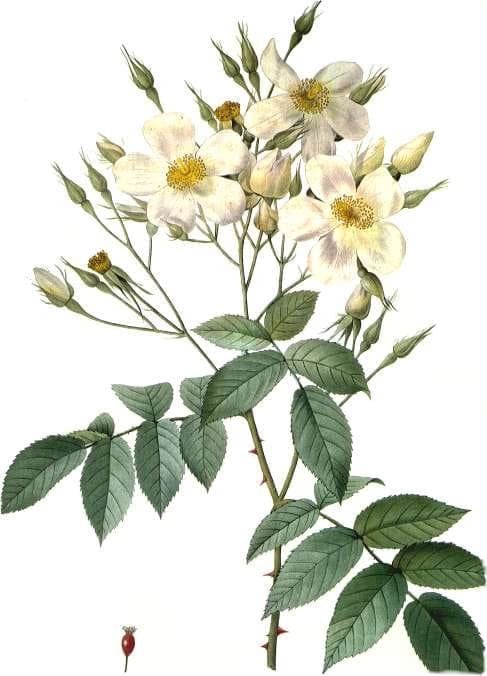
Pierre-Joseph Redouté / Public domain, via Wikimedia Commons
Musk rose: complete guide
Rosa moschata
Want to see Musk rose: complete guide in your garden?
1 minute, no credit card
Overview
Rosa moschata, commonly known as the Musk rose, is a vigorous climber with a subshrub growth habit, native to Afghanistan and Iran. It brings a relaxed elegance to gardens with its clusters of fragrant white flowers that bloom in May and June. Thriving in full sun to light shade (light level 8/10), this rose is perfect for covering walls, fences, or pergolas. Unlike many modern roses, it blooms on old wood, so pruning must be done carefully to avoid cutting off next year's flowers.
The Musk rose is not high-maintenance, but it does need the right conditions to shine. It can reach up to 3 meters in height with support, and spreads 1.5 to 1.8 meters wide if left unchecked. On gardenworld.app, you can visualise how this rose fits into your garden layout, helping you plan structures and companion planting effectively.
Appearance & bloom cycle
The flowers are pure white, often with a hint of yellow in the center, and appear in large clusters of 5 to 12 blooms. The petals have a soft, slightly crinkled texture, giving them a wild, informal charm. The fragrance is delicate and musky-more noticeable in the evening than during the day. Bloom time peaks in May and June, with occasional light reblooming in late summer if spent flowers are deadheaded.
Foliage is dark green, glossy, and pinnately compound, providing a lush backdrop even when not in bloom. Stems become woody over time and carry scattered, slender thorns-manageable for pruning and training. Without support, the plant sprawls as a dense shrub; with support, it climbs gracefully, making it ideal for vertical interest.
Ideal location
Full sun is best-aim for at least 6 hours daily. A south- or west-facing wall or trellis works perfectly. The Musk rose tolerates light afternoon shade, especially in hotter climates, but too much shade reduces flowering and encourages leggy growth.
Since it's a climber, install a sturdy support system early. Use wooden posts, metal wires, or a pergola frame. Train the main stems horizontally or at a slight angle to encourage more flowering spurs. On gardenworld.app, you can test different trellis designs and spacing to match the rose's growth pattern before installing anything physically.
Soil requirements
This rose prefers well-drained, loamy soil rich in organic matter. The ideal pH range is 6.5 to 7.0. Heavy clay soils are acceptable if amended with compost or coarse sand to improve drainage. Avoid waterlogged sites-root rot is a real risk in poorly drained soils.
At planting, mix in a bucket of well-rotted manure or compost into the planting hole. Top-dress with organic mulch (like bark chips or leaf mould) each spring to retain moisture and suppress weeds. Keep mulch a few centimetres away from the base to prevent collar rot.
Free design
Want to see Musk rose: complete guide in your garden? Make a free design now.
Watering
During the first growing season, water deeply once or twice a week, especially in dry spells. Aim for about 10 litres per plant weekly during spring and early summer. After the first year, the rose becomes more drought-tolerant but still performs best with consistent moisture.
Use rainwater when possible-roses can be sensitive to lime in tap water. Water at the base to avoid wetting the foliage, which can promote fungal diseases like black spot or powdery mildew. Early morning is the best time to water.
Pruning
Prune lightly and only after flowering. Since Rosa moschata blooms on old wood, hard pruning will remove potential flower buds. Focus on removing dead, damaged, or crossing stems. Cut back long, straggly canes by a third to maintain shape and encourage bushiness.
For older plants, thin out a few of the oldest stems at ground level every few years to rejuvenate growth. Always use sharp, clean secateurs and disinfect between cuts if disease is present.
Maintenance calendar
- january: Inspect for dieback, remove dead wood
- february: Light tidy-up; check support ties
- march: Start feeding with slow-release organic rose fertiliser
- april: Watch for aphids and fungal issues; increase watering if dry
- may: Primary bloom begins; avoid pruning
- june: Peak flowering; deadhead to encourage rebloom
- july: Reduce watering; monitor for mildew in humid weather
- august: Light shaping if needed after rebloom
- september: Stop feeding to prepare for dormancy
- october: Apply mulch with compost
- november: Clear fallen leaves to reduce disease carryover
- december: Minimal care; protect young plants in zone 6 if harsh winter expected
Winter hardiness
Rosa moschata is hardy in USDA zones 6 to 9 (-23°C to -1°C). In most of the UK and northern Europe, it survives winter well. Young plants benefit from a 5–10 cm layer of mulch around the base in colder regions. Mature plants need little protection, but avoid exposed, windy sites that increase desiccation risk.
Companion plants
Pair the Musk rose with lavender, catmint (Nepeta), or Russian sage for contrasting foliage and extended bloom time. Clematis integrifolia or Campanula carpatica work well at the base. Avoid invasive groundcovers that compete for nutrients.
For a cottage garden look, plant alongside white phlox, Allium 'Mount Everest', or tall verbena. Leave at least 60 cm between plants to ensure good air circulation and reduce disease pressure.
Closing
The Musk rose is a graceful, low-fuss climber that rewards with fragrant blooms and year-round structure. It's ideal for gardeners who want beauty without constant upkeep. Plant in spring or autumn from reputable garden centres. Look for healthy, well-branched specimens in pots or bare-root form.
When buying, check for signs of pests or disease. And remember: location and support are key. Once established, Rosa moschata becomes a garden staple-blooming reliably and adding vertical charm for years. Plan your layout smartly using gardenworld.app to maximise its potential.
Want to see Musk rose: complete guide in your garden? Make a free design now.
Upload a photo, pick a style, and get a photorealistic design with plant list in under a minute.
No credit card required


Similar plants
Siberian crab apple: complete guide
Malus x robusta
Complete guide to the Siberian crab apple (Malus x robusta): location, soil, pruning, winter hardiness and the best companion plants for your garden.
Chinese flowering crabapple (Malus x spectabilis): complete guide
Malus x spectabilis
Meet the Chinese flowering crabapple (Malus x spectabilis): a classic spring bloomer with carmine buds and pink blossom.
Potentilla crassinervia: complete guide
Potentilla crassinervia
Potentilla crassinervia, the Corsican cinquefoil, grows wild on Corsica and Sardinia's peaks. Discover how to grow this hardy alpine rock garden gem.