
Wikimedia Commons / Public domain, via Wikimedia Commons
Cinnamon rose: complete guide
Rosa majalis
Want to see Cinnamon rose: complete guide in your garden?
1 minute, no credit card
Overview
The cinnamon rose (Rosa majalis) is a tough, deciduous shrub that brings old-world charm and reliable performance to gardens across temperate zones. Native to woodlands and open slopes in Central and Eastern Europe - including Belarus, Finland, the Baltics, and parts of Germany and Austria - this species thrives in conditions where many modern roses struggle. Unlike hybrid tea roses, Rosa majalis demands little attention: it's disease-resistant, cold-tolerant, and blooms dependably each year without intensive care. It's a top pick for naturalistic planting schemes, cottage gardens, and wildlife-friendly borders. On gardenworld.app, you can design a planting plan that highlights its seasonal rhythm, pairing it with grasses or late-flowering perennials for year-round structure.
Appearance & bloom cycle
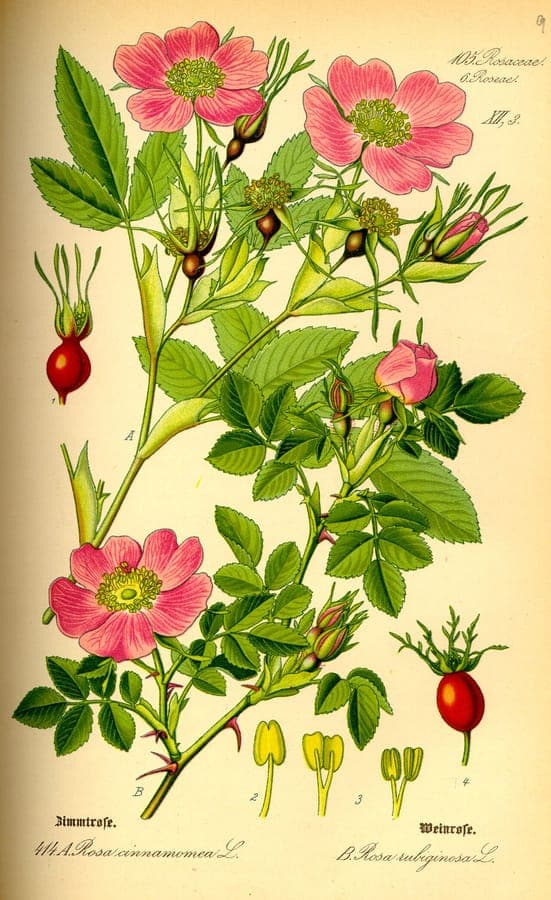
Rosa majalis reaches a mature height of 1 to 1.5 meters with a spread of about 1 meter. It grows in a graceful, slightly arching form with slender, thorny stems and rich green, pinnate foliage. In late May to early June, it produces clusters of 2 to 5 soft pink, single flowers - each about 4 to 6 cm in diameter - with a subtle, sweet scent. The bloom period lasts around three weeks. After flowering, it develops striking orange-red hips that persist well into winter, providing food for birds and visual interest. The foliage turns yellow in autumn before dropping, completing its seasonal cycle. This rose is truly a four-season plant.
Ideal location
For best results, plant in full sun (at least 6 hours of direct light daily). It will tolerate partial shade but may produce fewer flowers and become leggy. The cinnamon rose performs well in open borders, as part of a mixed hedgerow, or as a standalone specimen in a naturalistic garden. Its informal shape makes it ideal for relaxed designs. It's also suitable for larger containers, provided they are at least 40 cm wide and deep. When planning your layout, use gardenworld.app to visualise spacing and growth patterns, ensuring enough room for air circulation and natural development.
Soil requirements
This rose is adaptable to a wide range of soils as long as drainage is adequate. It grows well in loam, sandy loam, and even clay if amended with organic matter. The ideal pH is between 5.5 and 7.0. Avoid waterlogged soils - poor drainage is the most common cause of root rot. Adding compost at planting improves soil structure and provides slow-release nutrients. Once established, Rosa majalis shows good drought tolerance, making it suitable for drier garden areas or gravel gardens.
Free design
Want to see Cinnamon rose: complete guide in your garden? Make a free design now.
Watering
Water regularly during the first growing season, especially in dry spells. Aim for 10–15 litres per week per plant. After the first year, it typically survives on rainfall alone, though occasional deep watering during prolonged summer droughts (July–August) benefits flowering and hip development. Always water at the base to prevent fungal issues. Avoid overhead watering, particularly in humid conditions.
Pruning
Minimal pruning is needed. Since it flowers on previous year's wood, hard pruning in spring reduces bloom output. The best approach is light maintenance in late winter (February–March): remove dead, damaged, or crossing stems. You can also cut out older, woody stems (over 4 years) to encourage new growth from the base. Cut just above an outward-facing bud using clean, sharp secateurs. Never trim heavily - this rose looks best when allowed to express its natural, arching habit.
Maintenance calendar
- January: Inspect stems, remove any winter damage
- February: Begin light pruning, watch for pests
- March: Finish pruning, apply compost mulch
- April: Monitor for aphids on new growth
- May: Flowers appear, protect from late frost
- June: Blooms peak, check for powdery mildew
- July: Water during dry periods, no feeding needed
- August: Observe for stem sawfly or drought stress
- September: Leave hips intact for winter interest and birds
- October: Leaf drop begins, leave fallen leaves as natural mulch
- November: No action required
- December: Protect young plants with mulch if extreme cold is forecast
Winter hardiness
Rosa majalis is exceptionally hardy, surviving temperatures down to -35°C. It's suitable for USDA zones 2–7, making it ideal for gardens in the UK, Scandinavia, and Northern Europe. Mature plants need no winter protection. Young plants benefit from a 5–10 cm layer of organic mulch around the base to prevent frost heave.
Companion plants
Pair with herbaceous perennials that complement its airy form. Try Alliums, Campanula, or Geranium phaeum for texture contrast. For late-season interest, combine with Stipa tenuissima or Eryngium. The hips attract birds like redwings and fieldfares in winter, so plant near holly or rowan for added wildlife value. Its disease resistance means it won't spread issues to neighbouring plants - a major plus in mixed borders.
Closing
The cinnamon rose is a no-fuss, high-reward shrub. It doesn't need sprays, thrives in poor soils, and blooms reliably year after year. Its simple flowers, persistent hips, and clean foliage make it a standout in low-maintenance gardens. You can find Rosa majalis at garden centres across the UK, especially those specialising in heritage or species roses. And when planning your planting scheme, remember that gardenworld.app helps you visualise growth over time, ensuring your cinnamon rose has room to shine - both in summer bloom and winter structure.
Want to see Cinnamon rose: complete guide in your garden? Make a free design now.
Upload a photo, pick a style, and get a photorealistic design with plant list in under a minute.
No credit card required


Similar plants
Siberian crab apple: complete guide
Malus x robusta
Complete guide to the Siberian crab apple (Malus x robusta): location, soil, pruning, winter hardiness and the best companion plants for your garden.
Chinese flowering crabapple (Malus x spectabilis): complete guide
Malus x spectabilis
Meet the Chinese flowering crabapple (Malus x spectabilis): a classic spring bloomer with carmine buds and pink blossom.
Potentilla crassinervia: complete guide
Potentilla crassinervia
Potentilla crassinervia, the Corsican cinquefoil, grows wild on Corsica and Sardinia's peaks. Discover how to grow this hardy alpine rock garden gem.