
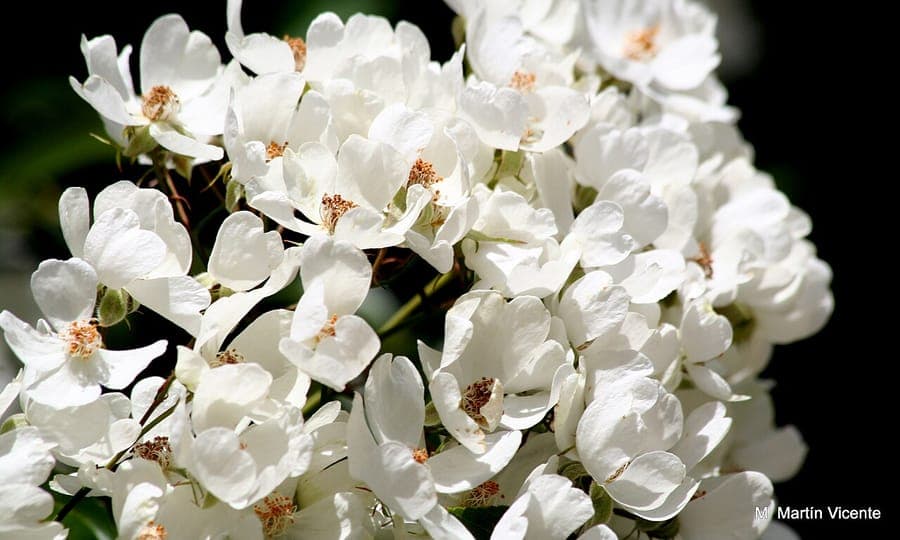
Manuel Martín Vicente from Valdemoro, Spain / CC BY 2.0, via Wikimedia Commons
Rosa indica: complete guide
Rosa indica
Want to see Rosa indica: complete guide in your garden?
1 minute, no credit card
Overview
Rosa indica, commonly known as Cyme rose or Indian rose, is a semi-climbing rose from southern China and Indo-China. Despite its name 'indica' (referring to India), the plant is native to East Asian highlands, where it grows in open forest and scrubland margins. This species belongs to the Rosaceae family and is renowned for its elegant, fragrant flowers that appear in clusters (cymes). In garden design, Rosa indica forms a refined flowering accent, suitable for borders, hedges, and light climbers.
Appearance and Bloom
Rosa indica grows into a semi-climbing shrub 1-2 meters tall with an arching, elegant growth form. The canes are slender and graceful, furnished with a few short thorns. The leaves are small to medium (4-8 centimeters), glossy green, irregularly compound with 5-7 leaflets. Flowers appear in May-June (and sporadically to October) in loose clusters of 3-7 blooms. Each flower is semi-double to fully double, about 3-4 centimeters across, in rose to reddish tones, often with yellow stamens at the heart. The flowers emit a subtle fragrance.
Ideal Location
Rosa indica thrives best in a location with at least 6-8 hours of direct sun daily. Partial shade is tolerated but inhibits blooming. The plant suits south and east-facing walls, pergolas, and hedges. Protect from harsh cold winds and from still, humid spots (fungal susceptibility). For front yard designs, a prominent planting against a brick wall works perfectly for climbing.
Soil
Rosa indica grows in normal garden soil with good drainage. Heavy clay should be improved with sand and organic matter. A neutral to slightly acidic pH (6.0-7.0) is ideal. Add compost or well-rotted horse manure when planting. Annual mulching (5 centimeters) with unbleached leaf mold helps moisture retention and root protection. Avoid strongly alkaline soils.
Watering
Water regularly, especially during the growing season (May-September). The soil must never completely dry out but must drain well. Ensure water doesn't splash on foliage (fungal risk). Mist in warm, dry periods with soft water. In winter, water minimally. Drip irrigation is ideal for plant health.
Free design
Want to see Rosa indica: complete guide in your garden? Make a free design now.
Pruning
Prune Rosa indica in February-March (before growth). Remove dead, weak, or diseased wood. Establish shape by shortening 1/3 of the longest canes to 60-80 centimeters. After first bloom (July), spent flowers can be removed to encourage more blooms. Remove wayward shoots. Every 3-4 years, heavy rejuvenation pruning may be beneficial.
Maintenance Calendar
January-February: Check for damage; perform pruning. March-April: Begin moderate watering; apply rose fertilizer (phosphorus-potassium rich). May-July: Water regularly; spray during droughts; remove spent flowers; apply second fertilizer dose in June. August-September: Maintain moisture; gradually reduce watering. October-December: Minimal water and nutrients; protect against frost in cold regions.
Winter Hardiness
Rosa indica is moderately hardy (USDA zones 7-8), suitable for temperate northern European climates. Severe frost (below -10°C) can damage canes. In areas with hard winters, protection is needed: mulch around the base (10-15 centimeters) and possibly burlap collars around young canes. In very cold regions, greenhouse overwintering may be necessary.
Companion Plants
Rosa indica grows well with:
- Lavender: for texture contrast and supporting flowers
- Coreopsis: for yellow flowering extension
- Salvia officinalis: for culinary-ornamental effect
- Geranium sanguineum: for low foreground and extended blooming
- Clematis: for vertical dimension on same pergola
Closing
Rosa indica offers elegance and refinement to garden designs with its subtle pink flowers and graceful growth. Though less robust than hybrid tea roses, it deserves a place for both beauty and historical significance. With attention to location, regular watering, and thoughtful pruning, Rosa indica will delight your garden for multiple seasons. Consult Intratuin or Gamma for plant sources, or GardenWorld.app for design support.
Want to see Rosa indica: complete guide in your garden? Make a free design now.
Upload a photo, pick a style, and get a photorealistic design with plant list in under a minute.
No credit card required


Similar plants
Siberian crab apple: complete guide
Malus x robusta
Complete guide to the Siberian crab apple (Malus x robusta): location, soil, pruning, winter hardiness and the best companion plants for your garden.
Chinese flowering crabapple (Malus x spectabilis): complete guide
Malus x spectabilis
Meet the Chinese flowering crabapple (Malus x spectabilis): a classic spring bloomer with carmine buds and pink blossom.
Potentilla crassinervia: complete guide
Potentilla crassinervia
Potentilla crassinervia, the Corsican cinquefoil, grows wild on Corsica and Sardinia's peaks. Discover how to grow this hardy alpine rock garden gem.