
Henryhartley / CC BY-SA 3.0, via Wikimedia Commons
Redleaf rose: complete guide
Rosa glauca
Want to see Redleaf rose: complete guide in your garden?
1 minute, no credit card
Overview
Rosa glauca, commonly known as the Redleaf rose, isn't your typical garden rose. Forget the tightly packed, fragrant blooms - this is a shrub that earns its place through foliage, structure, and year-round interest. Native to mountainous regions of Central and Southern Europe - including Austria, Greece, and Bulgaria - it thrives in open woodlands, rocky slopes, and dry, well-drained soils. In the garden, it grows 1.5 to 2 meters tall with a spread of about 1.2 meters, forming an airy, open habit. It's perfect for naturalistic plantings, informal hedges, or as a specimen shrub. On gardenworld.app, you can design a low-maintenance border that highlights the unique foliage of Rosa glauca alongside complementary grasses and perennials.
Appearance & bloom cycle
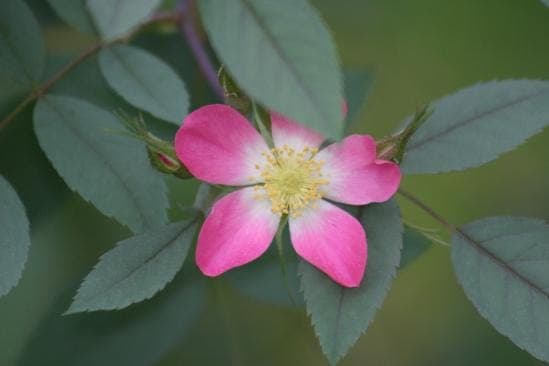
The standout feature of Rosa glauca is its foliage: a striking blue-green with a waxy, powdery coating that gives it a silvery sheen. New growth often has a deep purple or coppery tint, adding extra depth. In autumn, the leaves turn brilliant shades of orange, red, and burgundy - one of the best fall color displays among roses. The flowers appear from June to July: small, single, soft pink with five petals and a cluster of golden stamens. They're subtle but attractive to bees and hoverflies. After flowering, round red hips develop and persist into winter, providing food for birds like thrushes and finches.
Ideal location
Plant in full sun to light shade. The foliage color intensifies in direct sunlight, while too much shade leads to greener, less vibrant leaves. Choose a spot with good air circulation to reduce disease risk. This rose works well at the back of a mixed border, along a fence, or as part of a wildlife hedge. It needs space to grow naturally - avoid tight corners or heavily pruned areas. On gardenworld.app, you can visualise how Rosa glauca fits into a four-season garden plan, balancing texture and form with plants like miscanthus or sedum.
Soil requirements
Rosa glauca is adaptable but insists on well-drained soil. It tolerates poor, sandy, or stony soils but struggles in heavy clay or waterlogged conditions. The ideal pH is slightly acidic to neutral (5.5–7.0). No need for rich compost or fertiliser - too much nitrogen leads to weak, leggy growth and duller leaf color. A little grit added at planting time improves drainage in heavier soils.
Free design
Want to see Redleaf rose: complete guide in your garden? Make a free design now.
Watering
Once established, this rose is highly drought tolerant. Young plants need regular watering in their first summer - about 10 litres per plant, once or twice a week during dry spells. After that, natural rainfall is usually sufficient. Never let the roots sit in water; root rot is the main threat. Mulching with bark or gravel helps retain moisture and suppress weeds.
Pruning
Minimal pruning is best. Rosa glauca looks most natural when left to grow freely. Remove only dead, damaged, or crossing stems in late winter or early spring (February–March). If it gets too large, cut one or two of the oldest stems back to 30 cm to encourage fresh basal growth. Avoid heavy annual pruning - it reduces flowering and weakens the plant over time.
Maintenance calendar
- Jan: check for winter damage
- Feb: light pruning, remove dead wood
- Mar: plant new specimens, inspect for aphids
- Apr: no action needed
- May: water if dry, monitor for mildew
- Jun: flowering begins, watch for rose sawfly
- Jul: flowers fade, hips start forming
- Aug: leave hips intact, no pruning
- Sep: foliage starts changing color
- Oct: let fallen leaves decompose as natural mulch
- Nov: hips still feeding birds
- Dec: dormant period, no care required
Winter hardiness
Rosa glauca is fully hardy in USDA zones 4 to 8. It withstands temperatures down to -30°C and needs no winter protection. The plant is deciduous, losing its leaves in late autumn, but the bare stems and persistent hips add structure and interest to the winter garden. It's a reliable performer in UK, US, and Canadian gardens where cold winters are common.
Companion plants
Pair this rose with plants that share its low-maintenance nature and complement its texture. Try Panicum virgatum (switchgrass), Echinacea purpurea, or Salvia nemorosa for late-summer color. Low growers like Thymus or Alchemilla mollis work well at the base. Avoid overly vigorous plants that might crowd it out. For winter interest, combine with dogwoods or willows to create a multi-season focal point.
Closing
Rosa glauca is a quiet achiever - it doesn't shout, but it never fades into the background either. From its purple-tinged leaves in spring to the fiery autumn display and bird-friendly hips in winter, it earns its spot in any garden. It asks for little and gives back all year. Buy young plants in 40–60 cm pots from garden centres like those found in the UK or online retailers. Look for healthy, firm stems and no signs of powdery mildew. With the right spot and a little patience, this rose becomes a cornerstone of your garden's structure. Whether you're designing a cottage garden or a modern prairie scheme, Rosa glauca fits right in.
Want to see Redleaf rose: complete guide in your garden? Make a free design now.
Upload a photo, pick a style, and get a photorealistic design with plant list in under a minute.
No credit card required


Similar plants
Siberian crab apple: complete guide
Malus x robusta
Complete guide to the Siberian crab apple (Malus x robusta): location, soil, pruning, winter hardiness and the best companion plants for your garden.
Chinese flowering crabapple (Malus x spectabilis): complete guide
Malus x spectabilis
Meet the Chinese flowering crabapple (Malus x spectabilis): a classic spring bloomer with carmine buds and pink blossom.
Potentilla crassinervia: complete guide
Potentilla crassinervia
Potentilla crassinervia, the Corsican cinquefoil, grows wild on Corsica and Sardinia's peaks. Discover how to grow this hardy alpine rock garden gem.